
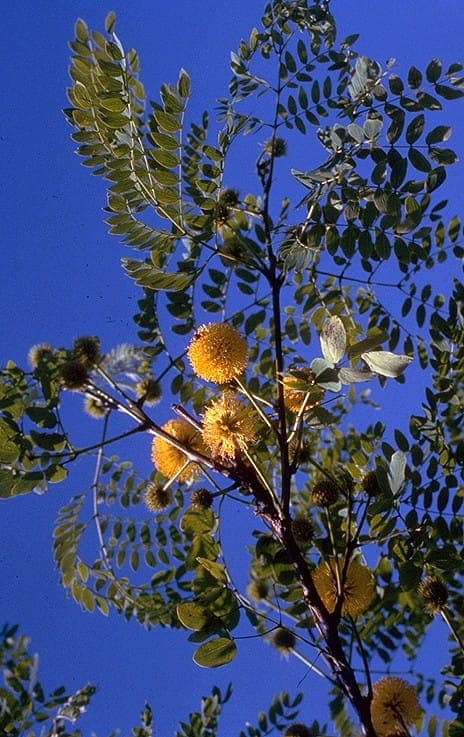
Clarence A. Rechenthin. Courtesy of USDA NRCS Texas State Office / Public domain, via Wikimedia Commons
Goldenball leadtree: complete guide
Leucaena retusa
Want to see Goldenball leadtree: complete guide in your garden?
1 minute, no credit card
Overview
The goldenball leadtree (Leucaena retusa) is a small to medium-sized multi-stemmed tree or large shrub belonging to the legume family (Fabaceae). It originates from the southern United States - particularly Texas and New Mexico - and northeastern Mexico, where it grows in dry canyons, limestone hillsides, and open scrubland. Outside its native range it remains something of a specialist's choice, but its combination of feathery foliage, spectacular golden pompom flowers, and genuine drought tolerance make it increasingly sought after in water-wise gardens.
The species name "retusa" refers to the slightly notched or indented leaf tips, a detail noted by the botanist Bentham when he formally described the species in 1852. Like all legumes, the goldenball leadtree fixes atmospheric nitrogen through root nodules, which means it can improve poor soils and rarely needs feeding once established. At gardenworld.app you will find garden design tools that help you integrate drought-tolerant trees like this one into a coherent, low-maintenance planting scheme.
Appearance and bloom cycle
The goldenball leadtree develops an airy, open crown with bipinnate leaves that are strongly reminiscent of mimosa or acacia foliage. Each compound leaf is made up of eight to twelve pairs of narrow, lance-shaped leaflets only a few millimetres wide, giving the tree a light, almost transparent appearance even in full foliage. The leaf colour ranges from soft mid-green to slightly grey-green, keeping the plant looking fresh even during the hottest summer months.
The flowers are the main event: round, powder-puff pompoms of bright golden yellow appear from April through September, peaking in May and June. Each flower head is roughly three to four centimetres across and consists of dozens of stamens that together form a fluffy golden ball - hence the common name. After flowering, flat, papery seed pods develop that reach ten to twenty centimetres in length. They turn brown as they ripen and can remain on the branches for several months, adding winter interest.
In its native habitat the tree can reach six metres or more, but in northern European gardens it typically stays between two and four metres, forming a bushy multi-stemmed specimen rather than a tall single-trunked tree.
Ideal location
Leuaena retusa demands full sun. In its native canyon and scrubland habitat it grows on open, rocky slopes with unobstructed sunlight throughout the day. In a northern European garden, a south-facing or south-west facing position against a wall, fence, or in a sheltered courtyard offers the best microclimate. The warmth accumulated by masonry and the protection from cold north and east winds will allow the tree to thrive in otherwise marginal conditions.
An exposed, well-ventilated spot where rainwater drains away quickly is ideal. Do not plant this tree in a low-lying area where water collects after rain. Container cultivation is perfectly possible provided the pot is generous in size and has ample drainage holes at the base.
Soil
The goldenball leadtree has clear soil preferences: it grows best in poor to moderately fertile, very well-drained, neutral to mildly alkaline soil with a pH between 6.2 and 8.5. Chalky or sandy-loam soils suit it perfectly. Heavy, waterlogged clay soils will cause root rot and rapid decline.
When planting in average garden soil, dig a generous hole and mix the backfill with coarse grit or gravel to improve drainage. There is no need to add compost or fertiliser to the planting mix - the tree is adapted to nutrient-poor conditions and, as a legume, manages its own nitrogen supply. Avoid adding high-nitrogen feeds, which promote lush but frost-vulnerable growth.
Watering
Once established, the goldenball leadtree is genuinely drought tolerant and one of the more self-sufficient trees you can grow. Young trees in their first and second seasons after planting benefit from regular watering, particularly during dry spells in summer. A deep, infrequent soak - for example once or twice a week - encourages roots to grow deep rather than staying near the surface.
From the third season onwards, established trees can usually survive extended dry periods without supplemental watering. Overwatering is far more damaging than underwatering: persistently wet roots lead to root rot, yellowing foliage, and plant death. Container-grown specimens should never be left standing in saucers of water. In wet winters, ensure pots are raised slightly to allow excess water to drain freely.
Free design
Want to see Goldenball leadtree: complete guide in your garden? Make a free design now.
Pruning
Pruning of Leucaena retusa is mostly about removing dead, damaged, or crossing wood. The best time for this light tidying is early spring, once the risk of hard frost has passed and the buds are beginning to swell. Use clean, sharp secateurs or loppers and cut just above a side shoot or dormant bud.
Hard or formative pruning should be used sparingly. The tree can tolerate being cut back reasonably well, but heavy pruning in late winter may reduce the flowering display that year, since flowers are borne on wood from the previous and current season. Any summer pruning should be restricted to removing vigorous water shoots that spoil the natural shape. If you want to prevent self-seeding, remove the seed pods before they split and shed their seeds.
Maintenance calendar
January to February: check the plant after frost for cold damage; protect young specimens with horticultural fleece if temperatures are forecast below -10 degrees Celsius. March: remove frost-damaged or dead wood; young plants can receive a small amount of slow-release, low-nitrogen fertiliser. April: first flowers appear; check for aphids on new growth. May to June: peak flowering; no special maintenance needed; enjoy the golden display. July to August: dry period; water young plants deeply once a week; established trees do not need supplemental watering. September: seed pods begin to ripen and turn brown; remove them if you wish to control self-seeding. October: prepare for winter; mulch the root zone of young trees with bark or straw. November to December: dormancy; no pruning; check monthly for frost damage after prolonged cold spells.
Winter hardiness
The goldenball leadtree is rated for USDA hardiness zones 7b to 9, meaning it can tolerate temperatures down to approximately -15 degrees Celsius, provided the roots are in dry, well-drained soil. Most of the United Kingdom and the warmer parts of northwestern Europe fall within USDA zones 8 to 9, which is in principle suitable, but the combination of wet winters and occasional severe frost poses more of a risk than cold alone.
Young plants and container specimens are best moved to a frost-free shed or unheated greenhouse between November and March. Established in-ground specimens in warm, sheltered positions can overwinter outdoors provided the root zone is well mulched. In the event of severe frost below -10 degrees Celsius, a temporary covering of horticultural fleece provides useful protection. Even if the top growth is killed back to the base by a hard winter, the plant will often regenerate from the roots in spring.
Companion plants
The airy structure and golden flowers of the goldenball leadtree work well alongside other drought-tolerant plants. Good companions from specialist nurseries and garden centres include:
- Russian sage (Perovskia atriplicifolia): blue-mauve flowers that contrast beautifully with the golden yellow.
- Lavender (Lavandula angustifolia): similar site requirements and classic silver-blue contrast.
- Agapanthus: blue-purple flower heads for a warm Mediterranean combination.
- Lamb's ear (Stachys byzantina): silvery leaf texture that sets off the fine foliage of Leucaena.
- Bloody cranesbill (Geranium sanguineum): low, weed-suppressing ground cover with purple-pink flowers.
Avoid tall, fast-growing neighbours that could shade the leadtree, as it will flower poorly without full sun.
Closing
The goldenball leadtree is a rewarding choice for gardeners who want a flowering tree that manages with minimal water and attention. Its golden pompom flowers attract bees and butterflies from April to September, its feathery foliage brings a relaxed, almost subtropical atmosphere, and its capacity to fix nitrogen makes it a quiet improver of the soil beneath it. Plan your planting thoughtfully at gardenworld.app: the right position - full sun, sharp drainage, sheltered from hard frost - will allow this remarkable tree to reward you with decades of golden summer colour.
Want to see Goldenball leadtree: complete guide in your garden? Make a free design now.
Upload a photo, pick a style, and get a photorealistic design with plant list in under a minute.
10,000+ gardens designed already
No credit card required


Similar plants
Drooping leucothoe: complete guide
Leucothoe fontanesiana
Everything about drooping leucothoe (Leucothoe fontanesiana): shade tolerance, soil, watering, pruning, hardiness and companion plants.
Appalachian blazing star: complete guide
Liatris squarrulosa
Everything about the Appalachian blazing star (Liatris squarrulosa): sun, soil, watering, care, winter hardiness and companion plants.