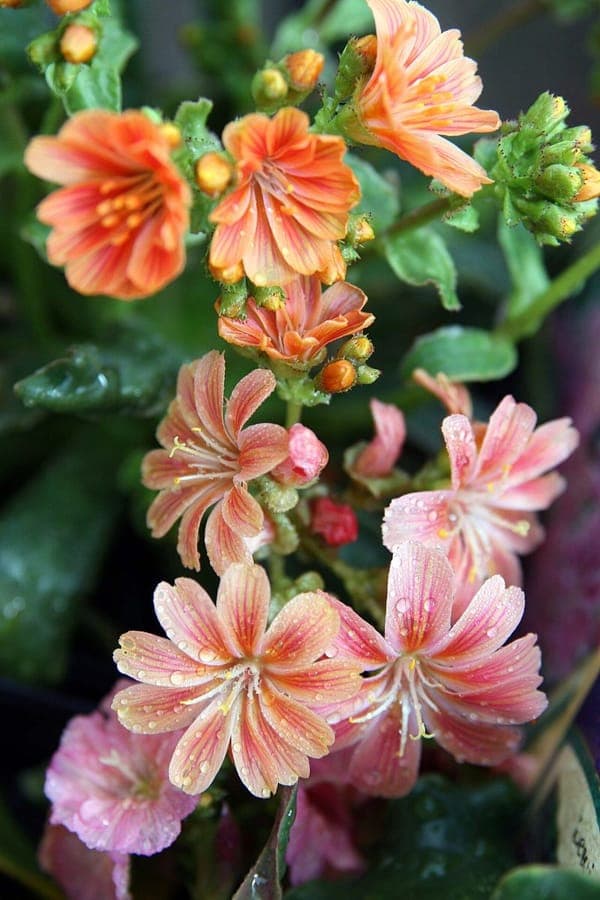
Photo by David J. Stang / CC BY-SA 4.0, via Wikimedia Commons
Lewisia: a complete guide for rockeries and walls
Lewisia cotyledon
Want to see Lewisia: a complete guide for rockeries and walls in your garden?
Full design in HD: €7.99
Look after your Lewisia with the GardenWorld app
Identify plants with your camera and get a care calendar with reminders for this plant.


Overview
Siskiyou lewisia (Lewisia cotyledon) is one of the most eye-catching plants you can grow in a rock garden. From a flat rosette of fleshy, evergreen leaves it sends up dozens of flowering stems in late spring, each topped with a cluster of starry blooms in pink, salmon, orange, apricot, yellow, magenta or white. Many flowers carry fine darker stripes along each petal, which makes them look almost hand-painted. Once you have seen a lewisia in full flower against grey stone, it is easy to understand why gardeners go out of their way to find it a home.
The species is native to the Siskiyou Mountains and neighbouring ranges of northern California and south-west Oregon, where it grows in rock crevices and on steep, gravelly slopes, often over acidic rock. That natural habitat explains almost everything about its care: the roots reach deep between stones for cool moisture, while the neck of the plant and the rosette dry quickly after rain. In the United States it is also known as cliff maids. Lewisia belongs to the Montiaceae, a family once grouped with the purslanes.
Most plants sold in garden centres are mixed seed strains such as 'Sunset Strain' and the Rainbow series, alongside colour-true selections in white, pink or yellow. In flower the plant reaches 15 to 30 cm, with a rosette 15 to 25 cm across. It is long-lived when it is happy, but it does not forgive overwatering. On gardenworld.app you can have a garden design made in which a dry stone wall or gravel bed with lewisia and other alpines gets a proper place.
Appearance and bloom cycle
The rosette is made of firm, spoon-shaped leaves 3 to 8 cm long, glossy green and sometimes wavy or finely toothed at the edge. They stay in place all winter. In May and June several stems of 10 to 30 cm rise from the heart of the rosette, branching into sprays of 10 to 40 flowers. Each bloom is 2 to 4 cm wide with seven to ten petals.
The main flush runs from May to early July. Many modern selections produce a second, smaller show in late summer if you remove the spent stems promptly. Bees and hoverflies visit the flowers. Afterwards small capsules form, holding shiny black seeds. Seedlings from mixed strains rarely match the parent's colour exactly, which makes saving seed a pleasant gamble.
As far as is known, Lewisia cotyledon is not toxic to people, dogs or cats, and it does not appear on the usual lists of poisonous garden plants. Even so, discourage children and pets from nibbling it: succulent rosettes can look like toys, and a damaged plant recovers slowly.
Ideal location
Give lewisia a bright position with morning or late-afternoon sun and some shelter from the fiercest midday heat. In the cooler climate of Britain and the Low Countries it will cope with full sun as long as its roots stay cool. Light shade beneath a tall, open tree also works, though flowering will be less generous.
How you plant matters more than where. Lewisia grows best set at an angle or vertically: in a crevice of a dry stone wall, wedged between two rocks in a rockery, or on a sloping bank. That way rain runs straight out of the rosette. Planted flat in an ordinary border, where water sits in the crown, the neck often rots within a single wet winter. A trough, wide pan or terracotta pot full of grit makes an excellent alternative, not least because it can be moved under cover in winter.
Soil requirements
The soil must be extremely free-draining, mineral and on the lean side. A mix of roughly one third lime-free compost or leaf mould, one third coarse sand and one third fine grit or lava granules works well. A pH between 5.5 and 7 suits it best. Lewisia cotyledon dislikes lime, so avoid limestone chippings and use granite, basalt, lava or quartz grit instead.
The golden rule is a collar of 2 to 3 cm of coarse grit around the neck of the plant. Set the rosette so that it sits just proud of the grit and never rests on wet soil. Do not spread compost or manure over the crown. A light dose of slow-release feed for alpines in March is plenty; too much nitrogen makes the leaves soft and prone to rot.
Free preview
Want to see Lewisia: a complete guide for rockeries and walls in your garden? Make a free preview of your design.
Watering
During the growing season lewisia needs more water than you might expect from a succulent. From March until after flowering, water whenever the top few centimetres feel dry. Pour it at the edge of the plant or between the stones, never into the heart of the rosette.
After flowering the plant takes a short summer rest; keep it drier then, especially if it is planted flat. From October onwards give plants in the ground nothing extra, and plants in pots only a small drink if the compost turns bone dry. Winter wet is the real enemy. A pane of glass or a small sloping roof propped over the rosette can make all the difference in a rainy winter.
Pruning
There is no real pruning to do. Cut faded flower stems back to the rosette unless you want to collect seed. This keeps the plant tidy and encourages many selections to flower again. In spring and autumn pick out dead or mouldy leaves carefully with tweezers, so that no decaying material is left in the crown.
Older plants sometimes produce offsets. In May or June you can slice these away with a sharp knife, let the cut surface dry for a few days and root them in a sandy mix. That gives you a spare should the parent plant fail after a wet winter.
Maintenance calendar
March-April: Remove dead leaves from the rosette. Top up the grit around the neck. Start watering moderately again and give a light dose of alpine feed if you wish.
May-June: Full bloom. Keep the soil lightly moist but never soggy. Watch for aphids in the flower buds and slugs around the rosette.
July-August: Cut off spent stems. Water less during the summer rest. Take offsets as cuttings or harvest ripe seed.
September: Plant new specimens so they can root before winter. Sow fresh seed in a cold frame; it germinates after a period of cold.
October-November: Stop watering plants in open ground. Move pots and troughs under cover or against a south-facing wall.
December-February: Rest. After long spells of rain, check the crown for rot and remove soft brown leaves straight away. Prop a sloping pane over rosettes that are planted flat. You can keep track of these jobs with the plant calendar on gardenworld.app.
Winter hardiness
Lewisia cotyledon tolerates dry cold well, down to about -15 °C and occasionally a little lower on a sharply drained site. In our climate the problem is rarely the cold itself but the combination of cold, wet and low light. A plant in a wall crevice or on a slope usually overwinters outside without trouble, whereas a lewisia set flat in heavy soil often fails to see the spring.
Pots and troughs are best wintered outdoors but dry: under the eaves, beneath a porch or in an unheated, bright greenhouse. Do not bring them into a warm room, as that breaks their dormancy. Hard frost without snow cover is no problem for the evergreen rosette as long as the roots are not standing in water.
Companion plants
Lewisia belongs among other alpines that ask for the same sharp drainage. Common houseleek (Sempervivum tectorum) and encrusted saxifrage (Saxifraga paniculata) form tight rosettes that contrast nicely with lewisia's glossy leaves. Cheddar pink (Dianthus gratianopolitanus) and moss phlox (Phlox subulata) add cushions of grey or green foliage and flower around the same time.
Blue fescue (Festuca glauca) brings a fine blue-grey texture between the rocks. In a trough, small sedums, dwarf bellflowers and creeping thyme fit well too. Keep lewisia away from vigorous spreaders that would smother the rosette, and avoid plants that need lime or plenty of water. In a wall, plant it on the cooler east or north-east face, with the flowers turned towards the light.
Final thoughts
Siskiyou lewisia (Lewisia cotyledon) is not a plant for an ordinary border, but give it a vertical or sloping spot between stones and it rewards you year after year with a profusion of flowers in colours rarely seen in a rock garden. The rules are simple: lime-free, gritty soil, a dry neck, water in spring and a dry winter.
Start with one or two plants in a wall crevice or trough, and pot up a few offsets each year as insurance. Step by step you will build a colourful collection that returns every spring with very little work.
Frequently asked questions about Lewisia
Is Lewisia winter hardy?
Lewisia cotyledon tolerates dry cold well, down to about -15 °C and occasionally a little lower on a sharply drained site. In our climate the problem is rarely the cold itself but the combination of cold, wet and low light.
When and how do you prune Lewisia?
There is no real pruning to do. Cut faded flower stems back to the rosette unless you want to collect seed.
How much water does Lewisia need?
During the growing season lewisia needs more water than you might expect from a succulent. From March until after flowering, water whenever the top few centimetres feel dry.
Where does Lewisia grow best?
Give lewisia a bright position with morning or late-afternoon sun and some shelter from the fiercest midday heat. In the cooler climate of Britain and the Low Countries it will cope with full sun as long as its roots stay cool.
What soil does Lewisia need?
The soil must be extremely free-draining, mineral and on the lean side. A mix of roughly one third lime-free compost or leaf mould, one third coarse sand and one third fine grit or lava granules works well.

See it in your garden
See Lewisia in your garden
One photo of your garden and a few questions. You see the result in about a minute.
Try it with a photoIdentify this plant in your own garden. Identify a plant
Similar plants
Houseleek: complete guide
Sempervivum tectorum
Houseleek is the classic succulent for roofs and rock gardens - hardy, drought-tolerant, and maintenance-free. Learn cultivation, propagation, and care.
Lifelong saxifrage: complete guide
Saxifraga paniculata
Complete care guide for lifelong saxifrage (Saxifraga paniculata): white flowers, silvery rosettes, alpine rockeries, and hardiness to USDA zone 2. Long-lived.
Cheddar pink: complete guide
Dianthus gratianopolitanus
Grow Dianthus gratianopolitanus successfully: care, soil, watering, pruning and ideal garden placement. Perfect for rock gardens and borders.
