Bjankuloski06 / CC BY 4.0, via Wikimedia Commons
Manuka (Leptospermum scoparium): growing and overwintering
Leptospermum scoparium
Want to see Manuka (Leptospermum scoparium): growing and overwintering in your garden?
Full design in HD: €7.99
Look after your Manuka with the GardenWorld app
Identify plants with your camera and get a care calendar with reminders for this plant.


Overview
Manuka (Leptospermum scoparium), also called New Zealand tea tree, is an evergreen shrub in the myrtle family (Myrtaceae). It grows wild across New Zealand and in south-eastern Australia, from coastal scrub to windswept hills. Most people know the name from manuka honey, the dark, strongly flavoured honey that bees make from its flowers. In British and European garden centres it usually appears in spring as a neat potted shrub smothered in white, pink or deep red blossom.
In its homeland manuka can become a large shrub or even a small tree several metres tall. In cultivation here it is far more modest. In a container it usually stays between 60 cm and 1.5 m, while in the ground in a mild, sheltered garden it may reach 2 to 3 m. Growth is slow to moderate, and over the years it forms a dense, finely branched shrub with an airy, graceful outline.
The real question for gardeners in north-west Europe is not whether manuka is pretty, but whether it will survive the winter. Leptospermum scoparium is only borderline hardy, so in most inland gardens it is best treated as a patio plant that lives outdoors from April to October and spends the cold months under frost-free cover. In coastal areas and sheltered town gardens, planting it out is a realistic option. If you want to see how a shrub like this would sit alongside the rest of your planting, you can have a garden design created on gardenworld.app that takes your terrace, your aspect and your winter storage into account.
Appearance and bloom cycle
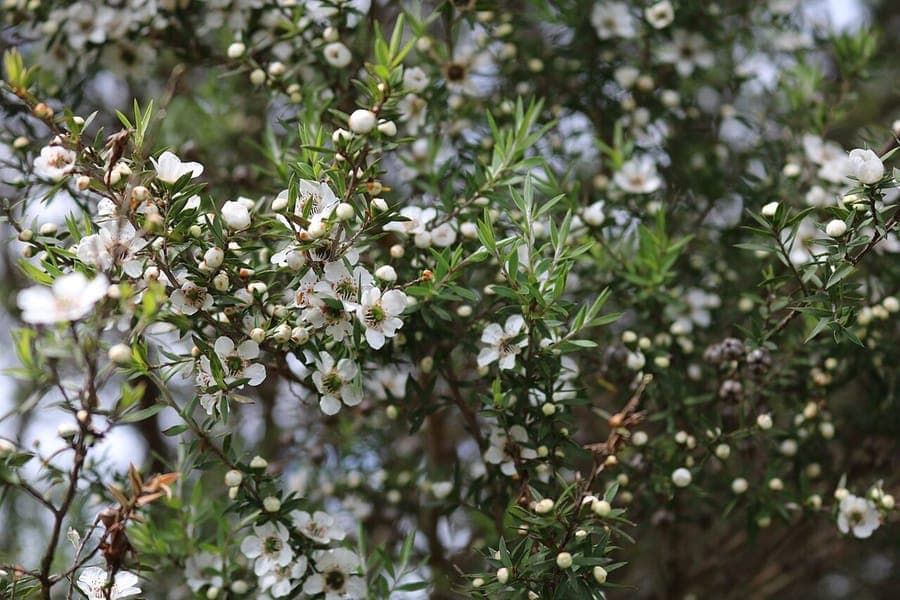
The leaves are small, narrow and stiff, roughly 7 to 20 mm long, each ending in a sharp point. Crush one and you will notice a light, resinous scent that recalls myrtle and eucalyptus. Some cultivars have bronze or reddish new growth. The slender twigs carry reddish-brown bark that peels in thin strips on older wood.
The flowers are the main attraction. They look like tiny wild roses: five rounded petals around a green centre that darkens to red as the flower ages. The wild form has white or pale pink flowers about 1 to 1.5 cm across. Garden selections often have double flowers in shades from pink to crimson, such as 'Red Damask'. Dwarf forms from the Nanum Group, including 'Kiwi', stay low and compact and suit pots and window boxes.
Plants sold in spring are usually already in bloom because nurseries bring them on under glass. Outdoors, manuka flowers mainly from April to June, with an occasional second flush in summer. Afterwards, small woody seed capsules stay on the stems for years. Bees and bumblebees visit the open single flowers; double forms offer them much less.
Manuka is not known to be toxic to people, cats or dogs, and the leaves were once brewed as a tea in New Zealand. As with any ornamental, it is still sensible to discourage children and pets from chewing it.
Ideal location: container or open ground
Give manuka plenty of light: full sun or very light shade, ideally at least six hours of direct sun a day. In shade it becomes thin and flowers poorly. A south or west-facing terrace is perfect, provided the pot is not stuck in a baking corner against a dark wall where the root ball dries out in July.
The shrub copes well with wind, which is no surprise for a plant that grows on exposed hills and coasts. Salt-laden air is not a problem either, so manuka is a good choice for seaside gardens in Cornwall, south-west Ireland, Brittany or the Belgian and Dutch coast.
Away from the coast, a container is the safer bet. Choose a pot one size larger than the root ball with generous drainage holes, and repot every two or three years in spring. A lightweight pot on a plant caddy makes the autumn move much easier. Manuka does not last long as a houseplant in a heated living room; the air is too warm and too dry and it soon drops its leaves.
Soil requirements and compost
This is where many plants fail. Leptospermum scoparium wants acidic to neutral, humus-rich soil that stays moist but drains freely. It dislikes lime: on chalky soil the leaves turn yellow between the veins and growth stalls.
In containers, use ericaceous compost of the kind sold for rhododendrons and heathers, mixed with about one fifth fine bark or grit to keep it open. Put a layer of gravel or clay pebbles at the bottom so excess water can escape. If you plant it in the ground, improve heavy clay with ericaceous compost and grit, and avoid limy spots such as the strip next to a concrete foundation.
Free preview
Want to see Manuka (Leptospermum scoparium): growing and overwintering in your garden? Make a free preview of your design.
Watering and feeding
Manuka is more sensitive to drought than its fine leaves suggest. A root ball that dries out completely even once can be fatal: the leaves shrivel and the stems fail to reshoot. Keep the compost evenly moist from spring to autumn, which on hot summer days may mean watering every day.
Waterlogging is equally harmful. Never leave water standing in the saucer, and check after a wet spell that the pot drains properly. Use rainwater where you can, because tap water in many areas is hard and will gradually raise the pH of the compost.
Feed from April to the end of July every three weeks with a liquid fertiliser for ericaceous plants at half the recommended strength. Stop in August so that the new shoots can ripen before winter.
Pruning
Prune manuka straight after flowering, and only lightly. Trim the faded shoot tips back to just above a few healthy leaves. This keeps the shrub dense and encourages next year's buds.
Never cut hard into old, bare wood. Unlike many shrubs, Leptospermum scoparium rarely reshoots from leafless stems. If a plant has grown too large, reduce it gradually over two or three years rather than all at once. Remove dead or frost-damaged twigs in April, when you can clearly see where the live wood starts.
Maintenance calendar
March-April: Repot in ericaceous compost if needed. Move the plant outside once hard night frosts are over, starting with a few days in shade to harden it off.
April-June: Flowering time. Keep the root ball moist and start light feeding.
June-July: Trim lightly after flowering. Water generously in warm weather, preferably in the morning.
August-September: Stop feeding. Check for scale insects and red spider mite.
October-November: Bring the plant under cover before temperatures fall below -3 °C. A plant calendar on gardenworld.app can remind you when it is time to move your container plants indoors.
December-February: Keep it cool and bright. Water sparingly, but never let the compost dry out.
Winter hardiness
Leptospermum scoparium tolerates brief frosts down to about -5 °C, and established plants in the ground may cope with a little more. Harder or prolonged frost damages the shoots and can kill the whole plant, and in a pot the root ball freezes far sooner than in open soil. The RHS treats the species as only partly hardy.
In practice manuka cannot be relied upon to survive outdoors in most inland gardens of north-west Europe. Along the coast, in city centres and against a sheltered south-facing wall it often comes through mild winters, but a long cold spell can still cost you the plant.
Overwintering
The ideal winter quarters are bright and cool, between 2 and 10 °C: an unheated conservatory, a cold porch, a garage with a good window or a stairwell. Cool conditions also help flowering, because a spell of low temperatures triggers the buds for spring.
Water sparingly in winter, just enough to keep the compost slightly moist, and check weekly. Keep the plant well away from radiators. In a mild autumn it can stay outside until the first night frost, and if a planted-out shrub faces a short cold snap below -3 °C, protect it with a double layer of horticultural fleece and a thick mulch over the roots.
Companion plants
Manuka looks at home with other southern hemisphere plants and with acid-loving shrubs. New Zealand flax (Phormium tenax) or a cabbage palm (Cordyline australis) gives a bold contrast to its fine foliage. Pittosporum tenuifolium, another New Zealander, shares its liking for a mild, sheltered spot.
On a terrace, manuka combines well with Pieris japonica and heather (Calluna vulgaris) in pots of ericaceous compost, so the whole group shares one compost, one watering routine and one feed. Low grasses and white-flowered ground cover complete the picture.
Final thoughts
Manuka is a graceful shrub with a good story and generous flowers, but it does need a little planning. Give it acidic compost, rainwater, plenty of light and a cool, frost-free place for winter, and prune only lightly after flowering. Follow those rules and Leptospermum scoparium will reward you for years on the patio, and in a coastal garden perhaps even in the border.
Frequently asked questions about Manuka
Is Manuka winter hardy?
Leptospermum scoparium tolerates brief frosts down to about -5 °C, and established plants in the ground may cope with a little more. Harder or prolonged frost damages the shoots and can kill the whole plant, and in a pot the root ball freezes far sooner than in open soil.
When and how do you prune Manuka?
Prune manuka straight after flowering, and only lightly. Trim the faded shoot tips back to just above a few healthy leaves.
How much water does Manuka need?
Manuka is more sensitive to drought than its fine leaves suggest. A root ball that dries out completely even once can be fatal: the leaves shrivel and the stems fail to reshoot.
Where does Manuka grow best?
Give manuka plenty of light: full sun or very light shade, ideally at least six hours of direct sun a day. In shade it becomes thin and flowers poorly.
What soil does Manuka need?
This is where many plants fail. Leptospermum scoparium wants acidic to neutral, humus-rich soil that stays moist but drains freely.

See it in your garden
See Manuka in your garden
One photo of your garden and a few questions. You see the result in about a minute.
Try it with a photoIdentify this plant in your own garden. Identify a plant
Similar plants
Pittosporum tenuifolium: complete guide to Tawhiwhi
Pittosporum tenuifolium
Tawhiwhi is an elegant New Zealand tree with thin leaves and fine texture. Learn growth, shaping and maintenance requirements.
New Zealand flax: complete guide
Phormium tenax
Discover Phormium tenax, the stunning architectural plant from New Zealand. Learn about its dramatic foliage, growing requirements, and design applications.
Japanese pieris: complete guide
Pieris japonica
Complete care guide for Japanese pieris (Pieris japonica): ideal location, soil, watering, pruning and companion plants. Perfect for shaded, acidic gardens.
