
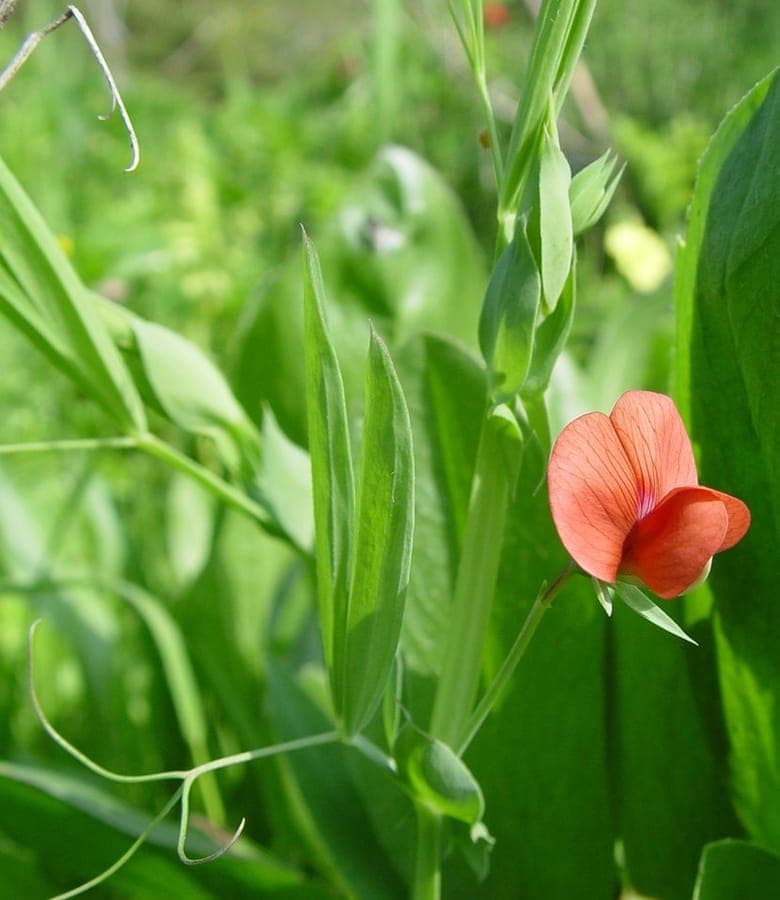
Wikimedia Commons / CC BY-SA 3.0, via Wikimedia Commons
Chickling Vetch: complete guide
Lathyrus cicera
Want to see Chickling Vetch: complete guide in your garden?
1 minute, no credit card
Overview
Chickling Vetch, scientifically known as Lathyrus cicera, is an interesting climbing plant from the Mediterranean region. This annual plant belongs to the Fabaceae family and is characterized by its red to purple flowers and elegant growth form. The plant spreads from Southeast Europe to the Mediterranean and Pakistan, showing the resilience of Mediterranean flora.
Although relatively unknown in Northern European gardens, this is a plant that adapts perfectly to warmer periods and thrives in dry conditions. On gardenworld.app, you can see how to integrate this wild beauty into your garden.
Appearance & Blooming
The Lathyrus cicera grows as a delicate climber with slender stems to about 30-50 cm. The plant bears characteristic red to purple flowers, often with a darker spot, appearing in May to June. Like other Lathyrus species, this plant has slender, curled tendrils that wrap around supporting structures. The pods are compact and contain a few small seeds.
Ideal Location
This plant loves sunny locations with well-drained, light soil. It is very tolerant of dry conditions and does not demand much nutrients. A south-facing, warm spot is ideal. The plant loves to climb along mesh, netting, twine or other ornamental supports. Protection from strong winds is desirable, although the plant is quite tough.
Soil
Low fertility is no problem for this plant. Sandy, well-draining soil is preferred. pH 6.0-7.5 is suitable. The plant tolerates even poor soils very well, which points to adaptation to Mediterranean rocky terrain. Preference for calcareous soil is noticeable.
Free design
Want to see Chickling Vetch: complete guide in your garden? Make a free design now.
Watering
This is a very drought-tolerant plant that, once established, manages with minimal water supply. Regular watering during the flowering period (May-June) gives better blooming. Ensure good drainage; waterlogging is harmful to this plant. After blooming, you can water even less.
Maintenance
Minimal maintenance is needed. Removing faded flowers extends the blooming period. The plant does not need pruning. If it grows too vigorously, you can remove a few stems. No fertilizer needed; too much nutrition can result in more foliage but fewer flowers.
Maintenance Calendar
April: Sow or plant May-June: Blooming period; minimal watering July: Seed formation August-September: Plant ends growing season
Winter Hardiness
The Lathyrus cicera is only annual and not winter-hardy in temperate climates. In warm regions (USDA zone 9+), the plant may possibly overwinter. For most of Europe, this is a seasonal plant.
Companion Plants
Excellent for Mediterranean planting schemes next to other heat-lovers such as rock rose (Cistus), rosemary (Rosmarinus), lavender (Lavandula), and wild marjoram (Origanum). The red-purple flowers contrast beautifully with yellow flowers of, for example, yellow vetchling.
Closing
Chickling Vetch brings wild, Mediterranean elegance to your garden. With minimalist care, good drainage and sunny conditions, this plant flourishes without much effort. Discover on gardenworld.app how to incorporate this beautiful climbing plant into your garden design.
Want to see Chickling Vetch: complete guide in your garden? Make a free design now.
Upload a photo, pick a style, and get a photorealistic design with plant list in under a minute.
No credit card required


Similar plants
Tall Silky Lupine: complete guide
Lupinus elatus
Tall silky lupine is a fast-growing Californian perennial with silvery foliage and blue-purple flower spikes, ideal for a prairie-style garden.
Garfield Lupine: complete guide
Lupinus garfieldensis
The Garfield lupine is a rare, fast-growing American perennial for alkaline, dry grassland gardens, with striking blue flower spikes.
Lupinus elegans: complete guide
Lupinus elegans
Lupinus elegans, the elegant lupine, is a spectacular blooming plant from Mexico with blue flower spikes. Care, cultivation and garden use.