
Zeynel Cebeci / CC BY-SA 4.0, via Wikimedia Commons
Gargano dead-nettle: complete guide
Lamium garganicum
Want to see Gargano dead-nettle: complete guide in your garden?
1 minute, no credit card
Overview
The Gargano dead-nettle (Lamium garganicum) is one of the more elegant members of the Lamium genus, native to a broad arc stretching from southern Spain and the western Mediterranean all the way through Turkey to Iran. It was formally described by Linnaeus in 1763, named for the Gargano peninsula in southern Italy where it grows abundantly on rocky limestone slopes, in olive groves, and along shaded woodland edges. Despite this attractive pedigree, it remains less commonly grown in gardens than its relative Lamium maculatum, yet for gardeners willing to seek it out, it offers refined beauty and reliable performance.
In garden terms, Gargano dead-nettle functions as a low, spreading groundcover perennial, typically reaching 20-40 cm in height. Its flowers are larger and often more vividly coloured than those of common spotted dead-nettle, ranging from pale cream-pink to deep rose-purple, and they appear in generous clusters from May through August. On gardenworld.app, Lamium garganicum appears frequently in design schemes for shaded front gardens and naturalistic border plantings where a low, weed-suppressing layer is needed.
Appearance and bloom cycle
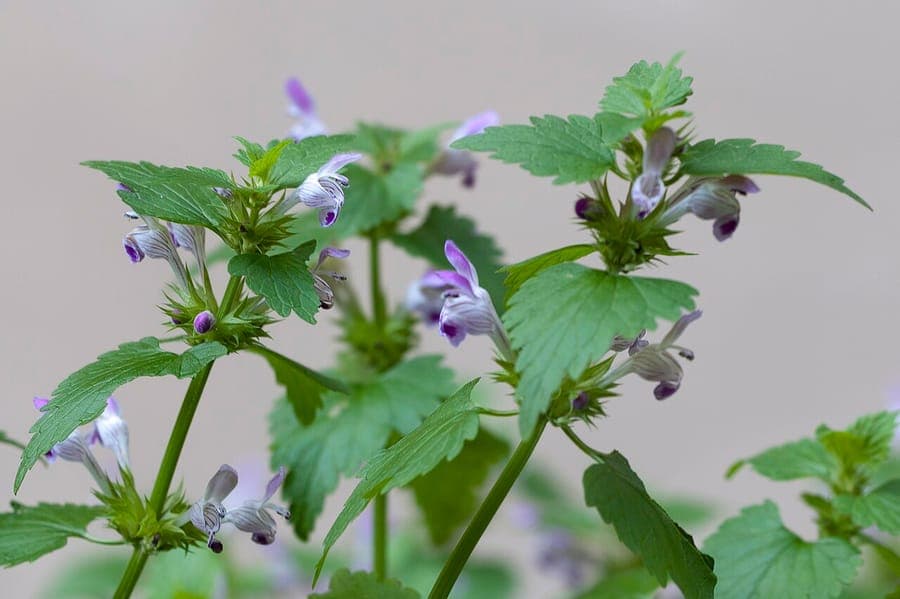
Lamium garganicum forms a clump-forming, semi-trailing perennial with square stems - the hallmark of the mint family. Stems are lightly hairy and reach 20-40 cm in height, branching freely at the base to form a dense mat. The leaves are heart-shaped to broadly ovate, with attractively scalloped margins and a soft, slightly rough texture. Leaf colour is deep green, often showing faint silvery patterning along the central veins, though this feature is more subdued than in Lamium maculatum.
Flowers appear from May to August, with the main flush occurring in June and July. Individual blooms are large and two-lipped in the classic Lamium fashion: a broad lower lip with three lobes and a hooded upper lip. Colour ranges from pale pink to deep rose-purple depending on the individual plant and its growing conditions. The flowers are clustered in whorls around the leaf axils, making each stem look like a candelabra of pink. They are highly attractive to bumblebees and long-tongued bees, who are the primary pollinators.
After flowering, the plant sets small four-parted nutlets typical of the family. These ripen by late summer and can self-sow modestly in favourable conditions, though Lamium garganicum is not considered invasive. The plant spreads slowly by creeping rhizomes, gradually filling available space without smothering neighbours.
Ideal location
This species is most at home in part shade or dappled shade - conditions that mimic its natural habitat beneath olive and oak trees on Mediterranean hillsides. In the garden, the perfect spot is one that receives morning sun (two to four hours) followed by afternoon shade, or a position in the filtered light beneath a deciduous tree canopy.
Full sun is tolerated in cooler climates and if adequate moisture is maintained, but in hot summers, exposed plants may develop scorched leaf margins. Deep, dry shade causes poor flowering and etiolated, pale growth. The ideal compromise is a position facing east or northeast, sheltered from the hottest afternoon sun.
Lamium garganicum works well along the north-facing side of a fence, under the dappled canopy of birch or rowan, or as an underplanting beneath shrub roses or hydrangeas. It tolerates the surface root competition that deters many other perennials.
Soil
In nature, Gargano dead-nettle grows on thin, well-drained, often calcareous (lime-rich) soils. In the garden, it is adaptable: it performs well in average, moderately fertile, well-drained soil with a pH of approximately 6.5-7.5. It does not require rich feeding and may actually produce more foliage than flowers if given too much nitrogen.
Heavy clay soils that stay waterlogged through winter should be amended before planting by working in horticultural grit and organic matter to improve drainage. On sandy soils, incorporating garden compost helps retain enough moisture during summer dry spells. The main requirement is that the soil does not become compacted or remain saturated for extended periods.
A layer of leaf mould as mulch around established plants benefits both moisture retention and the slow release of organic nutrients, closely replicating the conditions of a woodland floor.
Free design
Want to see Gargano dead-nettle: complete guide in your garden? Make a free design now.
Watering
Once established, Lamium garganicum is moderately drought-tolerant, reflecting its Mediterranean origins. In a typical mild, wet climate like that of the Netherlands or Belgium, supplemental watering is rarely needed for established plants.
During the first growing season after planting, regular watering is important to help the plant develop a strong root system. Water deeply at the base of the plant rather than overhead; wet foliage can encourage fungal issues. A deep watering once or twice a week during dry spells in the establishment year is sufficient.
For mature plants, only prolonged drought - more than two weeks of high temperatures and no rainfall - warrants intervention. Water deeply when you do water, rather than giving frequent shallow drinks; this encourages roots to grow deeper and makes the plant more resilient. During winter dormancy, no supplemental watering is needed and standing water should be avoided.
Pruning
Pruning requirements for Lamium garganicum are minimal. After the main flowering period concludes in August or September, cutting the plant back to within 5-10 cm of the ground refreshes the foliage and often stimulates a modest second flush of flowers in early autumn if temperatures remain mild.
In early spring, once the risk of hard frost has passed, remove any winter-damaged stems back to healthy tissue. New growth emerges vigorously from the base. This annual spring tidy is the main maintenance requirement - beyond that, the plant looks after itself.
Division every three to four years helps maintain vigour. Lift and divide clumps in spring or early autumn, replanting sections at the original spacing or sharing them with other gardeners. This is also the primary method of propagation and costs nothing.
Maintenance calendar
March - April: Remove winter-damaged stems and cut back to fresh growth. Apply a light top-dressing of garden compost as mulch around the base.
May - June: Main flowering period begins. Enjoy the display. No intervention needed unless the weather is exceptionally dry.
July - August: Peak bloom. Water established plants during prolonged dry spells. Deadhead if a tidier appearance is desired, though it is not strictly necessary.
September: Cut the plant back to 5-10 cm to promote fresh autumn foliage. Optional: apply a mulch of leaf mould.
October - November: Plant or transplant new specimens. The soil is still warm enough for good root establishment before winter.
December - February: Plant is dormant. No maintenance needed apart from protecting young first-year plants with a light covering of pine branches if hard frost is forecast.
Winter hardiness
Lamium garganicum is well-suited to temperate climates. It is rated as hardy in USDA zones 5 to 9, tolerating minimum temperatures of approximately -28 degrees Celsius in zone 5 through to mild winters in zone 9. For gardens in the Netherlands, Belgium, and northern France - zones 7-8 - the plant is reliably winter-hardy and will survive average winters without protection.
In unusually severe winters with temperatures dropping below -15 degrees Celsius, the above-ground foliage may be killed, but the rhizomes typically survive underground and send up fresh growth in spring. A light mulch of shredded leaves or straw (5-7 cm depth) over the crown provides insurance in cold winters, especially for recently planted specimens in their first season.
In sheltered urban gardens, where temperatures tend to be higher than in open rural areas, Lamium garganicum can be treated as semi-evergreen, retaining some leaves through mild winters.
Companion plants
Gargano dead-nettle pairs beautifully with other shade-tolerant perennials. Hostas make natural companions, their large, bold leaves providing strong contrast with the smaller, more delicate Lamium foliage. Astilbes offer feathery vertical interest above the low groundcover carpet. Hellebores share the same preference for dappled shade and extend the garden's interest through winter and early spring.
For texture contrast, combine Lamium garganicum with ferns such as Polystichum setiferum or Athyrium filix-femina. The soft, arching fronds and the compact Lamium mat complement each other well. Geranium macrorrhizum works at a similar height and also tolerates dry shade.
For a pollinator-friendly border, pair it with Ajuga reptans (bugle) and early-flowering bulbs such as Muscari or Scilla - both bloom before the Lamium gets going, providing season-long interest for bees and other insects.
Closing thoughts
The Gargano dead-nettle is a reliable, graceful perennial that earns its place in any garden with part shade to offer. It asks for little, gives back generously in bloom, and quietly performs as a weed-suppressing groundcover through the summer months. Its Mediterranean origins give it an innate tolerance for dry conditions that many gardeners will find valuable as summers become warmer and drier.
For inspiration on using Lamium garganicum and other shade-tolerant groundcovers in your own garden design, visit gardenworld.app, where you can explore thousands of design schemes tailored to your specific conditions. The plant can be found at specialist herbaceous perennial nurseries throughout the growing season; ask at local garden centres for availability.
Want to see Gargano dead-nettle: complete guide in your garden? Make a free design now.
Upload a photo, pick a style, and get a photorealistic design with plant list in under a minute.
10,000+ gardens designed already
No credit card required


Similar plants
Spotted dead-nettle (Lamium maculatum): complete guide
Lamium maculatum
Discover Spotted dead-nettle: cultivation, management and varieties. A pink-flowering groundcover for partial shade on gardenworld.app.
Ajuga: complete guide
Ajuga reptans
A comprehensive guide to Ajuga reptans: growing conditions, care tips, soil needs, and ideal planting locations for this hardy ground cover.
Woodland sage: complete guide
Salvia nemorosa
Everything about Woodland Sage (Salvia nemorosa): planting, care, pruning and combinations. Expert tips for months of blue-violet flower spikes.