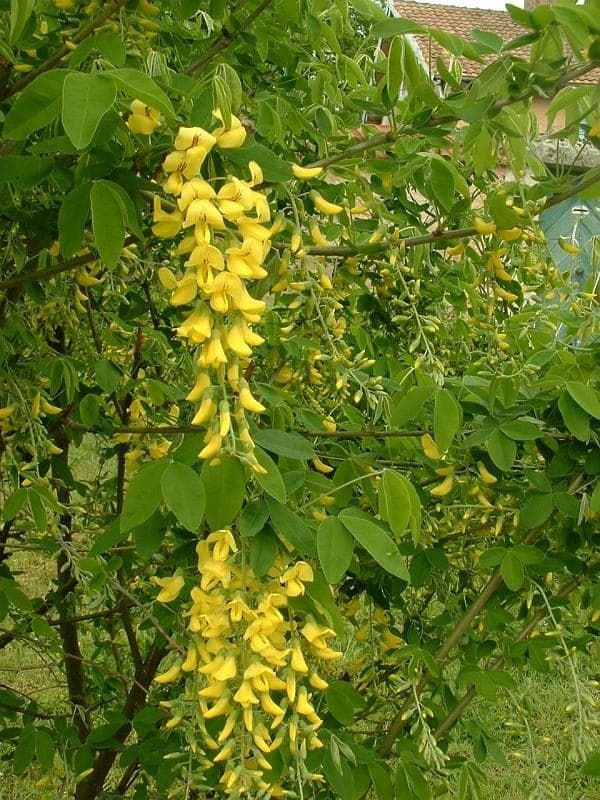
J.F. Gaffard, licence GFDL / CC BY-SA 3.0, via Wikimedia Commons
Common laburnum (Laburnum anagyroides): complete guide
Laburnum anagyroides
Want to see Common laburnum (Laburnum anagyroides): complete guide in your garden?
Full design in HD: €7.99
Look after your Common laburnum with the GardenWorld app
Identify plants with your camera and get a care calendar with reminders for this plant.


Overview
Common laburnum, Laburnum anagyroides, is one of the classic trees of European gardens. In late May the small tree is draped in long chains of bright yellow pea flowers, an image of dripping gold that explains its other English name, golden chain. The species grows wild in the mountains of central and southern Europe, from France and the Jura through the Alps to Italy and the Balkans, where it occurs in open deciduous woodland and along woodland edges, often on limestone slopes.
Laburnum anagyroides is also a parent of the best-known garden laburnum, Laburnum × watereri, a cross with Scotch laburnum (Laburnum alpinum). That hybrid, and especially its cultivar 'Vossii', is now more common in garden centres than the species itself. Even so, common laburnum remains a tough, easy tree for smaller gardens: it reaches 5 to 7 m in height and 3 to 5 m in spread, grows in almost any well-drained soil and shrugs off hard frost.
There is one major drawback that you need to understand before planting: laburnum is among the most poisonous plants commonly grown in gardens. A separate section below covers this in detail. If you want to know whether a laburnum suits your garden, and where it would pose the least risk, gardenworld.app can prepare a garden design that takes your household into account.
Appearance and bloom cycle
Common laburnum grows as a small tree with one or several trunks and a loose, somewhat irregular crown. The bark is smooth and olive green to grey-brown. The leaves are trifoliate, like clover: three elliptic leaflets 3 to 8 cm long on a long stalk. Their undersides are grey-green and covered in fine, flattened hairs, as are the young shoots. This is a handy way to tell it from Scotch laburnum, which is almost hairless.
Flowering takes place in late May and early June. Pendulous racemes 10 to 25 cm long hang from the branches, densely packed with bright yellow pea flowers around 2 cm across. They are lightly scented and busy with bees and bumblebees. After flowering, flat, hairy pods 4 to 6 cm long develop, each holding a few blackish-brown seeds. These pods often hang on the tree well into winter.
The heartwood is strikingly dark brown and hard. It was once used for inlay and small turned objects as a cheap substitute for ebony.
Toxicity to children and pets
Every part of Laburnum anagyroides is poisonous: roots, bark, leaves, flowers, pods and above all the seeds. They contain the alkaloid cytisine, which acts on the nervous system. To a child, the seeds in the pods look like peas or beans, and that is exactly why laburnum is one of the plants most often involved in childhood poisonings across Europe. Just a few seeds can cause clear symptoms in a child.
Typical symptoms appear within an hour: a burning feeling in the mouth and throat, nausea, severe and repeated vomiting, abdominal pain, sweating, pallor, dilated pupils, a rapid heartbeat and drowsiness. Large amounts can cause convulsions and breathing difficulties. Serious outcomes are rare because the body usually vomits the poison out quickly, but any ingestion calls for immediate medical advice.
Laburnum is dangerous to animals too. Dogs are at risk when they chew branches or pods or play with a laburnum stick. Horses and donkeys are highly sensitive, and cats, rabbits, guinea pigs and birds should not have access to the leaves, bark or seeds either.
What you can do:
- Do not plant laburnum near a play area, sandpit, school or nursery, nor overhanging a paddock with horses.
- Choose Laburnum × watereri 'Vossii' where possible, as it sets far fewer seeds. It is still poisonous, though.
- On a young tree, cut off the spent flower clusters before the pods ripen.
- Teach children never to touch or eat the "beans" from this tree.
- Keep prunings away from animals and never use the wood as a throwing stick or for barbecue fuel.
- If you suspect ingestion, contact NHS 111 or your doctor straight away, or call 999 for severe symptoms. For an animal, call your vet immediately.
Free preview
Want to see Common laburnum (Laburnum anagyroides): complete guide in your garden? Make a free preview of your design.
Ideal location
Laburnum flowers most freely in full sun but also tolerates light dappled shade. It makes an excellent specimen tree in a lawn or small front garden, or a backdrop in a border. Its fairly narrow, open crown casts little shade, so you can still plant beneath it.
A well-known use is the laburnum arch or tunnel, where young trees are trained over a framework or pergola. For this, Laburnum × watereri 'Vossii', with even longer racemes, is the usual choice. Give laburnum a spot sheltered from strong winds where possible: the wood is somewhat brittle and branches can snap in storms. Stake young trees firmly for the first few years.
Laburnum anagyroides self-seeds from time to time and has naturalised in parts of Europe outside its native range, including Britain. Pull up seedlings promptly, which also reduces the risk to children and animals.
Soil requirements
It is not fussy. Ordinary garden soil, sand, loam or chalky ground all suit it, provided water can drain away. On wet, heavy soil that stays waterlogged for long periods it develops root problems. Improve heavy clay with coarse grit and organic matter, or plant slightly raised.
Laburnum tolerates lime well and also grows happily on slightly acidic soil. As a member of the pea family it fixes nitrogen in root nodules, so extra feeding is unnecessary. A mulch of compost in spring keeps the soil in good condition. Plant between October and March, avoiding frosty spells.
Watering
During the first two years, water a young tree in dry periods: a 10 to 15-litre bucket every other week. After that an established laburnum usually manages without extra water in a temperate climate. In prolonged heat and drought the leaves may yellow early, and a thorough soak helps. Avoid waterlogging, especially in winter.
Pruning
Laburnum needs little pruning. Remove dead, damaged and crossing branches, along with suckers at the base of the trunk. Prune in late summer, from late July to September. In spring the tree bleeds heavily from cuts, and in winter wounds heal slowly.
Avoid large pruning wounds, as laburnum recovers poorly from them. For a laburnum arch, tie in young shoots during summer and shorten side shoots to a few buds so the racemes hang neatly beneath the framework. Wear gloves and clear away all prunings.
Maintenance calendar
January–February: Check stakes and ties on young trees. Plant new trees when the ground is not frozen.
March–April: Spread a layer of compost around the base. No pruning now, as the tree bleeds.
May–June: Full bloom. On young trees, remove spent racemes to limit seed production.
July–September: Prune out dead wood, crossing branches and suckers. Tie in shoots on a laburnum arch.
October–December: Remove remaining pods if children or animals are nearby. Weed out seedlings.
A monthly overview of all these tasks, together with the rest of your garden, is available in the planting calendar on gardenworld.app.
Winter hardiness
Laburnum anagyroides is very hardy, tolerating frost down to around -25 °C or below. It never needs winter protection in the UK or north-western Europe. A late frost in May can damage the flower buds, giving a year with fewer flowers. Wet soil in winter is a greater threat than cold.
Companion plants
Laburnum and Chinese wisteria (Wisteria sinensis) flower at about the same time and make a classic pairing on a pergola. Ornamental onions (Allium hollandicum) with purple globes beneath a laburnum provide a striking colour contrast in May. Common lilac (Syringa vulgaris) sits well alongside it in a traditional, romantic garden. As ground cover under the tree, Geranium macrorrhizum works well, coping with dry shade and suppressing weeds. If you want a safer alternative, look at the related Laburnum × watereri as well.
Final thoughts
Laburnum anagyroides is a robust, easy tree that delivers a spectacle of yellow chains in May and June. It needs little care, withstands severe frost and grows in almost any well-drained soil. At the same time it is highly poisonous, particularly its seeds. Plant it only if you can manage that risk, choose 'Vossii' where possible and keep it well away from playing children and grazing animals.
Frequently asked questions about Common laburnum
Is Common laburnum winter hardy?
Laburnum anagyroides is very hardy, tolerating frost down to around -25 °C or below. It never needs winter protection in the UK or north-western Europe.
When and how do you prune Common laburnum?
Laburnum needs little pruning. Remove dead, damaged and crossing branches, along with suckers at the base of the trunk.
How much water does Common laburnum need?
During the first two years, water a young tree in dry periods: a 10 to 15-litre bucket every other week. After that an established laburnum usually manages without extra water in a temperate climate.
Where does Common laburnum grow best?
Laburnum flowers most freely in full sun but also tolerates light dappled shade. It makes an excellent specimen tree in a lawn or small front garden, or a backdrop in a border.
What soil does Common laburnum need?
It is not fussy. Ordinary garden soil, sand, loam or chalky ground all suit it, provided water can drain away.

See it in your garden
See Common laburnum in your garden
One photo of your garden and a few questions. You see the result in about a minute.
Try it with a photoIdentify this plant in your own garden. Identify a plant
Similar plants
Golden chain tree: complete guide to growing Laburnum x watereri
Laburnum x watereri
Everything you need to know about the golden chain tree: planting, pruning, toxicity warnings, and companion planting for a stunning May display.
Chinese Wisteria: complete guide
Wisteria sinensis
Everything about Chinese Wisteria (Wisteria sinensis): planting, pruning, training and care. Expert tips for breathtaking cascading blooms.
Persian onion: complete guide
Allium hollandicum
Persian onion (Allium hollandicum) blooms with striking purple spherical flower heads. Learn how to grow this spectacular bulb plant and enjoy its dramatic spring display.
