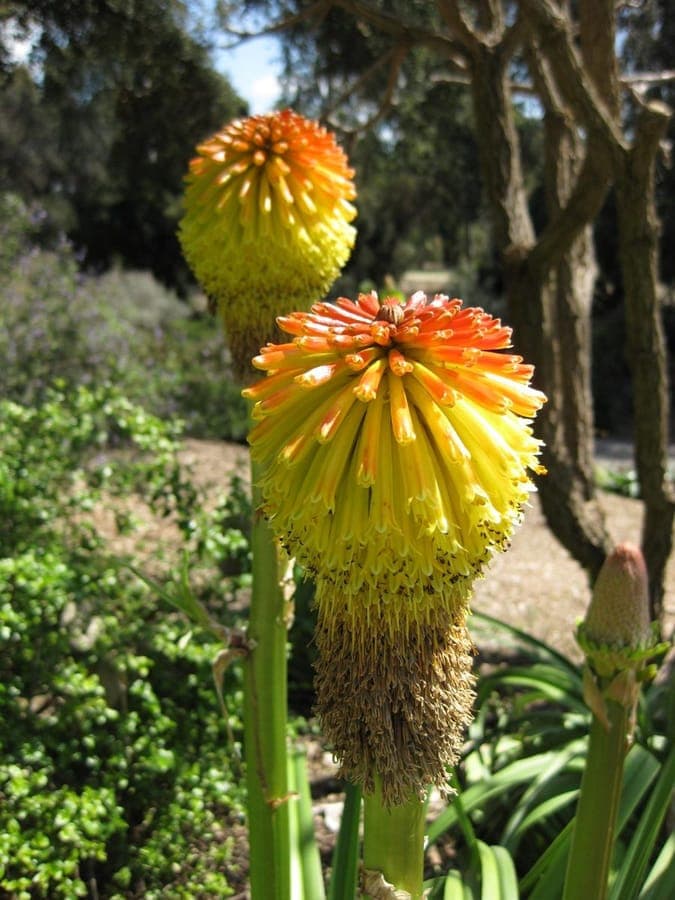
Raffi Kojian / CC BY-SA 3.0, via Wikimedia Commons
Kniphofia rooperi: the autumn red hot poker
Kniphofia rooperi
Want to see Kniphofia rooperi: the autumn red hot poker in your garden?
Full design in HD: €7.99
Look after your Kniphofia rooperi with the GardenWorld app
Identify plants with your camera and get a care calendar with reminders for this plant.


Overview
Kniphofia rooperi is a red hot poker that breaks with the familiar slender, tapering shape. Instead of long, pointed spikes it carries rounded to egg-shaped flower heads that look like glowing torches or little lanterns. The buds at the top are orange-red and the open flowers below are clear yellow, so each head shows a warm gradient from red to yellow. It also flowers late: in Britain and north-west Europe mainly in September and October, when many other perennials have finished.
The species comes from South Africa, from the Eastern Cape and KwaZulu-Natal, where it grows in damp grassland, along streams and in marshy hollows. That explains why it copes with more summer moisture than you might expect from a poker. Kniphofia rooperi forms a substantial clump of long, channelled, evergreen leaves. The flower stems reach 90 to 120 cm and the clump spreads 60 to 90 cm. It is sometimes sold as Kniphofia 'C.M. Prichard', a name often applied to the same plant. The species holds the RHS Award of Garden Merit.
If you want to see where such a striking autumn plant would look best, on gardenworld.app you can create a garden design that takes sun, soil and the colours already in your garden into account. Red hot pokers are not considered toxic to people, dogs or cats; the American animal welfare organisation ASPCA lists the genus as non-toxic.
Appearance and bloom cycle
The leaves are long and narrow, up to about 1 m, with a distinct central keel and a gutter-like shape. They stay green through winter, although the tips may brown after hard frost. The clump slowly widens and after a few years forms an impressive green fountain.
From late August or September, sturdy round stems appear, each topped by a globular head 8 to 12 cm tall. The individual flowers are narrow tubes about 3 cm long, tightly packed and angled downwards. They open from the bottom upwards, so the head changes colour as it flowers: first almost entirely orange-red, then yellow below with a red crown, and finally a faded brown lower section. Flowering carries on into October and, in a mild autumn, even into November. The nectar-rich flowers attract bumblebees and bees, which welcome every source of food so late in the season.
Ideal location
Red hot pokers are sun lovers, and Kniphofia rooperi is no exception. Choose a spot in full sun, at least six hours a day, sheltered from cold northerly winds. A south- or west-facing border, a position in front of a warm wall or an open, sunny part of a prairie-style or grass border is ideal. In shade it barely flowers and the stems flop.
Because the flower heads are heavy, a spot that is not too windy helps. Give the plant room: set it 60 to 75 cm from its neighbours so the leafy clump can develop without being swamped. A group of three makes a powerful autumn accent in a larger border.
Soil requirements
Unlike many other pokers, Kniphofia rooperi likes soil that stays moist in summer, but it will not tolerate cold, wet ground in winter. The ideal soil is deep and humus-rich yet free-draining: a good garden loam or sandy loam with some compost. On heavy clay, work in coarse grit or fine gravel and plant slightly proud of the surface so the crown does not sit in water in winter.
pH is not critical; slightly acidic to neutral is fine. Add a few spadefuls of well-rotted compost at planting time and, if you like, a handful of organic fertiliser in spring. Generous feeding mainly produces lots of leaves and few flowers.
Watering
After planting, water regularly for the first few months until the plant is well rooted. After that it needs little extra water in an average summer, but it appreciates soil that does not dry out completely. During a long dry spell in July and August, just as the flower stems are forming, give it a thorough soak once a week. That results in more and larger flower heads.
From October onwards, stop watering. In winter the soil around the crown should be on the dry side: standing water combined with frost is the main cause of winter losses in red hot pokers. In containers, water regularly in summer and move the pot to a dry, sheltered spot in winter.
Free preview
Want to see Kniphofia rooperi: the autumn red hot poker in your garden? Make a free preview of your design.
Pruning
Cut spent flower stems as low as possible once the heads turn brown. This keeps the plant tidy and stops it putting energy into seed.
Do not cut back the foliage in autumn. The evergreen leaves protect the crown from cold and wet. A useful trick is to tie the leaves loosely together in November into a sort of wigwam, so rain runs off the centre. In April, once the worst frosts are over, untie them and remove brown or damaged leaves. Do not cut into healthy green foliage.
After several years, large clumps can be divided in late spring. Do this carefully: red hot pokers dislike disturbance and sometimes need a year to flower freely again.
Maintenance calendar
March–April: Untie the leaves and remove brown foliage. Spread a thin layer of compost around the plant.
May: The best time to plant or divide. Water in after planting.
June–July: Leaf growth. Keep the soil moist during prolonged dry weather.
August: The first flower stems appear. Water in dry spells for a generous display.
September–October: Full flower. Remove faded heads.
November: Tie the leaves together and, if you like, tuck dry leaves or straw around the base.
December–February: Winter rest. After heavy snow or rain, check that no water is sitting in the crown.
To keep track of these jobs month by month, the planting calendar on gardenworld.app reminds you what needs doing and when.
Winter hardiness
Kniphofia rooperi is reasonably hardy. The RHS rates it H5, which corresponds to temperatures down to around -10 to -15 °C. In most gardens in southern and central Britain and the Low Countries it survives winter in a well-drained spot without trouble. In cold areas, on wet clay or after a severe spell of frost, it can be damaged or lost.
Protection is mainly needed against the combination of frost and wet. Tie the leaves together, add a layer of dry leaves, straw or conifer branches around the base and keep the crown dry. Young plants set out in autumn are the most vulnerable, so plant in late spring whenever possible, giving the plant a full season to establish.
Companion plants
The fiery colours of Kniphofia rooperi are perfect in a warm autumn border. Sneezeweed (Helenium autumnale) and black-eyed Susan (Rudbeckia fulgida) flower at the same time in yellow, orange and coppery red, reinforcing the autumn mood. Ornamental grasses such as Chinese silver grass (Miscanthus sinensis) provide a calm, swaying backdrop against which the rounded torches stand out even more.
For colour contrast, choose blue or purple plants. African lily (Agapanthus praecox) shares the same South African character and flowers a little earlier, keeping the border interesting for longer. Purpletop vervain (Verbena bonariensis) floats its small purple flowers among the pokers and also draws butterflies. Crocosmias and dahlias make good neighbours in a sunny spot too.
Final thoughts
Kniphofia rooperi is a red hot poker for gardeners who want something different. Its rounded, orange and yellow heads are unlike those of the classic species and appear just when the garden can use some colour. The evergreen foliage gives structure all winter, and once established the plant asks little of you.
Give it a sunny position, soil that does not dry out in summer yet does not stay wet in winter, and a little protection from winter wet. In return you will get a spectacular autumn display year after year that stops bees, bumblebees and passers-by in their tracks.
Frequently asked questions about Kniphofia rooperi
Is Kniphofia rooperi winter hardy?
Kniphofia rooperi is reasonably hardy. The RHS rates it H5, which corresponds to temperatures down to around -10 to -15 °C.
When and how do you prune Kniphofia rooperi?
Cut spent flower stems as low as possible once the heads turn brown. This keeps the plant tidy and stops it putting energy into seed.
How much water does Kniphofia rooperi need?
After planting, water regularly for the first few months until the plant is well rooted. After that it needs little extra water in an average summer, but it appreciates soil that does not dry out completely.
Where does Kniphofia rooperi grow best?
Red hot pokers are sun lovers, and Kniphofia rooperi is no exception. Choose a spot in full sun, at least six hours a day, sheltered from cold northerly winds.
What soil does Kniphofia rooperi need?
Unlike many other pokers, Kniphofia rooperi likes soil that stays moist in summer, but it will not tolerate cold, wet ground in winter. The ideal soil is deep and humus-rich yet free-draining: a good garden loam or sandy loam with some compost.

See it in your garden
See Kniphofia rooperi in your garden
One photo of your garden and a few questions. You see the result in about a minute.
Try it with a photoIdentify this plant in your own garden. Identify a plant
Similar plants
Fall Sneezeweed (Helenium autumnale): complete guide
Helenium autumnale L.
Discover Fall Sneezeweed, a stunning late-season bloomer with red, yellow, and copper flowers. Hardy perennial for borders and late-season color.
Chinese Silver Grass: complete guide
Miscanthus sinensis
Everything about Chinese Silver Grass (Miscanthus sinensis): planting, cutting back, cultivars and winter silhouette. Expert tips for a spectacular ornamental grass.
Agapanthus praecox: complete guide
Agapanthus praecox
Agapanthus praecox or African lily is an elegant ornamental plant with striking purple-blue flower heads. Master cultivation, care and design tips here.
