
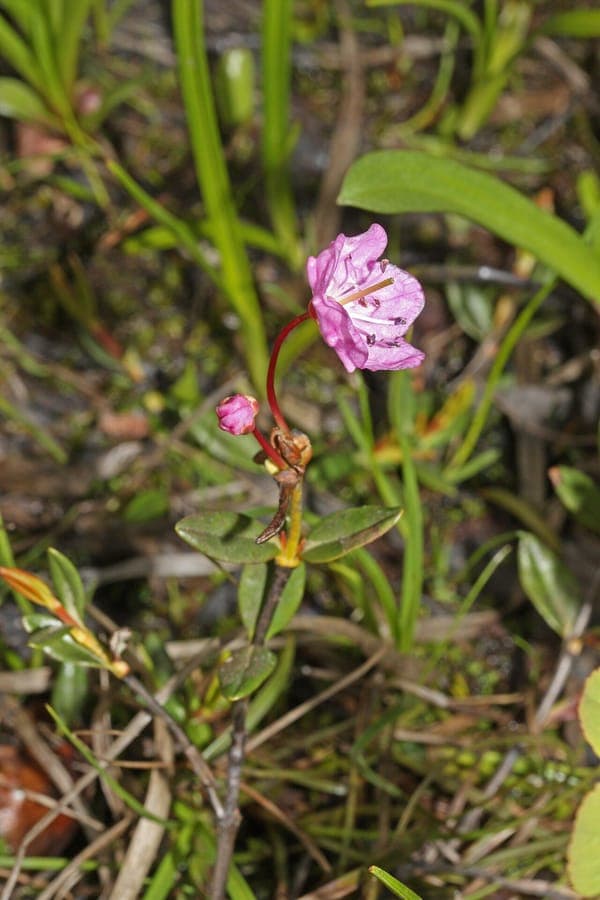
Walter Siegmund (talk) / CC BY-SA 3.0, via Wikimedia Commons
Bog-laurel: complete guide
Kalmia microphylla
Want to see Bog-laurel: complete guide in your garden?
1 minute, no credit card
Overview
Bog-laurel (Kalmia microphylla) is a small, slow-growing subshrub in the heath family (Ericaceae), native to the western half of North America from Alaska and the Yukon Territory southward through British Columbia, Alberta, Washington, Oregon, Idaho, Montana, and California to Nevada, Colorado, Utah, and Wyoming. Its natural habitats are high-elevation bogs, alpine wet meadows, moist coniferous forest margins, and streamside vegetation, from sea level in northern Alaska to elevations above 3,500 metres in the Sierra Nevada and Rocky Mountains.
The botanical name is straightforwardly descriptive: micro (small) + phylla (leaves), distinguishing this species from its relatives by the noticeably small leaves. For much of botanical history, bog-laurel was treated as a variety of the closely related Kalmia polifolia (Kalmia polifolia var. microphylla), but it is now recognised as a distinct species. It is also known under the synonyms Kalmia glauca var. microphylla and Kalmia polifolia subsp. microphylla.
Bog-laurel is a multi-stemmed shrub reaching 20–50 cm in height and similar spread. The flowers are disproportionately large and showy for the size of the plant - deep pink to rose-purple blooms of 1–1.5 cm diameter appearing in late spring to early summer. Like all Kalmia species, it contains toxic alkaloids (grayanotoxins, formerly called andromedotoxins), making it poisonous to humans and livestock. This should be borne in mind when planting near areas accessible to children or animals.
For gardeners creating acid-soil plantings - heather gardens, bog gardens, rhododendron borders, or moist rock gardens - bog-laurel is a highly rewarding plant that combines excellent cold-hardiness with ornamental foliage and spectacular flowers. Visit gardenworld.app for inspiration on designing garden schemes that incorporate acid-loving plants like Kalmia.
Appearance & bloom cycle
Bog-laurel has the characteristic compact, multi-stemmed habit of ericaceous shrubs. The stems are thin and upright, lightly branched, forming a dense rounded mound 20–50 cm tall and wide. The leaves are small - 1–3 cm long - narrowly oblong to oval, with a glossy dark green upper surface and a markedly pale, almost silvery-white underside. Leaf margins are revolute (rolled under), a common ericaceous adaptation that reduces water loss from the leaf surface. The foliage is evergreen, providing year-round interest.
The flowers are the plant's most spectacular feature. They appear from May through July depending on latitude and elevation, each flower bowl-shaped and deep pink to rose-purple, measuring approximately 1–1.5 cm across. The most remarkable botanical detail is the ten stamens, each with its anther trapped in a small pouch in the petals until a pollinating insect touches the flower. At that moment the stamens spring free in a catapult action, dusting the insect with pollen - a mechanism unique to the genus Kalmia and highly effective for ensuring cross-pollination.
Flowers are borne in small terminal clusters at the tips of the branches, and a well-established plant in good conditions can produce so many flower clusters that it appears smothered in bloom. After flowering, small round seed capsules form and persist on the plant decoratively. The plant grows slowly - a specimen of 30 cm height may be five to ten years old - so patience is rewarded with a permanent, low-maintenance fixture in the garden.
Ideal location
Bog-laurel thrives in partial shade to full shade conditions, consistent with its natural habitats in open alpine bogs and beneath light conifer canopy. Full sun is possible in cool, moist climates (northern Scotland, Scandinavia, high Alpine gardens) but leads to leaf scorch in warmer, drier conditions. In the average garden in the Netherlands, Belgium, or the British Isles, a position receiving morning sun and afternoon shade is ideal - similar to the requirements of most rhododendrons.
A location beside a garden pond, along a stream, in a moist woodland border, or in a dedicated heather garden alongside other ericaceous plants is perfect. The plant tolerates exposure to wind reasonably well once established and handles cold sites effectively given its origin in boreal and alpine environments.
Space plants 40–50 cm apart. A group of three to five specimens achieves the best visual effect; bog-laurel is at its most impressive as part of a mixed ericaceous planting rather than as a solitary specimen.
Soil requirements
Bog-laurel shares the strict soil requirements common to all ericaceous plants. The recorded soil pH range is 6.0–7.3, but in practice the plant thrives best at the lower end - pH 4.5–6.0 - in line with rhododendrons, heather (Calluna), and Pieris. On neutral or alkaline soils, iron becomes unavailable to the plant, leading rapidly to lime-induced chlorosis (yellowing leaves) and eventual decline.
The ideal soil is peaty, humus-rich, moisture-retentive but free-draining - never waterlogged. Ericaceous compost, acidic sandy loam enriched with pine bark, or natural peat (where still available) are all excellent growing media. On heavy clay soils, excavate a planting hole of at least 50 × 50 cm and backfill entirely with ericaceous compost mixed with coarse grit in a 2:1 ratio.
Mulching is strongly recommended: a 5–7 cm layer of pine bark chips, pine needles, or acidic leaf mould (oak or beech) keeps the soil moist, cool, and at the correct pH. Renew the mulch layer each spring and autumn. Never use calcareous mulch or general-purpose fertilisers that might raise the pH.
Key soil preparation tips:
- Mix existing garden soil with ericaceous compost in a 1:1 ratio at minimum
- Add sulphur dust (50 g per m²) to lower pH if starting soil is above 6.5
- Always use rainwater or softened water for irrigation in hard water areas
Free design
Want to see Bog-laurel: complete guide in your garden? Make a free design now.
Watering
Bog-laurel has relatively high moisture requirements compared to most garden shrubs, reflecting its boggy and streamside natural habitats. In the garden, the soil should be kept consistently moist - never waterlogged, but never allowed to dry out completely. This is the critical balance to maintain for healthy, floriferous plants.
For newly planted specimens during the first growing season, water every two to three days in dry weather to keep the root ball evenly moist. Established plants need watering once or twice a week during extended dry spells. In prolonged dry periods of three to four weeks or more, even well-established plants should be watered regularly.
Rainwater is strongly preferred over mains tap water in areas with hard, calcareous water supply. In the Netherlands and Belgium, tap water is often calcareous and will gradually raise soil pH to the detriment of ericaceous plants. Where only tap water is available, add a small amount of acidifying liquid fertiliser periodically, or water occasionally with a dilute solution of citric acid or acidifying mineral water.
Drip irrigation directly to the root zone is the most efficient delivery method. Avoid wetting the foliage unnecessarily; while bog-laurel is more tolerant of moisture than some ericaceous shrubs, persistent leaf wetness in cool conditions can encourage fungal issues.
Pruning
Bog-laurel requires very little pruning. Its slow growth rate and naturally compact habit make hard pruning unnecessary and counterproductive. In spring, remove any winter-damaged or dead stems by cutting back to healthy wood. After flowering in June or July, spent flower clusters can be removed to encourage stronger bud set for the following year - though this is less critical than deadheading in rhododendrons.
Light shaping to maintain a neat mound can be done in early spring, before new growth commences, by removing any excessively long or crossing stems. Never prune in late summer or autumn, as this removes already-formed flower buds and significantly reduces the following spring's display.
Seed capsules that form after flowering are decorative and can be left in place through autumn; they do not significantly deplete the plant's energy and provide some wildlife value.
Maintenance calendar
February–March: Check for winter damage; remove dead or frost-damaged stems. Renew mulch layer. April: First bud swell; check for yellowing (chlorosis) indicating pH is too high - apply acidifying fertiliser if needed. May–June: Flowering season - water during dry spells, enjoy the blooms. July: After flowering, remove spent clusters; maintain soil moisture through summer heat. August–September: Vegetative growth of new shoots; no pruning during this period. October: Restore mulch layer; reduce watering frequency as temperatures drop. November–January: Minimal care; protect from desiccating cold winds with a light windbreak if site is very exposed.
Winter hardiness
Bog-laurel is exceptionally cold-hardy, reflecting its origins in Alaska, the Yukon, and high-elevation Rocky Mountain habitats. It withstands temperatures of -30 °C or below - USDA hardiness zone 2 to 3 - and is completely problem-free through the winters of the Netherlands, Belgium, Germany, France, and the British Isles.
The evergreen leaves are subject to desiccation damage in cold, dry, windy winters without snow cover (a condition known as winter scorch or frost drought). In exposed positions without snow protection, leaves may turn brown at the tips but recover quickly in spring. A light windbreak - nearby shrubs or a garden fence - eliminates this problem.
No winter mulching or covering is required. Young first-year plants can benefit from a light layer of pine needles around the crown as insulation in the coldest regions, but this precaution is rarely necessary in north-western Europe.
Companion plants
Bog-laurel combines most naturally with other ericaceous plants and with moisture-loving perennials that share its requirements for acidic, humus-rich, moist soil:
- Dwarf rhododendrons (Rhododendron williamsianum, R. yakushimanum): shared soil requirements, complementary flowering times in April–May.
- Heather (Calluna vulgaris): summer-blooming purple, same acid soil preference, combined as a heather tapestry.
- Cross-leaved heath (Erica tetralix): prefers damp, acidic conditions; pink flowers in July–September.
- Bog bilberry (Vaccinium uliginosum): native bog plant with edible berries, identical habitat requirements.
- Cottongrass (Eriophorum angustifolium): architectural bog plant with white fluffy seed heads, dramatic contrast.
- Purple moor-grass (Molinia caerulea): graceful grass for the moist acid border, stunning golden autumn colour.
Plant bog-laurel at 40–50 cm spacing within a mixed ericaceous border or bog garden. A planting beside a garden pond with reflected light enhances the flower display. Find more plant combination ideas for heather gardens and moist acid borders at gardenworld.app.
Closing
Bog-laurel is a gem of a plant for the acid-soil garden: compact, extremely cold-hardy, requiring minimal pruning, and producing flowers of outstanding beauty for its small size. The catapult-action stamens make it a fascinating talking point for garden visitors, while the glossy evergreen leaves provide year-round structure in the heather border or bog planting. Sourced from specialist alpine and heather nurseries, it will reward patient cultivation with decades of reliable flowering. It is well worth seeking out at garden centres with a good ericaceous range, such as specialist heather nurseries, where you can also find the named cultivar 'Rocky Mountain Form' with particularly deep rose-pink flowers.
Want to see Bog-laurel: complete guide in your garden? Make a free design now.
Upload a photo, pick a style, and get a photorealistic design with plant list in under a minute.
10,000+ gardens designed already
No credit card required


Similar plants
Zenobia pulverulenta: complete guide
Zenobia pulverulenta
Everything about Zenobia pulverulenta (honeycup): siting, acid soil, pruning and the fragrant white bells, in this complete care guide.
Dwarf huckleberry: complete guide
Gaylussacia dumosa
Everything about dwarf huckleberry (Gaylussacia dumosa): acidic soil, partial shade, pruning and care for this compact North American berry shrub.
Drooping leucothoe: complete guide
Leucothoe fontanesiana
Everything about drooping leucothoe (Leucothoe fontanesiana): shade tolerance, soil, watering, pruning, hardiness and companion plants.