
Jerry Friedman / CC BY-SA 2.0, via Wikimedia Commons
Texas walnut: complete guide
Juglans microcarpa
Want to see Texas walnut: complete guide in your garden?
1 minute, no credit card
Overview
Texas walnut, botanically Juglans microcarpa Berland., is a small to medium deciduous tree in the walnut family (Juglandaceae). The species was described in 1850 by Belgian-Mexican naturalist Jean-Louis Berlandier, and its native range spans from Texas, New Mexico, Oklahoma, and southern Kansas down into northeastern Mexico. The common names 'Texas walnut', 'little walnut', and 'river walnut' all reflect characteristics of the plant - its limited size compared to other walnuts, and its preference for riparian and streamside habitats in semi-arid landscapes.
What sets Juglans microcarpa apart from its larger relatives such as the common English walnut (Juglans regia) is its modest proportions: mature trees typically reach between 3 and 9 metres in height, with a broad, open crown that at times looks more like a large, multi-stemmed shrub than a classic tree form. On gardenworld.app you will find inspiration for incorporating unusual specimens like this one into a balanced front garden design.
Appearance and bloom cycle
Texas walnut has an unmistakably walnut-like silhouette, with a rugged, deeply furrowed grey-brown bark that gives even young trees a weathered, characterful appearance. The alternate, pinnately compound leaves consist of 7 to 25 narrow leaflets, each 5 to 12 cm long. Like all walnuts, the foliage releases a distinctive aromatic scent when crushed, due to volatile compounds in the leaf tissue.
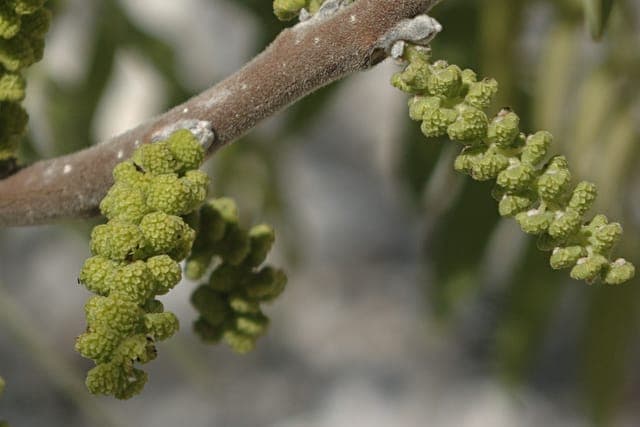
The tree is monoecious - male and female flowers are separate but carried on the same tree. The inconspicuous, wind-pollinated male catkins appear early in spring along with the unfolding young leaves. Female flowers are smaller still and quite discreet. After pollination, the characteristic small nuts develop: round fruits only 1 to 2.5 cm in diameter, enclosed in a green to dark brown-black husk. The nuts are edible but have a small kernel and an exceptionally hard shell, making them commercially uninteresting - though squirrels, birds, and small mammals value them highly.
Autumn colour is a handsome yellow, adding ornamental interest in the final weeks of the growing season. Leaf drop tends to come relatively late in the year.
Ideal location
In its natural habitat, Juglans microcarpa grows along rivers, on rocky limestone slopes, and on dry loamy hillsides in a semi-arid climate. This tells you exactly what it prefers in cultivation: full sun, dry to moderately moist conditions, and an open, warm position.
Garden planting recommendations:
- Sun: at least 6 hours of direct sunlight per day; in part shade growth is slower and the crown less well-formed
- Space: allow for a mature spread of 3 to 6 metres; roots extend far horizontally
- Distance from structures: at least 3 to 4 metres from buildings or paved surfaces because of root spread and juglone release from fallen leaves
- Wind: wind-tolerant and grows well in open, exposed positions
A sunny front garden corner, an open lawn bed, or a sloped area are all ideal sites. The tree also works well as a specimen plant on a large terrace or as a characterful accent in a drought-tolerant planting scheme.
Soil
Texas walnut is remarkably adaptable in terms of soil type but shows a clear preference for free-draining ground. In its native range it grows on calcareous loam, rocky terrain, and river alluvium. The pH preference is 5.5 to 6.9 - slightly acid to neutral.
Soil preparation guidelines:
- Texture: light to medium; excellent drainage is essential; the tree dislikes prolonged waterlogging
- pH: 5.5 to 6.9; avoid strongly alkaline soils, although the tree tolerates some calcareousness in the wild
- Fertility: moderate; heavy feeding is unnecessary and can push excessive vegetative growth
- Depth: the tree develops a deep taproot system; ensure at least 60 cm of loose, free-draining soil
When planting in heavy clay, dig a hole at least 80 x 80 cm and fill it with a mix of the excavated soil, coarse sand, and a modest amount of compost (ratio 3:2:1). Do not cap the hole with an impermeable layer.
Watering
Once well rooted, Texas walnut is an outstandingly drought-tolerant tree that needs little supplementary water even through dry summers. This is one of its most valuable qualities for contemporary gardens where water use is increasingly under scrutiny.
Year one: After planting, regular watering is essential. Water two to three times a week deeply enough that moisture penetrates at least 30 cm into the soil. This encourages the taproot to grow downward and ensures good establishment.
Years two and three: Gradually reduce to once a week during dry weather. The tree will increasingly regulate its own water uptake.
Established tree: After three years, supplementary watering in normal summers is unnecessary. Only during extreme dry spells - four to six or more weeks without significant rainfall - would a thorough watering be beneficial.
A deep mulch layer (10 to 15 cm of wood chip or gravel) around the base of the tree - but not touching the bark - helps retain soil moisture during the establishment period. On gardenworld.app you can have a personalised garden design created that maps out the water requirements of your specific plot.
Free design
Want to see Texas walnut: complete guide in your garden? Make a free design now.
Pruning
Texas walnut has a naturally elegant, open growth habit and needs little corrective pruning. That said, there are situations where pruning is useful or necessary:
Raising the crown in the early years: During the first three to five years, you can gradually raise the crown by removing the lowest side branches to a clear stem height of around 120 to 150 cm. This improves the light environment beneath the tree and makes the space underneath more usable.
Dead wood removal: Remove dead, diseased, or damaged branches in late spring or early summer. Avoid pruning in autumn or early winter, as walnuts can bleed sap heavily at those times.
Crossing branches: Remove branches that cross or grow toward each other to maintain an open crown structure.
Timing: Prune preferably from late spring through early summer, once the leaves have fully unfurled. Wound healing is optimal then, and the risk of fungal infection is lowest.
Always use clean, sharp tools. Cover large cut surfaces with a wound sealant to reduce the risk of fungal disease.
Maintenance calendar
January - February: Winter dormancy. Inspect the branch structure for dead or potentially dangerous limbs. Plan any pruning work for spring.
March: Start of the growing season. Male catkins appear - the signal that the tree is awakening from dormancy. Apply a layer of compost around the base (not touching the trunk).
April - May: Young foliage unfurls. Carry out any planned pruning once the leaves are fully open. Watch for pests such as walnut scale or leaf-rollers.
June - July: Nuts are forming. Avoid heavy pruning during this period. Water only during prolonged dry spells.
August - September: Nuts ripen and fall. Collect fallen nuts promptly to limit unwanted germination elsewhere in the garden.
October - November: Handsome yellow autumn colour. Rake up fallen leaves promptly; accumulated juglone in the leaves can affect soil flora over time.
December: Full dormancy. No active care needed.
Winter hardiness
Juglans microcarpa is one of the hardiest walnut species. It is rated for USDA hardiness zones 6 through 9, meaning it can handle temperatures down to around -20 degrees Celsius at zone 6. In northwest European garden settings (typically USDA zones 7-8), the tree survives comfortably in most winters, provided it is planted on a well-draining site.
In severe winters, the terminal buds of young shoots may sustain minor frost damage, but the tree recovers quickly from the buds lower on the stem. Established specimens generally come through normal temperate winters without difficulty. Young trees in their first winter can benefit from a light wrapping of hessian around the stem base if hard frost is forecast.
A dry planting position significantly improves winter hardiness: a tree that has hardened off well (through a dry and sunny autumn) survives cold spells far better than one growing in persistently wet clay.
Companion plants
When choosing companions for Texas walnut, juglone must be considered - a compound released by the roots and fallen leaves that is toxic to a range of plants. Juglone-tolerant companions include:
- Ivy (Hedera helix): Handles juglone well and provides attractive ground cover around the trunk.
- Sunflowers (Helianthus species): Notably tolerant of juglone, and they thrive in full sun under the open crown.
- Forsythia: Fast-growing flowering shrubs that tolerate juglone and provide early spring colour.
- Grasses and sedges: Most grass and sedge species handle juglone without issue and make a graceful, drought-tolerant understorey planting.
- Grape (Vitis species): Reasonably tolerant of juglone and can be trained over a nearby pergola.
Avoid planting tomatoes, apples, pears, rhododendrons, and many other common garden plants that are sensitive to juglone within the root zone of the tree.
At garden centres, ask for Texas walnut in the specimen tree or unusual tree section. Specialist tree nurseries are the most reliable source. On gardenworld.app you can explore planting combinations that work around juglone-sensitive neighbours and make the most of the tree's exceptional drought tolerance and ornamental value.
Closing thoughts
Texas walnut (Juglans microcarpa) is a small, characterful tree that excels through its extreme drought resistance, its elegant open crown, and its genuine value to local wildlife. Where the common walnut grows too large for an average front garden, J. microcarpa fits more modest spaces - provided you plan for juglone release and give the taproot adequate depth.
The effort of seeking it out is richly rewarded by a tree that can last for generations, needs virtually no intervention once established, and provides ornamental interest in every season - from the delicate catkins of spring through the yellow autumn canopy to the rugged, textured bark of winter.
Want to see Texas walnut: complete guide in your garden? Make a free design now.
Upload a photo, pick a style, and get a photorealistic design with plant list in under a minute.
10,000+ gardens designed already
No credit card required


Similar plants
Texas walnut: complete guide
Juglans microcarpa
Complete guide to Texas walnut (Juglans microcarpa): a small, drought-tolerant walnut tree for gardens. Location, soil, watering, and care advice.
Witch-hazel: complete guide
Hamamelis virginiana
Witch-hazel growing guide: autumn and winter flowering shrub for your garden. Complete care and pruning tips for year-round interest and aromatic blooms.
Halesia carolina: complete guide
Halesia carolina
Discover Halesia carolina, a stunning American snowdrop tree. Complete guide to planting, growing, and caring for this beautiful ornamental tree.