
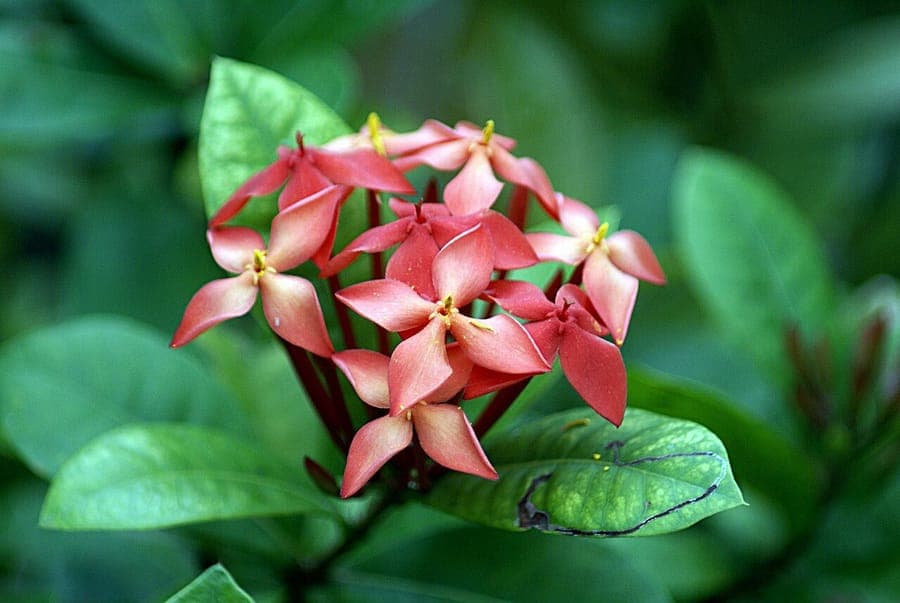
User:Kokkarani / CC BY-SA 3.0, via Wikimedia Commons
Ixora coccinea: complete guide
Ixora coccinea
Want to see Ixora coccinea: complete guide in your garden?
1 minute, no credit card
Overview
Ixora coccinea, commonly known as Flame-of-the-woods or Jungle flame, is a stunning tropical shrub native to South Asia, particularly India, Sri Lanka, and Bangladesh. This ornamental from the Rubiaceae family produces masses of bright red to red-orange flowers in dense ball-like clusters. The plant is a classic choice for tropical and subtropical gardens and very popular in container cultivation.
Though Ixora coccinea naturally comes from warm climates, it can be cultivated under certain conditions in the Netherlands, Belgium, and Germany. Outdoor cultivation is usually only possible if a frost-free location is available or if you protect the plant indoors during winter.
Appearance & Bloom
Ixora coccinea is a compact to medium-sized shrub reaching 1 to 1.5 meters high under ideal conditions. The leaves are lanceolate, glossy green, and remain present year-round. The flowers appear in whorls of approximately 8-12 small tubular florets fused in brilliant red to orange-red colors.
The flowers have a light sweet fragrance and attract butterflies and hummingbirds. The blooming period extends from May to December in subtropical areas, with peak blooming in summer and autumn. Each flower cluster blooms approximately 3-4 weeks. The plant doesn't produce notable seeds; propagation occurs via cuttings.
Ideal Location
Ixora coccinea prefers full sun, at least six to eight hours of direct sunlight daily. In full sun, the plant blooms most profusely. In partial shade, the plant grows well but blooms less abundantly. Provide protection from cold winds; the plant is sensitive to temperature drops below 10°C.
Indoors: place on a sunny windowsill or under grow lights. Ensure adequate humidity by misting regularly.
Soil
Ixora coccinea grows best in well-drained, slightly acidic soils (pH 6.0-6.5) with good organic matter content. Heavy clay must be improved with sand and peat moss. For container culture, use potting soil with added perlite or sand (2:1).
Improve soil yearly with compost layer and feeding. Regular nutrient needs are high because the plant produces many flowers.
Free design
Want to see Ixora coccinea: complete guide in your garden? Make a free design now.
Watering
During growing season, water regularly so soil remains moist but not waterlogged. Check daily in warm periods; evaporation is rapid. Foliage spraying also helps increase humidity levels, which promotes blooming.
In winter reduce watering, especially for indoor potted plants where drier climate prevails. Water not until soil completely dries, but alternating wet and dry cycles are preferable to constantly soggy soil.
Pruning
Pruning is important for compact form. In early spring (March) cut back to approximately 30-40 centimeters height to promote branching. Remove weak or dead branches. Deadheading spent clusters stimulates further blooming. In container culture, prune more aggressively to maintain compactness.
Maintenance Calendar
March: Heavy pruning and start feeding. April to September: Regular watering, feeding every two weeks, deadheading. October to February: Reduce watering; minimal feeding. February: Preparation for new season.
Winter Hardiness
Ixora coccinea is not winter-hardy in Northern Europe. In the Netherlands and Belgium, treat as a frost-sensitive plant grown indoors or outdoors only possibly in July-August in protected locations. For outdoor winter survival of potted plants, bring them inside by October. Outdoor ground-planted specimens don't survive after frost.
In southern Germany, very protected warm microclimates might support frost-free survival, but this is risky.
Companion Plants
Ixora coccinea pairs well with other tropical flowering plants like Pentas, Zinnias, and Bougainvillea. For contrast use gray-leaved plants like Artemisia or silver-leaved Dusty Miller. In containers combine with tropical grasses and foliage plants.
Closing
Ixora coccinea brings tropical color and exoticism to your garden or greenhouse. With its intense red blooms and attraction for butterflies, it's an excellent choice for heat-loving gardeners. Plant in well-drained soil, provide plenty of sun, and enjoy the long bloom period from May to December. For outdoor overwintering in most Dutch and Belgian locations: move potted plants to window and ensure minimal winter care.
For this and other exotic plants, design your front garden with gardenworld.app - a free online garden designer for warm, sunny garden corners. With gardenworld.app, you create tropical garden days in your front yard.
Want to see Ixora coccinea: complete guide in your garden? Make a free design now.
Upload a photo, pick a style, and get a photorealistic design with plant list in under a minute.
No credit card required


Similar plants
Ixia maculata: complete guide
Ixia maculata
Yellow ixia from South Africa with spotted flower centers. A blooming beauty for sunny gardens.
Lagerstroemia indica: complete guide
Lagerstroemia indica
Discover Lagerstroemia indica, or Crepe-myrtle, an exceptional ornamental shrub featuring stunning flowers and distinctive bark structure.