A. Barra / CC BY 3.0, via Wikimedia Commons
Holly-leaved sweetspire (Itea ilicifolia): complete guide
Itea ilicifolia
Want to see Holly-leaved sweetspire (Itea ilicifolia): complete guide in your garden?
Full design in HD: €7.99
Look after your Holly-leaved sweetspire with the GardenWorld app
Identify plants with your camera and get a care calendar with reminders for this plant.


Overview
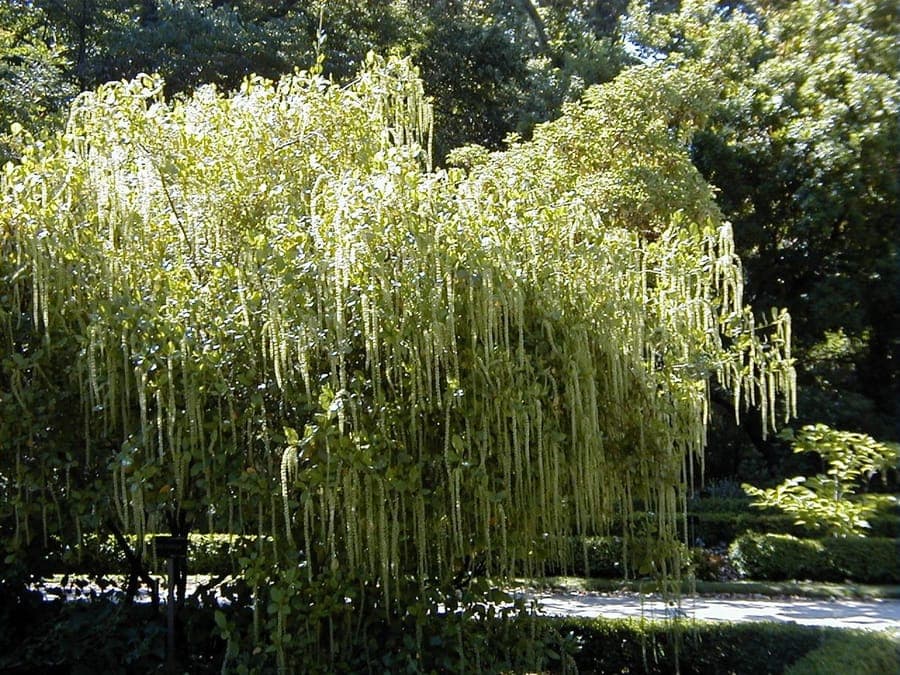
Holly-leaved sweetspire (Itea ilicifolia) is an evergreen shrub from western China that saves its big moment for the end of summer. In August and September it hangs with dozens of long, slender tassels of greenish-white flowers, some of them 30 cm long, swaying like catkins in the breeze. For the rest of the year it is clothed in glossy, dark green leaves with soft spiny teeth, so at first glance most people take it for a holly. The species name says exactly that: ilicifolia means "with leaves like Ilex".
It belongs to the small family Iteaceae, which also includes the better-known Virginia sweetspire, Itea virginica. The two are very different garden plants, though. The American species is deciduous, low and grown for autumn colour in damp ground, whereas Itea ilicifolia is larger, evergreen, late-flowering and happiest in a warm, sheltered spot. It has long been a favourite wall shrub in British gardens and holds the Royal Horticultural Society's Award of Garden Merit.
In the garden it usually reaches 2.5 to 4 m in height with a similar spread, though it takes its time: allow ten to fifteen years for full size. Trained against a wall it can be kept flatter, so it takes up less room in the border. If you are unsure where such a shrub would sit best on your plot, you can have a garden design made on gardenworld.app that takes sun, wind and the walls around your house into account.
Appearance and bloom cycle
The leaves are oval to broadly elliptic, 5 to 10 cm long, firm and leathery. They are deep glossy green above and paler beneath, with fine spiny teeth along the margin. Those teeth are much softer than on a true holly, so pruning will not leave your hands scratched. With age the branches arch gently outwards, which gives the shrub a loose and graceful outline.
Flowering usually starts in mid-August and carries on to the end of September, occasionally earlier after a hot summer. The flowers are borne in long, pendulous racemes of 15 to 30 cm, a little longer still in the selection 'Westonbirt'. Each raceme is packed with hundreds of tiny greenish-white flowers, so from a distance the whole shrub looks draped in strings of pale beads. On mild evenings the air around it carries a sweet scent often likened to honey. Bees and hoverflies visit in good numbers, which is welcome at a time of year when many shrubs have long finished.
Ideal location
Itea ilicifolia likes warmth. In most of northern Europe it flowers best against a south- or west-facing wall, where the brickwork soaks up heat by day and releases it at night. Full sun or light dappled shade suits it; in deep shade it still grows, but you will get far fewer tassels.
Shelter matters as much as sun. Cold easterly and north-easterly winds in winter scorch the evergreen foliage, particularly on young plants. A courtyard, a corner between two walls or a spot beside a solid fence works well.
Keep the mature spread in mind. Plant at least 1 m out from a wall and leave a couple of metres either side. Fix horizontal wires or a trellis to the wall so you can tie the main branches in as a loose fan.
Soil requirements
The soil should be fertile, moisture-retentive and yet well drained. Heavy clay that stays waterlogged for days in winter is a poor choice, because cold, wet roots are this shrub's main weakness. On clay, dig a planting hole about twice the width of the root ball and work in plenty of garden compost and some coarse grit. On thin, sandy soils, well-rotted compost helps hold moisture through summer.
The pH is not critical. Slightly acid to neutral ground is ideal, but mildly alkaline soil is tolerated as long as it does not dry out. Plant in spring, in April or May, so the roots have a full season to settle before the first winter. A 5 cm mulch of bark or leaf mould keeps the roots cool in summer and gives some protection in winter.
Watering
Regular watering in the first year makes a big difference. During dry spells give roughly 10 litres per plant once a week, aimed directly at the root ball. Be wary of walls: the ground close to a house often receives far less rain than you would expect because the eaves create a rain shadow. Check the soil there regularly by pushing a finger about 10 cm down.
Once established, the shrub copes reasonably well with a dry spell, but it flowers more generously when the soil does not dry out completely. A thorough soaking in July, when the racemes are forming, pays off during a prolonged drought. Avoid the opposite extreme too: a plant standing in water develops yellowing leaves and soon sulks.
Free preview
Want to see Holly-leaved sweetspire (Itea ilicifolia): complete guide in your garden? Make a free preview of your design.
Pruning
This is a shrub that needs very little pruning, and the best advice is to let it develop its natural, gently arching shape. Prune in April once the worst frosts are over. Remove dead wood, frost-damaged tips and any branches that cross or grow into the centre.
On a wall-trained plant, tie in the new long shoots each spring and shorten those growing straight out from the wall back to a side branch. Do not be heavy-handed, as hard pruning can cost you a year of flowers. An old, bare specimen can be rejuvenated over three years by cutting a third of the oldest stems close to the base each spring. Spent racemes can be left to fall naturally or snipped off in autumn if you find them untidy.
Maintenance calendar
March: Check for winter damage, but hold off pruning until hard frosts have passed.
April: Light pruning and tying in against the wall. Feed with a handful of organic shrub fertiliser and renew the mulch. A good month for planting.
May and June: Main growing season. Water during dry spells, especially young plants and those close to a wall.
July: Flower racemes develop. Do not let the soil dry out.
August and September: Peak flowering. Enjoy the scent on warm evenings and watch the insects at work.
October and November: Remove spent racemes if you wish. Stop feeding so new growth can ripen before winter.
December to February: Protect young plants during hard frost with a double layer of horticultural fleece over the crown and an extra layer of mulch at the base.
Winter hardiness
Itea ilicifolia is reasonably hardy. The RHS rates it H5, meaning an established plant should survive frosts of around -10 °C to -15 °C. That covers most winters in the UK and the Low Countries, especially in a sheltered spot against a wall.
Young plants are more vulnerable. During long spells below -10 °C, particularly combined with drying easterly winds, leaves can brown and shoot tips may die back, though the shrub usually regrows from older wood in spring. Protect young specimens with fleece and a thick mulch for their first two or three winters. If you grow one in a large container, move it close to the house in winter and wrap the pot in hessian or bubble wrap, since roots in a pot freeze far more quickly than those in open ground.
There are no reports of toxicity: Itea ilicifolia does not appear on the usual lists of poisonous garden plants for people or pets, though it is always sensible to stop children and animals eating any plant material. The species is not invasive anywhere in Europe.
Companion plants
As a late-flowering evergreen wall shrub, Itea ilicifolia works best with partners that peak at other times. Star jasmine (Trachelospermum jasminoides) can climb the same wall and flowers fragrantly in June and July, giving you scent twice in one summer. Mexican orange blossom (Choisya ternata) makes a good evergreen neighbour with white flowers in spring.
For a calm, green corner, pair it with oakleaf hydrangea (Hydrangea quercifolia), which turns rich red in autumn, and with Osmanthus heterophyllus, which shares the holly-like leaves and flowers fragrantly in autumn. Laurustinus (Viburnum tinus) carries white flowers through winter. At the foot of the shrub, Japanese forest grass (Hakonechloa macra) or Japanese anemones look lovely and flower at the same time as the Itea.
Final thoughts
Itea ilicifolia is not a plant that shouts for attention, but once you have seen one in full flower you will not forget it. Give it a warm wall, shelter from cold winds and soil that never becomes waterlogged, and it will reward you for decades.
Not sure when to prune, feed or protect? The plant calendar on gardenworld.app sets out the jobs month by month for this and the other plants in your garden. Plant a holly-leaved sweetspire against your sunniest wall next spring and give it a few years: every August it will look better than the last.
Frequently asked questions about Holly-leaved sweetspire
Is Holly-leaved sweetspire winter hardy?
Itea ilicifolia is reasonably hardy. The RHS rates it H5, meaning an established plant should survive frosts of around -10 °C to -15 °C.
When and how do you prune Holly-leaved sweetspire?
This is a shrub that needs very little pruning, and the best advice is to let it develop its natural, gently arching shape. Prune in April once the worst frosts are over.
How much water does Holly-leaved sweetspire need?
Regular watering in the first year makes a big difference. During dry spells give roughly 10 litres per plant once a week, aimed directly at the root ball.
Where does Holly-leaved sweetspire grow best?
Itea ilicifolia likes warmth. In most of northern Europe it flowers best against a south- or west-facing wall, where the brickwork soaks up heat by day and releases it at night.
What soil does Holly-leaved sweetspire need?
The soil should be fertile, moisture-retentive and yet well drained. Heavy clay that stays waterlogged for days in winter is a poor choice, because cold, wet roots are this shrub's main weakness.

See it in your garden
See Holly-leaved sweetspire in your garden
One photo of your garden and a few questions. You see the result in about a minute.
Try it with a photoIdentify this plant in your own garden. Identify a plant
Similar plants
Star jasmine: complete guide
Trachelospermum jasminoides
Everything about Star Jasmine (Trachelospermum jasminoides): planting, care, pruning and winter protection. Expert tips for a fragrant evergreen climber.
Choisya ternata: complete guide
Choisya ternata
Mexican orange: fragrant blooming shrub for warm spots. Elegant foliage and white flowers. Mediterranean character for gardens.
Oak-leaf hydrangea: complete guide
Hydrangea quercifolia
Everything about oak-leaf hydrangea (Hydrangea quercifolia), ornamental shrub with striking flowers. Cultivation, location, watering and pruning.
