Hectonichus / CC BY-SA 3.0, via Wikimedia Commons
Dutch iris (Iris × hollandica): planting, cutting and care
Iris × hollandica
Want to see Dutch iris (Iris × hollandica): planting, cutting and care in your garden?
Full design in HD: €7.99
Look after your Dutch iris with the GardenWorld app
Identify plants with your camera and get a care calendar with reminders for this plant.


Overview
The Dutch iris (Iris × hollandica) is one of the best-known cut flowers in the world and, at the same time, a rewarding bulb for the garden. Hundreds of millions of stems are grown every year, and you will know them from the florist as the slender blue or yellow irises on sale almost all year round. In the garden they flower in May and June, neatly between the last tulips and the first roses, with elegant blooms on strong stems.
Iris × hollandica is not a wild species but a group of hybrids. It arose in the early twentieth century in the nurseries of Dutch growers, who crossed the Spanish iris (Iris xiphium) with related species from North Africa and the Iberian Peninsula, such as Iris tingitana. The result was an earlier-flowering, vigorous plant with large flowers in a wide range of colours, and the name recalls that Dutch origin.
The plant belongs to the iris family (Iridaceae) and grows from a small, brown-skinned bulb rather than the rhizome of a bearded iris. That keeps things simple: plant in autumn, enjoy in early summer. On gardenworld.app you can have a garden design drawn up in which Dutch irises sit among perennials that neatly hide their foliage after flowering.
Appearance and flowering season
Dutch irises grow 40 to 60 cm tall. The leaves are narrow, grey-green and channelled, and often appear in autumn shortly after planting. In spring each bulb sends up a round, straight stem carrying one or two flowers.
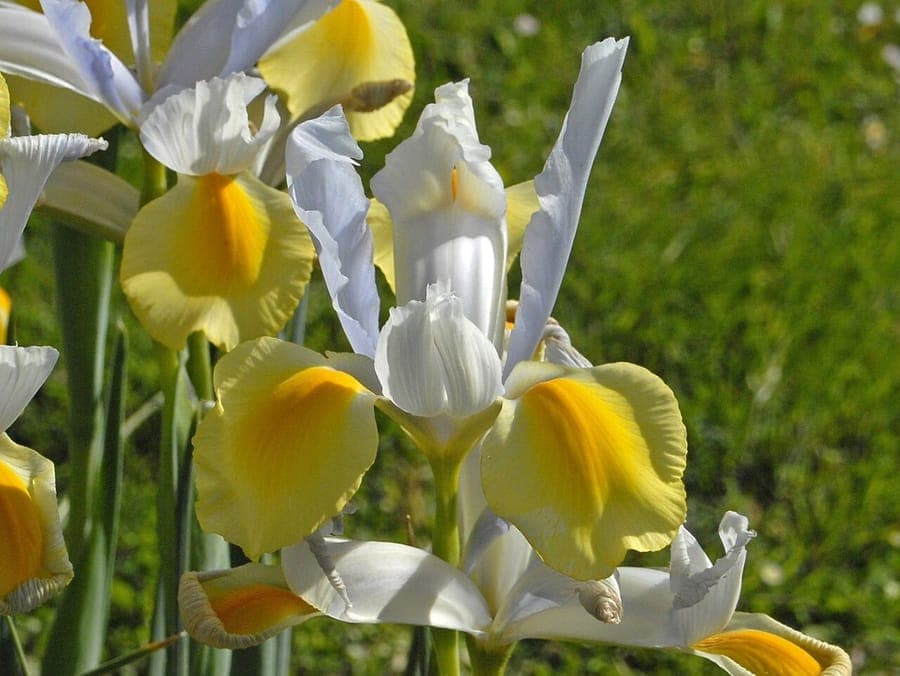
The flower has the classic iris structure. Three large, outward-curving petals, the falls, carry a striking yellow or orange blotch in the centre. Three narrower, upright petals, the standards, rise from the heart. Between them lie three style arms that look like small petals themselves. Each flower is 8 to 10 cm across and lasts a few days, after which the second bud opens.
There are dozens of varieties. 'Blue Magic' is violet-blue, 'Professor Blaauw' a deep ultramarine, 'White Excelsior' pure white and 'Golden Harvest' golden yellow. Bicolours such as 'Apollo' and 'Symphony' combine white standards with yellow falls. In the garden flowering runs from mid-May to late June; bulbs from the same batch tend to open together, so plant in two rounds if you want to spread the display. After flowering the foliage yellows in July and the bulb goes into summer rest.
Ideal position
Give Dutch irises the sunniest spot you have. At least six hours of sun a day means sturdy stems and generous flowering. A south-facing border, a bed in front of the house wall or a corner of the vegetable plot set aside for cutting flowers is ideal. In partial shade they flower less and the stems topple more easily.
A sheltered position helps, because the autumn foliage then suffers less from hard, cold winds. Plant in groups of fifteen to twenty-five bulbs for impact, or in rows if cutting is your main aim. As the leaves turn yellow and untidy after flowering, place the bulbs behind or between perennials that fill out from June onwards.
Soil requirements
Free-draining soil is essential. The bulb comes from warm regions with dry summers and rots quickly in wet, cold clay. Light sandy soil, sandy loam and gritty ground are ideal. A neutral to slightly alkaline pH suits it.
On heavy soil, work coarse sand or grit into the top 20 cm, or plant in a raised bed. Moderately fertile soil is enough: a handful of compost at planting and some bulb fertiliser in spring will do. Avoid fresh manure, which encourages bulb rot.
Planting the bulbs
Plant the bulbs in October and November, or until mid-December if the ground is still workable. Planting too early produces a lot of autumn foliage that hard frost can damage, which is why many growers wait until the soil has cooled a little.
Plant 8 to 10 cm deep, measured from the base of the bulb, 8 to 10 cm apart and pointed end up. For cutting rows, leave 15 cm between rows. Set the bulbs on a layer of sand if the soil is on the heavy side. Firm gently; extra water is only needed in a very dry autumn.
In pots you can plant closer, about 5 cm apart, in a mix of compost and grit. A 30 cm pot holds fifteen to twenty bulbs. Stand it against a sheltered wall for the winter.
Be aware that every part of the Dutch iris is toxic, the bulb most of all. It contains compounds that cause vomiting, diarrhoea and abdominal pain in people, dogs and cats if eaten, and the sap can irritate the skin. Wear gloves when planting and cutting, and keep bulbs well away from children and pets.
Free preview
Want to see Dutch iris (Iris × hollandica): planting, cutting and care in your garden? Make a free preview of your design.
Watering
In open ground, watering is rarely needed. In spring, while the stems are growing, the soil can stay slightly moist. If there is no rain for two weeks in April or May, give each group a good can of water.
After flowering, once the leaves start to yellow, stop watering. The bulb needs a dry, warm summer rest to flower again the following year. Move pots to a dry spot after flowering, or simply lay them on their side.
Pruning and cutting
For the vase, cut stems when the bud shows colour but is still closed. The flower opens within a day and then lasts five to seven days in clean water. Cut as low as you can, but leave as many leaves on the plant as possible if you want to keep the bulb.
In the garden, remove faded flowers to stop seed forming. Leave the foliage until it has turned yellow and dry, as it feeds the bulb for next year. In practice Dutch irises put on their best garden show in the first year. On dry, warm soil they come back for years; on heavier ground you can lift the bulbs in July, store them dry and airy, and replant in October, or simply add a few new bulbs each autumn.
Maintenance calendar
October–November: Plant bulbs 8 to 10 cm deep in a sunny, well-drained spot.
December–February: Young leaves are often already above ground. In hard frost below -10 °C, lay a loose layer of straw or conifer branches over them.
March–April: Remove the winter cover. Scatter some bulb fertiliser around the clumps. Check for slugs and aphids, which can spread viruses.
May–June: Flowering. Cut stems for the vase at bud stage. Snip off faded flowers.
July: Foliage yellows. Let it die back and lift the bulbs if you want to store them dry.
August–September: Summer rest. Keep lifted bulbs cool, dry and well ventilated.
Winter hardiness
Iris × hollandica is moderately hardy. Across most of Britain and the Low Countries it survives winter in the ground, especially in free-draining soil. The foliage that appears in autumn can be frosted at around -10 to -15 °C. The bulb sits deeper and usually survives, although flowering may be weaker afterwards.
The bigger risk is wet. A wet winter on heavy clay loses many bulbs to rot, so choose a drier spot or plant in a raised bed. A loose layer of straw, leaves or conifer branches protects the autumn foliage in hard frost. Move pots against the house wall or into an unheated shed.
Companion plants
Dutch irises sit well among perennials that also enjoy sun and good drainage. Catmint (Nepeta × faassenii) and Balkan clary (Salvia nemorosa) flower at the same time and form a soft, loose base beneath the upright iris stems. Lady's mantle (Alchemilla mollis), with its soft green leaves and frothy yellow flowers, covers the ground and hides the dying iris foliage.
For a taller accent, choose Allium hollandicum, whose purple globes appear at the same time and contrast playfully with the flat iris flowers. Lavender and thyme suit a Mediterranean-style border too. If you like the wild forms, plant the Spanish iris (Iris xiphium) nearby; it flowers a few weeks later.
Final thoughts
The Dutch iris (Iris × hollandica) combines the elegance of a florist's flower with the ease of an ordinary spring bulb. Give it sun, dry feet and a warm summer rest and it will flower in colours from ice blue to golden yellow. Keep its toxicity in mind, especially with children or pets about, and wear gloves when planting.
Want to know when to plant, feed and cut? The planting calendar on gardenworld.app sets it out for your own garden, so you can pick your own irises for the vase every spring.
Frequently asked questions about Dutch iris
Is Dutch iris winter hardy?
Iris × hollandica is moderately hardy. Across most of Britain and the Low Countries it survives winter in the ground, especially in free-draining soil.
When and how do you prune Dutch iris?
For the vase, cut stems when the bud shows colour but is still closed. The flower opens within a day and then lasts five to seven days in clean water.
How much water does Dutch iris need?
In open ground, watering is rarely needed. In spring, while the stems are growing, the soil can stay slightly moist.
What soil does Dutch iris need?
Free-draining soil is essential. The bulb comes from warm regions with dry summers and rots quickly in wet, cold clay.

See it in your garden
See Dutch iris in your garden
One photo of your garden and a few questions. You see the result in about a minute.
Try it with a photoIdentify this plant in your own garden. Identify a plant
Similar plants
Persian onion: complete guide
Allium hollandicum
Persian onion (Allium hollandicum) blooms with striking purple spherical flower heads. Learn how to grow this spectacular bulb plant and enjoy its dramatic spring display.
Catmint: complete guide
Nepeta faassenii
Everything about catmint (Nepeta faassenii): long-blooming blue flowers, drought-proof, ideal rose companion. Expert tips for a carefree, pollinator-rich border.
Woodland sage: complete guide
Salvia nemorosa
Everything about Woodland Sage (Salvia nemorosa): planting, care, pruning and combinations. Expert tips for months of blue-violet flower spikes.
