
Wikimedia Commons / Public domain, via Wikimedia Commons
Giant potato vine: complete guide
Ipomoea mauritiana
Want to see Giant potato vine: complete guide in your garden?
1 minute, no credit card
Overview
Ipomoea mauritiana, known in English as the giant potato, Mauritanian convolvulus, or large forest ipomoea, and in German as the Haiti-Prunkwinde, is a vigorous tropical climbing plant in the Convolvulaceae family - the same family as the familiar garden bindweed (Convolvulus) and the sweet potato (Ipomoea batatas). The species was first described in 1791 by botanist Nikolaus Joseph von Jacquin and is native to tropical America and Africa, with a range extending from West Africa across East Africa to Madagascar, Mauritius, and the islands of the Indian Ocean, and from Central America across the Caribbean islands into parts of North and South America.
The English name 'giant potato' refers to the large, tuberous root this plant develops in its native habitat - a water reservoir that allows the plant to survive dry periods. In some tropical regions these roots are consumed locally, though in Europe the plant is grown exclusively as an ornamental. The species belongs to a subgroup of Ipomoea characterised by seven- to nine-lobed, palmate leaves that resemble the hand-shaped leaves of a date palm - a distinguishing feature that makes Ipomoea mauritiana immediately recognisable.
In European horticulture, Ipomoea mauritiana is a relatively unusual choice, but it is prized by enthusiasts of tropical gardens and exotic plants for its spectacular flowers and rapid, lush growth. The blooms closely resemble those of the common morning glory (Ipomoea purpurea) but are larger and display a striking pink to purple-pink colour with a darker-coloured throat. At gardenworld.app you can explore how tropical climbing plants like Ipomoea mauritiana can be integrated into a garden design for an exotic and colourful character.
As a climber, Ipomoea mauritiana quickly develops long, twining stems that latch onto trellises, pergolas, fences, and other supports. In tropical climates the plant can reach many metres in length and is sometimes considered invasive. In European gardens - where it is grown as an annual or container plant - growth is more contained but still impressive: 2 to 4 metres of new growth in a single season is easily achieved. The plant is of tropical origin and is not frost hardy in northwest European climates.
Appearance & bloom cycle
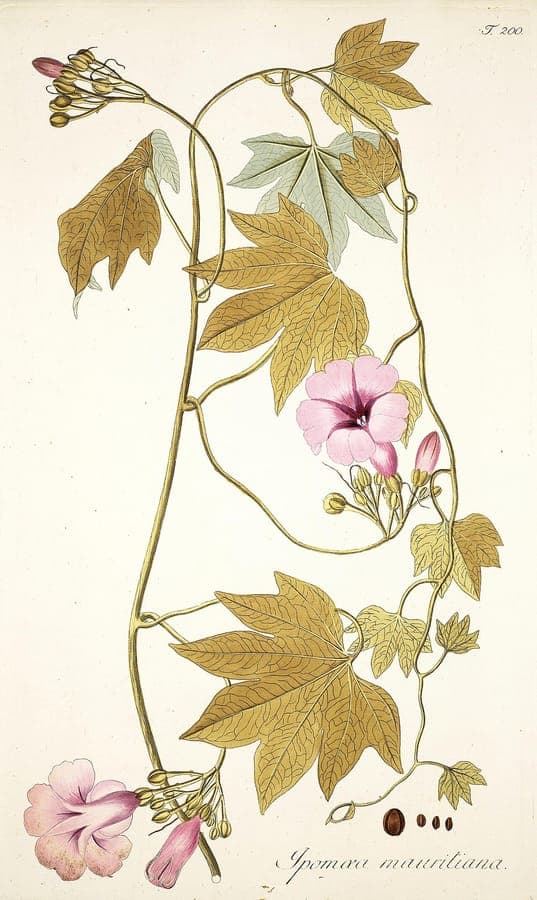
Ipomoea mauritiana distinguishes itself from most other morning glory species by its deeply divided, palmate leaves. Each leaf is seven- to nine-lobed, with narrow, sharply tapering lobes reminiscent of a date palm or finger-leaved fig. The leaf stalk is long - sometimes 15 cm - and the leaf blade can reach 10 to 20 cm in diameter. The colour is a glossy deep green, with a slightly heart-shaped base. At first glance the leaf looks nothing like the heart-shaped foliage of the common morning glory (Ipomoea purpurea), making Ipomoea mauritiana immediately recognisable to those who know it.
The flowers are funnel-shaped, typical of the bindweed family, and measure 5 to 8 cm across. The colour ranges from pink-red to purple-pink, with a dark purple or red throat shading into the pink outer margin. As with virtually all Ipomoea species, the flowers open in the morning and close in the afternoon. Under tropical conditions the plant blooms for most of the year. In European gardens, flowering runs from July through September, depending on the starting date and growing temperatures.
Flowers are followed by small capsule fruits of about 1 cm in diameter, each containing four seeds. In tropical native ranges the plant spreads effectively by seed, but in Europe the seeds rarely ripen fully before the end of the season. The underground tuber can reach considerable size in multi-year specimens; in Europe the tuber is generally preserved by overwintering it frost-free.
As a climber, Ipomoea mauritiana wraps its stems clockwise around available support structures. The stems are lightly hairy and robust enough to withstand wind when adequately supported. In a warm, sheltered corner, the plant can reach 3 to 5 metres in a single European growing season.
Ideal location
Ipomoea mauritiana is a tropical plant that requires full sun for optimal flowering. In its native range it grows at forest edges, in forest margins, and along riverbanks in sunny, sheltered positions. In the European garden, choose the warmest, most sheltered, and sunniest spot available: a south-facing or south-west-facing wall or fence, a sheltered courtyard, or a glasshouse are ideal.
The plant can also be kept as a container plant, making it easy to bring indoors for the winter. A terrace or balcony with full afternoon sun is suitable, provided there is shelter from strong wind. The stems are vulnerable to wind - always ensure firm attachment to a trellis or other support structure.
The minimum temperature at which Ipomoea mauritiana thrives outdoors is about 10 to 12 degrees Celsius. Once nights regularly fall below this threshold - typically from September to October in the Netherlands and Belgium - the plant should be brought indoors or protected. As a bedding plant it is planted outdoors after 15 May and brought in before the first night frost. In a heated glasshouse or conservatory it can be grown year-round.
Soil requirements
Ipomoea mauritiana has no particularly demanding soil requirements but thrives best in a fertile, well-draining soil with a pH between 6.0 and 7.5. A light to medium loam or a good garden soil rich in organic matter is excellent. The plant has a pronounced dislike of waterlogging and stagnant moisture: wet, poorly draining soils rapidly cause root rot and decline.
For container growing: use a quality universal potting compost or a blend of garden soil and perlite in a 3:1 ratio for optimal drainage. The pot must have large drainage holes. A dark-coloured pot or a pot positioned in a warm alcove helps the roots and tuber receive sufficient warmth.
In the open ground: dig deeply to 40 cm and incorporate generous amounts of well-rotted compost (10 to 15 litres per square metre). On heavy clay soils, work sand and compost into the top layer. Mulching with 5 cm of composted bark after planting helps maintain soil temperature and suppress weeds - both factors that promote vigorous growth.
Container plants benefit from a fortnightly liquid fertiliser application (a balanced NPK fertiliser) during the growing season from May to August. Avoid excessive nitrogen, which promotes leafy growth at the expense of flowering.
Free design
Want to see Giant potato vine: complete guide in your garden? Make a free design now.
Watering
During the growing season, Ipomoea mauritiana needs regular watering. The soil should remain moist but not wet: the roots, and especially the tuber, are sensitive to waterlogging. Check soil moisture every two to three days in warm summer weather and water when the top 3 to 5 cm of soil feels dry.
For container plants: water thoroughly but never allow the pot to stand in a saucer of water. A generous, well-distributed watering is better than frequent small amounts. In full sun on a warm day, a large container plant may need daily watering. During cooler, cloudier periods, water requirements are considerably lower.
In the open ground on a heat-absorbing position (a hot south-facing wall), watering three times per week during dry summer weather is a reliable guideline. Preferably use rainwater or tap water at room temperature, as cold water applied in full sun can cause root shock.
After the first night frost or when bringing the plant indoors: reduce watering substantially. Overwintering the tuber requires dry storage at around 10 degrees Celsius - the tuber should not dry out completely but must certainly not become wet. Check fortnightly for rot.
Pruning
Pruning Ipomoea mauritiana is largely optional: the plant grows rapidly and vigorously enough to require little correction. At the start of the growing season, any damaged or excessively weak stems can be removed and the remaining stems guided along the support structure in the desired direction.
If the plant grows too exuberantly and flowering lags, the long stems can be shortened to the desired length mid-season. Ipomoea mauritiana blooms on new wood produced in the current year, so cutting back has no negative effect on flowering in the same season - provided enough time remains for the plant to produce new flowering stems. Cutting back before 15 July is safe; later in the season it restricts flowering.
When preparing for overwintering, the above-ground stems are cut back completely, just above ground level or just above the pot rim. The tuber is then carefully lifted or left in the container and stored dry. Remove all remaining stem material and give the tuber a light dusting with bulb powder or sulphur to protect against fungal infection during storage.
Maintenance calendar
January-February: Tuber in dormancy, stored dry at 8 to 12 degrees Celsius. Check monthly for rot. Do not water.
March: Carefully replant tuber in fresh potting compost. Keep warm and bright at a minimum of 15 degrees Celsius. Keep container indoors.
April: First shoots appear. Place at a sunny window or in a glasshouse. Begin light watering when the soil feels slightly moist.
May: After 15 May, place outdoors in the warmest sheltered position. Install climbing support and secure stems. Begin fortnightly fertilising.
June: Rapid growth phase. Water regularly. Guide stems along the support.
July-August: Flowering begins. Water freely in dry weather. Apply liquid fertiliser fortnightly.
September: Peak flowering. Nights become cooler. Prepare to bring in once night temperatures consistently fall below 10 degrees Celsius.
October: Bring plant indoors before the first night frost. Cut back stems. Lift tuber and store dry.
November-December: Store tuber in dormancy - dry, frost-free, in low light. The tuber needs little light during rest.
Winter hardiness
Ipomoea mauritiana is entirely frost-tender in the Dutch and Belgian climate. The plant cannot tolerate frost: once temperatures drop below zero, the above-ground parts die immediately and the roots rot in cold ground. It is a true tropical species adapted to USDA zones 9 to 12 and requires year-round temperatures above 10 degrees Celsius to grow.
The tuber, however, can be successfully overwintered by lifting it after the first cold night in late September or October, removing the stems, and storing it dry and frost-free at around 10 degrees Celsius. A cellar, a frost-free indoor room, or a cool glasshouse is suitable. The tuber must be kept dry: storing in a box of dry sand, dry peat, or dried vermiculite prevents desiccation without wetting the tuber.
In southern Europe (Mediterranean region, USDA zone 9-10), Ipomoea mauritiana can overwinter outdoors if winters are mild enough. In areas with light frost, the tuber can be protected with a thick layer of mulch (30 cm). In the Netherlands and cooler parts of Belgium, this is not a reliable method.
For those who find annual overwintering too demanding: the plant can also be grown quite effectively as an annual from seed. Sow early (February-March) on a warm windowsill at 20 to 25 degrees Celsius for best results. Specialist garden centres and online nurseries can supply seeds.
Companion plants
Thanks to its rapid growth, its exotic-looking foliage, and its generous pink flowers, Ipomoea mauritiana makes an excellent focal point plant in tropical-inspired gardens or a colourful addition to a summer border. Recommended companion plants:
- Ipomoea batatas (sweet potato vine): a family member with decorative leaves in bronze, green, or purple. Together they create a complementary foliage display on the same support.
- Thunbergia alata (black-eyed Susan vine): another climber that combines well with the morning glory family. The orange flowers with dark centres create a striking contrast to the pink blooms of Ipomoea mauritiana.
- Canna indica (canna lily): the broad leaves and vivid flowers of canna provide structure and colour at the base of the climbing ipomoea.
- Tibouchina urvilleana (glory bush): the blue-purple flowers and velvety leaves create a sumptuous combination with the pink ipomoea flowers.
- Passiflora caerulea (passion flower): a climber with spectacular blooms that flowers slightly later than ipomoea, after which the ornamental fruits take over.
Specialist garden centres and online plant suppliers can source Ipomoea mauritiana tubers or seeds. At gardenworld.app you can request a custom garden design where the integration of unusual climbing plants and tropical ornamentals in your specific garden is professionally worked out.
Closing
Ipomoea mauritiana is an extraordinary climbing plant for lovers of tropical gardens and unusual exotica. Its robust growth, deeply lobed palmate leaves, and generous pink flowers make it a plant that draws attention on any terrace, balcony, or tropical border. The annual overwintering of the tuber requires a certain amount of attention and storage space, but the effort is rewarded by a plant that returns each season larger and more magnificent.
Curious about how a tropical climber like the giant potato vine could be incorporated into your garden design? Visit gardenworld.app for professional bespoke garden designs including advice on climbing plants, tropical exotica, and colourful summer bloomers for every garden style.
Want to see Giant potato vine: complete guide in your garden? Make a free design now.
Upload a photo, pick a style, and get a photorealistic design with plant list in under a minute.
10,000+ gardens designed already
No credit card required


Similar plants
Spreading alkaliweed: complete guide
Cressa truxillensis
Full growing guide for Cressa truxillensis, the salt-tolerant groundcover of alkaline flats: location, soil, watering, pruning and winter care.
Betony-leaved bindweed: complete guide
Convolvulus betonicifolius
Full guide to betony-leaved bindweed (Convolvulus betonicifolius): origin, appearance, ideal site, soil, watering and garden uses.
Ivyleaf morning glory: complete guide
Ipomoea hederacea
Everything about Ipomoea hederacea: location, soil and climbing care. A fast-growing annual vine with blue funnel flowers for sunny walls and pergolas.