
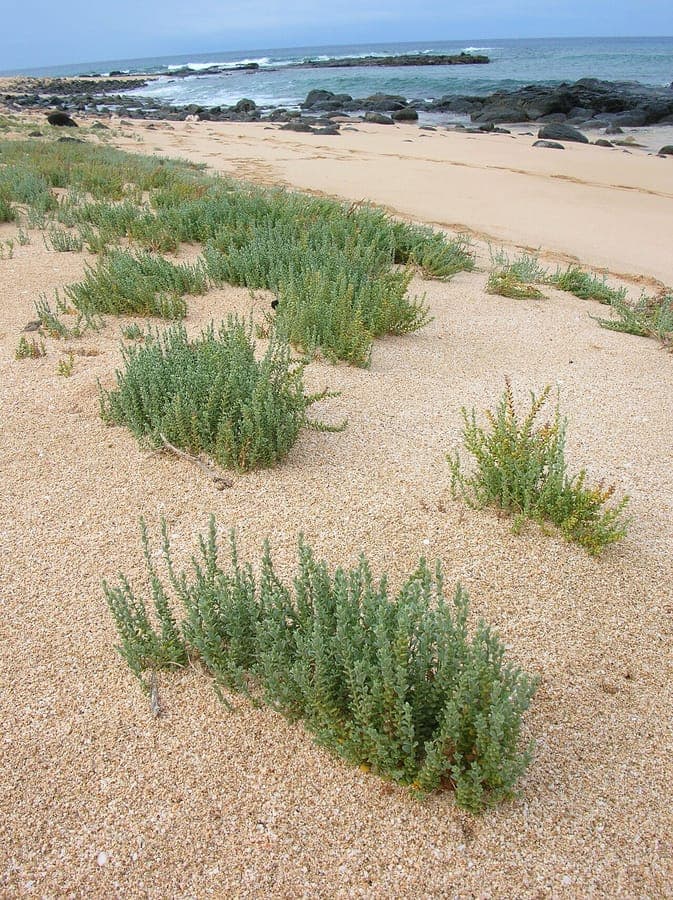
Forest & Kim Starr / CC BY 3.0, via Wikimedia Commons
Spreading alkaliweed: complete guide
Cressa truxillensis
Want to see Spreading alkaliweed: complete guide in your garden?
1 minute, no credit card
Overview
Cressa truxillensis, commonly known as spreading alkaliweed or spreading alkali-weed, is a remarkable salt-tolerant subshrub and herb belonging to the Convolvulaceae family - the same family as bindweeds and morning glories. Described by botanist Kunth in 1819 from material collected near Trujillo, Peru (hence the species epithet 'truxillensis'), this plant has one of the most extraordinary soil tolerances in the plant world. It thrives in alkaline conditions with soil pH values ranging from 6.8 all the way up to 9.2, a range that would kill the vast majority of cultivated plants. Visit gardenworld.app to discover more specialist salt-tolerant plants and design ideas for challenging soil conditions.
The native range spans a vast swath of the Americas: from the western and central United States (Arizona, California, Nevada, New Mexico, Oklahoma, Oregon, Texas, and Utah) through Mexico, Ecuador, and the Galapagos Islands, and deep into South America including Bolivia, Peru, Argentina, Paraguay, Uruguay, and Chile. Hawaii has an introduced population. This wide range across such varied climates speaks to the plant's remarkable adaptability.
Cressa truxillensis grows as a low, spreading subshrub with moderate growth rate. It colonises salt flats, dry river margins, alkaline meadows, and coastal areas with high salt concentrations - habitats where competition from other plants is minimal. Its botanical history is complex, with numerous synonyms including Cressa erecta, Cressa depressa, Cressa minima, and Cressa cretica var. truxillensis reflecting the taxonomic difficulties posed by this variable species.
Appearance and bloom cycle
Cressa truxillensis forms a low, spreading mat rarely exceeding 15-25 cm in height. The stems are densely branched and covered with small, leathery leaves that carry a fine silvery-grey pubescence. This silvery coating is an adaptation to intense sun and high temperatures: the hairs reduce water loss through evaporation and reflect excess solar radiation, helping the plant survive in harsh, exposed environments.
The flowers are small but conspicuous within the plant's modest scale - white and funnel-shaped, typical of the Convolvulaceae family. They appear in small clusters at the tips of the stems and are attractive to small bees and hoverflies. In the southwestern United States, blooming typically runs from July through November, though in warmer parts of its range the flowering season can be longer and less seasonally restricted. After flowering, small fruits develop and are dispersed by wind.
Overall, spreading alkaliweed offers a subtle beauty: its silvery-grey foliage provides year-round textural interest, while the white flowers add a gentle sparkle during the long blooming season. It is a plant for thoughtful, specialist plantings that value texture, resilience, and ecological appropriateness.
Ideal location
Cressa truxillensis demands full sun and excellent drainage. In the wild it occupies open, exposed positions on salt flats, dry river banks, alkali meadows, and rocky slopes where competition from taller plants is suppressed by the hostile soil conditions. It does not tolerate shade or wet conditions under any circumstances.
In garden settings, this plant is most at home in a rock garden, a dry Mediterranean-style border, or a specialist salt-tolerant planting. It works well as a low groundcover on poor, dry soils where little else will grow. In coastal gardens with naturally saline conditions it can perform extremely well, stabilising bare ground and providing persistent foliage cover throughout the year.
In northern European gardens, choose the warmest, most sheltered sunny position available. A south-facing slope or raised bed with fast-draining soil maximises the plant's chances. It should never be planted in low-lying areas where water collects, nor against walls where moisture may concentrate at the base.
Soil
The most remarkable characteristic of Cressa truxillensis is its tolerance of alkaline soils with pH values from 6.8 to 9.2. This is genuinely exceptional: most plants struggle at pH values above 7.5 and fail outright above 8.0. This species not only survives but actually grows best in conditions that most ornamental plants cannot tolerate.
In the garden, you do not need to add salt or alkaline amendments to grow this plant successfully. What you must provide is excellent drainage and relatively poor soil. Heavy clay that retains moisture is entirely unsuitable. The ideal growing medium is a free-draining mix of garden soil and coarse sand or fine gravel at a ratio of about 1:1. Avoid adding large amounts of compost or rich organic matter, which encourages excessive soft growth and can reduce the plant's natural resilience.
For container cultivation, use a cactus or succulent potting mix with added perlite. An alkaline pH of 7.0-7.5 in the pot is ideal. Ensure the pot has generous drainage holes and do not use saucers that allow water to collect beneath the container.
Free design
Want to see Spreading alkaliweed: complete guide in your garden? Make a free design now.
Watering
Cressa truxillensis is among the most drought-tolerant plants you can grow. In its native habitat it survives extended dry seasons in semi-desert and desert-fringe environments. Overwatering is by far the most common mistake made with this species in cultivation.
During the establishment period (the first growing season after planting), water occasionally to help the roots penetrate the soil. After that, a well-established plant growing in suitable soil requires virtually no supplementary irrigation in a typical northern European climate. Rainfall alone is usually sufficient. Only during prolonged extreme heat and drought lasting several weeks should supplementary watering be considered.
In winter, outdoor plants need no watering at all. The plant is dormant and uses minimal moisture. The critical point is that the soil must remain well-drained during cold, wet winters: waterlogged roots combined with frost will kill the plant quickly. Container plants overwintered indoors should be watered only occasionally, allowing the compost to dry out completely between waterings.
Pruning
Spreading alkaliweed requires minimal pruning. The plant's natural compact, spreading form is part of its charm and rarely needs corrective cutting. In early spring, you can remove any dead or winter-damaged stems by cutting them back close to healthy base growth using clean, sharp scissors or secateurs. This tidying encourages fresh new growth and improves the plant's appearance without altering its natural character.
Major pruning is seldom needed or desirable. If the plant spreads beyond its allotted space, the outer stems can be trimmed back by half in spring. Avoid pruning during the flowering period (summer through autumn) if you want to preserve the blooms. After flowering, spent flower stems can be snipped off to keep the plant looking neat. There is no need to cut the plant back hard in autumn: the stems provide some protection to the root crown during winter frost.
Maintenance calendar
January through February: dormancy, no watering needed outdoors, check that drainage remains good after winter rains.
March: plant begins to reawaken, inspect for winter damage, remove dead stems if present.
April through May: growth resumes, plant out new specimens after the frost-free period is reliably established, no fertiliser needed.
June through August: peak blooming begins, minimal watering only during extreme drought, observe for any signs of stress.
September through October: late-season flowering continues, fruits develop and disperse, plant activity gradually reduces.
November: plant enters dormancy, ensure soil drainage is adequate before winter wet sets in.
December: full dormancy, no care required beyond verifying the soil remains dry.
Winter hardiness
Cressa truxillensis is hardier than its desert origins might suggest. Its natural range extends to areas with cold winters in the higher elevations of the southwestern United States, and it has been recorded tolerating light frost conditions. Based on this distribution, the species is considered reliable in USDA hardiness zones 7-9, equivalent to minimum winter temperatures of approximately -18 to -7 degrees Celsius at the colder end.
In the UK, Ireland, and most of western continental Europe (broadly zones 8-9), the plant can overwinter outdoors on well-drained soil in sheltered positions. However, it is not fully reliable through wet, cold winters typical of maritime climates. The combination of cold and persistent moisture is more damaging than cold alone. On heavier or wetter soils, offer some frost protection: a covering of dry straw, horticultural fleece, or a layer of coarse gravel around the root crown. At gardenworld.app you can plan a dry garden layout and find drought-tolerant companion plants that match perfectly.
Companion plants
Cressa truxillensis pairs well with other drought-tolerant, sun-loving plants in a rock garden or dry border setting. Lavender (Lavandula angustifolia), thyme (Thymus vulgaris), sea holly (Eryngium maritimum), sea kale (Crambe maritima), and various Sedum and Sempervivum species share its preference for poor, well-drained soils and sunny exposures.
For a dedicated salt-tolerant planting, combine it with sea campion (Silene uniflora), sea purslane (Atriplex portulacoides), and shoreline plants that naturally colonise coastal habitats. Rock garden enthusiasts can pair it with Arabis, Aubrieta, and low-growing Phlox. Garden centres will generally carry compatible plants in their drought-tolerant and rock garden ranges.
Avoid planting near moisture-loving or heavy-feeding plants. The lean, dry conditions that Cressa truxillensis requires are inhospitable to most common garden plants, and mixing incompatible species leads to either the alkaliweed or its companions failing to thrive.
Closing
Spreading alkaliweed is a specialist plant for the adventurous gardener who seeks solutions for challenging, extreme conditions. Its extraordinary tolerance of alkaline and saline soils sets it apart from virtually all cultivated ornamentals. Once established in the right position, it demands almost no maintenance and rewards the patient grower with persistent silvery foliage and delicate white flowers through a long summer and autumn season. For rock gardens, dry borders, coastal plantings, and any situation where conventional plants refuse to grow, Cressa truxillensis offers a genuinely reliable and botanically fascinating choice.
Want to see Spreading alkaliweed: complete guide in your garden? Make a free design now.
Upload a photo, pick a style, and get a photorealistic design with plant list in under a minute.
10,000+ gardens designed already
No credit card required


Similar plants
Betony-leaved bindweed: complete guide
Convolvulus betonicifolius
Full guide to betony-leaved bindweed (Convolvulus betonicifolius): origin, appearance, ideal site, soil, watering and garden uses.
Ivyleaf morning glory: complete guide
Ipomoea hederacea
Everything about Ipomoea hederacea: location, soil and climbing care. A fast-growing annual vine with blue funnel flowers for sunny walls and pergolas.
Giant potato vine: complete guide
Ipomoea mauritiana
Everything about Ipomoea mauritiana, the giant potato vine: a tropical climber with pink trumpet flowers, cultivation, location tips and overwintering.