
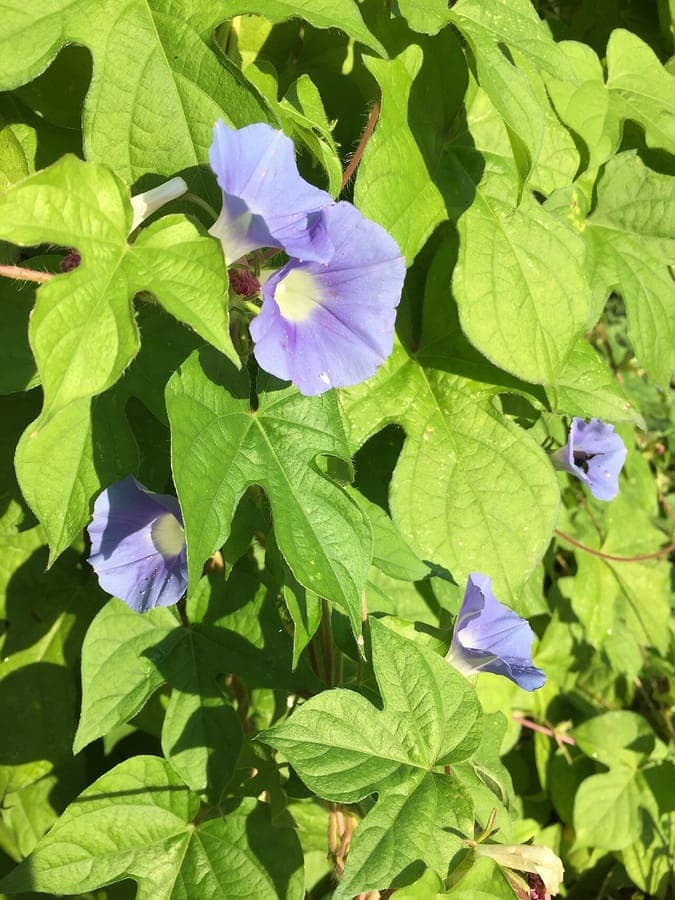
Famartin / CC BY-SA 4.0, via Wikimedia Commons
Ivyleaf morning glory: complete guide
Ipomoea hederacea
Want to see Ivyleaf morning glory: complete guide in your garden?
1 minute, no credit card
Overview
Ipomoea hederacea, commonly known as ivyleaf morning glory or ivy-leaved morning glory, is a fast-growing annual vine in the family Convolvulaceae. Native to Mexico, the species has spread widely across the world, becoming naturalised across much of the eastern United States, parts of Europe, India, Pakistan, and Australia. It is one of the most widespread members of the enormous Ipomoea genus, which includes the familiar sweet potato (Ipomoea batatas) and the well-known ornamental morning glories of the horticultural trade.
The species name hederacea refers directly to the shape of the leaves: they resemble the ivy (Hedera) leaf in being deeply three-lobed with a prominent central lobe and two smaller lateral lobes. This distinctive leaf shape is one of the easiest ways to distinguish this species from closely related morning glories like Ipomoea tricolor and Ipomoea purpurea, both of which have more heart-shaped, less deeply lobed leaves.
In the garden, ivyleaf morning glory is valued primarily as a decorative climber for warm, sunny positions. Given adequate support, the plant can reach 2 to 3 metres in height within a single summer, covering fences, trellises, pergolas, and walls in a lush curtain of green, punctuated throughout the day by the fresh funnel flowers that open each morning. Its blue to purple blooms, long flowering period, and ease of cultivation from seed make it a popular choice for the summer garden.
Discover how climbing plants like ivyleaf morning glory fit into a complete garden design at gardenworld.app, including advice on trellis systems and companion plantings for the best seasonal impact.
Appearance & bloom cycle
The leaves of Ipomoea hederacea are heart-shaped to deeply three-lobed, with a soft, velvet-like hairy texture on the undersides and along the stems. The colour is a fresh, bright green, and the size varies from 3 to 10 cm wide depending on growing conditions and nutrient availability. The long, flexible leaf stalks help the plant to twine and climb effectively.
The flowers are the plant's outstanding feature. They are funnel-shaped, 3 to 5 cm in diameter, and range in colour from blue-violet to purple-blue, with a clean white interior to the flower tube that accentuates the colour contrast. Soil pH and growing conditions can influence the exact hue. Each flower lasts only a single day - opening in the morning and closing by midday - which is the origin of the common name 'morning glory'. However, because multiple new flowers open each day throughout the season, the plant appears to be in near-continuous bloom from June to October.
Bees, bumblebees, and butterflies visit the flowers regularly. After flowering, the plant produces small, round seed pods containing three to four round seeds each. These seeds are the primary means of propagation and can be collected in September and October for sowing the following year.
The plant is a tender annual and does not survive frost. In frost-free climates (USDA zones 10 and above) it can persist as a short-lived perennial, but in western Europe it is treated strictly as an annual, raised from seed each spring.
Ideal location
Ipomoea hederacea requires a warm, sunny location receiving at least six hours of direct sunlight per day. As a plant originating from the warm regions of Mexico, it needs a long, warm summer to reach its full flowering potential. A south-facing or west-facing wall, a sunny pergola, or a sheltered fence or trellis are ideal positions.
Shelter from strong winds is important. The thin climbing stems can be damaged by persistent wind, which also slows the plant's progress up a trellis. A position near a warm wall, fence, or larger shrubs provides wind protection and captures reflected heat, both of which stimulate vigorous growth.
In regions with cool or rainy summers, such as coastal areas of the North Sea, flowering may begin later and be less profuse than in warmer, more continental climates. Starting seeds indoors in March (six to eight weeks before the last frost) helps extend the growing season and ensures flowering well before the autumn frosts arrive.
Avoid positions in shade or partial shade. While the plant will produce foliage in low light, flowering is sharply reduced, and the plant becomes weak and leggy.
Soil requirements
Ipomoea hederacea is not demanding about soil, but performs best in light, well-drained ground. It tolerates a slightly acidic to neutral pH of around 6 to 7 and prefers moderate fertility. Overly rich soil - heavily amended with fresh manure or concentrated fertilisers - stimulates excessive leaf growth at the expense of flowers. Morning glory species in general flower more freely when not over-fed: moderate soil fertility keeps the plant compact and productive.
Good drainage is essential. Standing water in the root zone causes rapid root problems, particularly in combination with cool, wet spring weather. On clay soil, incorporate sharp sand or perlite before planting. A top-dressing of garden compost 3 to 5 cm deep at planting time is sufficient nutrition for the entire growing season.
For container growing on a terrace or balcony: use a quality potting mix with added perlite or vermiculite in roughly a 3:1 ratio to improve drainage. Containers dry out quickly in warm weather, making regular monitoring and watering essential. Choose a container of at least 25 to 30 cm in diameter to allow sufficient root development.
Specialist climber and annual compost mixes, available from most garden centres, are well suited to Ipomoea hederacea and provide a convenient ready-to-use option.
Free design
Want to see Ivyleaf morning glory: complete guide in your garden? Make a free design now.
Watering
The water requirements of Ipomoea hederacea are moderate. Once established in open ground, the plant needs little supplemental watering, provided the soil does not dry out completely. Water once a week during dry spells, adjusting frequency based on rainfall and temperature. During heat waves with temperatures above 30 degrees Celsius, daily watering may be needed.
It is better to water deeply and less frequently than to give small amounts often. A deep watering of 3 to 5 litres per plant encourages roots to grow deeper into the soil, which increases drought tolerance over time.
In containers, the situation is different: pots dry out quickly in warm weather, and daily moisture checks are necessary. Never allow the compost to dry out completely, but ensure the container has adequate drainage holes, as morning glories do not tolerate waterlogged roots. During extreme heat, containers may need watering twice a day.
Avoid wetting the leaves in direct sunlight: water droplets on leaves can cause scorch marks. Always water at the base of the plant, ideally in the evening or late afternoon.
Pruning
As an annual, Ipomoea hederacea benefits little from intensive pruning. The main pruning task is trimming back shoots that extend beyond the intended climbing area. Cut back long runners during the summer to focus the plant's energy on flowering rather than vegetative extension.
Dead-heading (removing spent flowers) is not strictly necessary since the plant is self-tidying: spent flowers fall off quickly and are replaced by new ones. However, remove seed pods if you want to limit self-seeding - in warm summers, dropped seeds can germinate spontaneously in the following season and appear as volunteers in unexpected places.
In autumn, after the first frost kills the plant, remove the dead stems from the trellis or support before winter. Collect a few ripe seed pods first for sowing the following spring. Compost the dead plant material.
Maintenance calendar
January to February: Store saved seeds in a cool, dry place in a paper envelope. No garden action required.
March: Start seeds indoors on a warm, bright windowsill or heated propagator at a minimum of 20 degrees Celsius. Soak seeds in lukewarm water for 24 hours before sowing to soften the seed coat and speed germination. Sow in small individual pots or root trainers.
April to early May: Germination typically occurs within 5 to 10 days. Ensure ample light to prevent spindly seedlings. Begin hardening off in the second half of May by placing plants outside during the day and bringing them in at night.
Late May to June: Plant out after the last frost date (in the Benelux this is typically mid-May). Erect trellis, netting, or string supports for the plant. First flowers may appear as early as June.
July to August: Peak flowering. Water regularly during dry spells. Check the trellis for any damage caused by the weight of growing stems.
September to October: Flowering continues until the first autumn frost. Seed pods ripen - collect dry pods before frost kills the plant.
November to December: Plant dies after frost. Remove dead stems from the trellis, tidy the support structure, and prepare the soil for next season.
Winter hardiness
Ipomoea hederacea is a tender annual with no winter hardiness in northern or western European conditions. As a plant of tropical Mexican origin, it only thrives at temperatures above 10 degrees Celsius and is killed by the first frost. It has no hardiness in USDA zones 8 and below.
In USDA zone 10 and warmer (parts of coastal California, Florida, and the Mediterranean), the plant can behave as a short-lived perennial, but it is not reliably so. For all practical purposes in Belgium, the Netherlands, Germany, and the UK, it must be treated as an annual, raised from seed each year.
Seeds are the most practical way to carry the plant through winter: collect ripe pods in September or October, dry them thoroughly, and store in a paper envelope in a cool, dry location. Seeds typically retain good germination rates for three to five years when properly stored.
Alternatively, stem cuttings taken in early autumn can be rooted and overwintered indoors as houseplants in a frost-free, bright room. This approach requires more effort but preserves a particular colour form or plant you want to keep. Explore design possibilities for annual climbers on walls and fences at gardenworld.app.
Companion plants
Ipomoea hederacea pairs attractively with other summer-flowering climbers and sun-border plants:
-
Cobaea scandens (cup and saucer vine): another fast-growing annual climber with showy purple bell flowers from August to October. The two species climb well side by side along a pergola or fence, extending the colour season.
-
Thunbergia alata (black-eyed Susan vine): a charming annual climber with orange flowers and dark centres, blooming from June to October. Its warm, orange tone provides a striking complement to the blue-purple of morning glory.
-
Tropaeolum majus (nasturtium): a cheerful, fast-growing annual that also climbs or trails, with orange and yellow flowers. Planted at the base of a trellis, it creates a warm colour story alongside the blue morning glory above.
-
Lathyrus odoratus (sweet pea): a classic climbing plant for the cooler end of the border or semi-shaded trellis, with fragrant flowers in many colours from June to August. Complements the morning glory in seasons where it grows in parallel.
-
Zinnia elegans (zinnia): a floriferous, upright border plant that does not climb but decorates the base of the trellis with its bold, round flowers from July to October, providing a colourful ground-level foreground.
Combine ivyleaf morning glory with established perennial climbers like Clematis, which flower earlier in the year. The morning glory fills in through midsummer and autumn when the Clematis is in its second-flush or fully past bloom.
Conclusion
Ipomoea hederacea is a rewarding, fast-growing annual climber that transforms any sunny wall, pergola, or fence into a vibrant flowering screen through the summer months. Its distinctive ivy-shaped leaves, the charming blue to purple trumpet flowers that open each morning, and its near-continuous blooming from June to October make it one of the more satisfying annuals to grow. Easy to raise from seed and requiring minimal maintenance once established in the right position, it is a dependable addition to the summer garden.
Ready to explore how climbing plants like Ipomoea hederacea can shape and enrich your garden design? Find inspiration and expert guidance at gardenworld.app.
Want to see Ivyleaf morning glory: complete guide in your garden? Make a free design now.
Upload a photo, pick a style, and get a photorealistic design with plant list in under a minute.
10,000+ gardens designed already
No credit card required


Similar plants
Spreading alkaliweed: complete guide
Cressa truxillensis
Full growing guide for Cressa truxillensis, the salt-tolerant groundcover of alkaline flats: location, soil, watering, pruning and winter care.
Betony-leaved bindweed: complete guide
Convolvulus betonicifolius
Full guide to betony-leaved bindweed (Convolvulus betonicifolius): origin, appearance, ideal site, soil, watering and garden uses.
Giant potato vine: complete guide
Ipomoea mauritiana
Everything about Ipomoea mauritiana, the giant potato vine: a tropical climber with pink trumpet flowers, cultivation, location tips and overwintering.