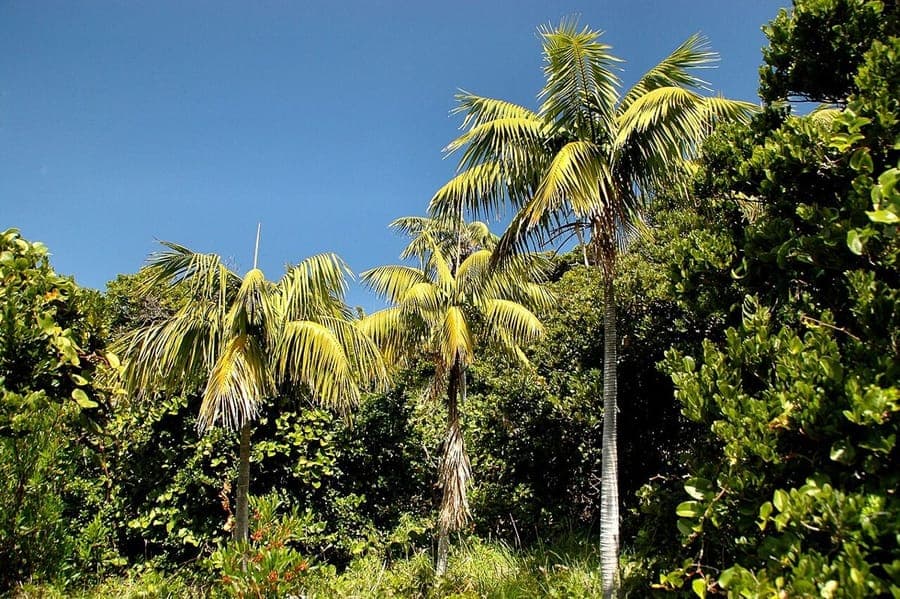
Black Diamond Images / CC BY 2.0, via Wikimedia Commons
Kentia palm: complete guide
Howea forsteriana
Want to see Kentia palm: complete guide in your garden?
Full design in HD: €7.99
Look after your Kentia palm with the GardenWorld app
Identify plants with your camera and get a care calendar with reminders for this plant.


Overview
The kentia palm (Howea forsteriana) has been the king of indoor palms for well over a century. In Victorian times it graced the parlours of grand houses and the lobbies of fashionable hotels, and today it is still one of the most sought-after palms in garden centres. That is no accident: few palms cope as well with the lower light, dry air and fluctuating temperatures of a living room. The kentia belongs to the palm family (Arecaceae) and grows naturally only on Lord Howe Island, a small subtropical island off the east coast of Australia.
On its home island the palm becomes a slender tree 10 to 15 metres tall, with a grey, ringed trunk and a crown of gracefully arching leaves. Indoors it stays much smaller and grows very slowly, often producing only one to three new fronds a year. A two-metre kentia in a large pot is therefore usually many years old, which explains the price tag. Growers generally put several young plants together in one pot, so you get a full, lush specimen straight away.
For anyone who loves a calm, green interior, the kentia is an ideal focal point. It looks just as good in a traditional room as next to clean modern design, and it is not toxic to cats or dogs.
Appearance and growth
Howea forsteriana has large, feather-shaped fronds that can reach 1.5 to 2.5 metres long indoors. Each frond carries dozens of narrow, dark green leaflets that droop elegantly. The leaf stalks are long, smooth and spineless, which gives the plant an airy, open look. New fronds appear as an upright spear in the heart of the plant and unfurl over a few weeks.
Indoors a kentia usually reaches 2 to 3 metres, but that takes many years. You will almost never see flowers or fruit on a houseplant; those only appear on mature trees growing in the ground. On Lord Howe Island the seeds are still harvested for growers around the world, and virtually every kentia on sale has been raised from them.
The great strength of this palm is its tolerance. It copes with less light, a cooler room and the odd forgotten watering far better than most other palms, which makes it a good choice for offices, hallways and corners where other houseplants struggle.
Ideal indoor position
Give the kentia a bright spot out of direct midday sun. A metre or two from an east- or west-facing window is ideal, as is a well-lit room with a north-facing window. Strong sun through glass scorches the fronds and causes yellow or brown patches. It will tolerate a darker corner, but it then grows even more slowly and the fronds become longer and floppier.
Do not place it right next to a radiator, in the warm draught of a convector heater or in the cold draught of a frequently opened door. Turn the pot a quarter turn every few weeks so the palm grows evenly instead of leaning towards the light.
From June to September a kentia can also go outside on a sheltered, shady patio or balcony, provided nights stay above 12 °C. On gardenworld.app you can have a garden design made for your patio, with a shady summer spot for your indoor palms built in from the start. Let the plant acclimatise in deep shade for a week first, or the leaves will scorch.
Compost and repotting
Kentias like an open, well-drained mix that holds moisture without staying wet. A specialist palm compost works well, or mix ordinary houseplant compost with a third perlite or fine bark. A pot with a good drainage hole is essential; you can add a layer of clay pebbles at the bottom.
Only repot when the roots really fill the pot, usually every two or three years, and always in spring. Choose a pot just a few centimetres wider and, above all, deep, because palms produce long, straight roots. Handle the rootball gently: kentia roots are brittle and resent disturbance. Avoid splitting a pot with several plants; their roots are usually completely entwined. For large specimens in heavy containers, replace the top few centimetres of compost each spring instead of repotting.
Free preview
Want to see Kentia palm: complete guide in your garden? Make a free preview of your design.
Watering and humidity
Overwatering is the main cause of death for indoor kentias. Water only when the top 2 to 3 cm of compost feels dry. In summer that usually means once a week, in winter once every two to three weeks. Water thoroughly until it runs out of the bottom, then empty the saucer after fifteen minutes. Wet feet quickly lead to root rot.
Use rainwater if possible, or tap water at room temperature that has stood overnight. Kentias are sensitive to salts and lime, which build up in the compost and cause brown leaf tips. Flush the pot through with soft water twice a year.
Humidity of 40 to 60 % is ideal. In winter, when central heating dries the air, mist the fronds now and then with tepid water or stand the pot on a tray of damp pebbles. Dry air makes the palm more prone to spider mite. From April to September feed every four weeks with a palm fertiliser at half strength; give nothing in winter.
Leaf care and pruning
A kentia needs hardly any pruning. Only remove old fronds that have turned completely brown or yellow, cutting them close to the stem without damaging it. Never cut off healthy green fronds, which the plant needs for growth, and never touch the heart of the plant. A palm has a single growing point per stem; damage it and that stem dies.
You can trim brown leaf tips with sharp scissors, but leave a thin brown edge, otherwise the leaf dries back further. Wipe the fronds with a damp cloth every few weeks: this removes dust, lets in more light and helps you spot pests early. Watch out for spider mite (fine webbing, speckled leaves), mealybug (white fluff in the leaf axils) and scale insects (brown bumps on the stalks).
Maintenance calendar
March-April: Start of the growing season. Repot if needed, or top-dress with fresh compost. Begin feeding.
May-June: More water needed. Check for spider mite. From June the plant can move to a shady patio.
July-August: Main growth period. Water and feed regularly, letting the top of the compost dry slightly between waterings.
September: Bring the plant back indoors before nights drop below 12 °C. Last feed of the year.
October-February: Less water, no feed. Keep it away from radiators and mist the fronds occasionally. The plant calendar on gardenworld.app lists the care jobs for your houseplants month by month.
Temperature and overwintering
The kentia is happiest at 18 to 24 °C. In winter it can be cooler, around 12 to 16 °C, which gives it a welcome rest. Below 10 °C growth stops and the risk of damage rises. It is therefore not hardy in Britain or northern Europe and belongs indoors from October to May.
In mild coastal climates such as the Mediterranean, Howea forsteriana can stay outside all year and tolerates brief light frost down to about -2 °C. In cooler regions that is not an option. In winter, also keep the plant away from cold windows where the fronds touch the glass.
Companion plants
A kentia looks its best alongside other plants that enjoy the same calm conditions. Group it with the shade-tolerant cast iron plant (Aspidistra elatior), the glossy ZZ plant (Zamioculcas zamiifolia) or a peace lily (Spathiphyllum wallisii), whose white spathes add a touch of light. Together they make a sturdy, low-maintenance green corner.
Other palms fit in too. The small parlour palm (Chamaedorea elegans) can sit at its feet as a low companion, and the lady palm (Rhapis excelsa) adds a different rhythm with its fan-shaped leaves. Avoid pairing it with cacti and succulents that need full sun.
Final thoughts
The kentia palm (Howea forsteriana) is a houseplant for the long haul. It grows slowly but rewards you with years of elegance and asks very little in return: a bright spot out of harsh sun, sparing watering, gentle feeding in summer and an occasional wipe with a cloth.
Follow those simple rules and you will have a plant that can last for decades and becomes more beautiful with every new frond. Give it room to spread its leaves, and your home gains a little piece of Lord Howe Island.

See it in your garden
See Kentia palm in your garden
One photo of your garden and a few questions. You see the result in about a minute.
Try it with a photoIdentify this plant in your own garden. Identify a plant
Similar plants
Aspidistra elatior: complete guide
Aspidistra elatior
Discover the hardy cast-iron plant (Aspidistra elatior), a tough houseplant from Japan. Perfect growing conditions, care tips, and hardy characteristics.
Parlor Palm: complete guide
Chamaedorea elegans
Discover the Parlor Palm (Chamaedorea elegans), an elegant, compact palm perfect for indoors and outdoors. This beginner-friendly plant grows slowly to 1.5 meters and thrives in partial shade.
Rhapis excelsa: complete guide
Rhapis excelsa (Thunb.) A.Henry
Discover the elegant lady palm, ideal for indoor and patio gardens. Fine, feathery fronds and graceful growth make this palm exceptionally popular.
