Abu Shawka / CC0, via Wikimedia Commons
Haworthia cooperi: care for the window-leaf succulent
Haworthia cooperi
Want to see Haworthia cooperi: care for the window-leaf succulent in your garden?
Full design in HD: €7.99
Look after your Haworthia cooperi with the GardenWorld app
Identify plants with your camera and get a care calendar with reminders for this plant.


Overview
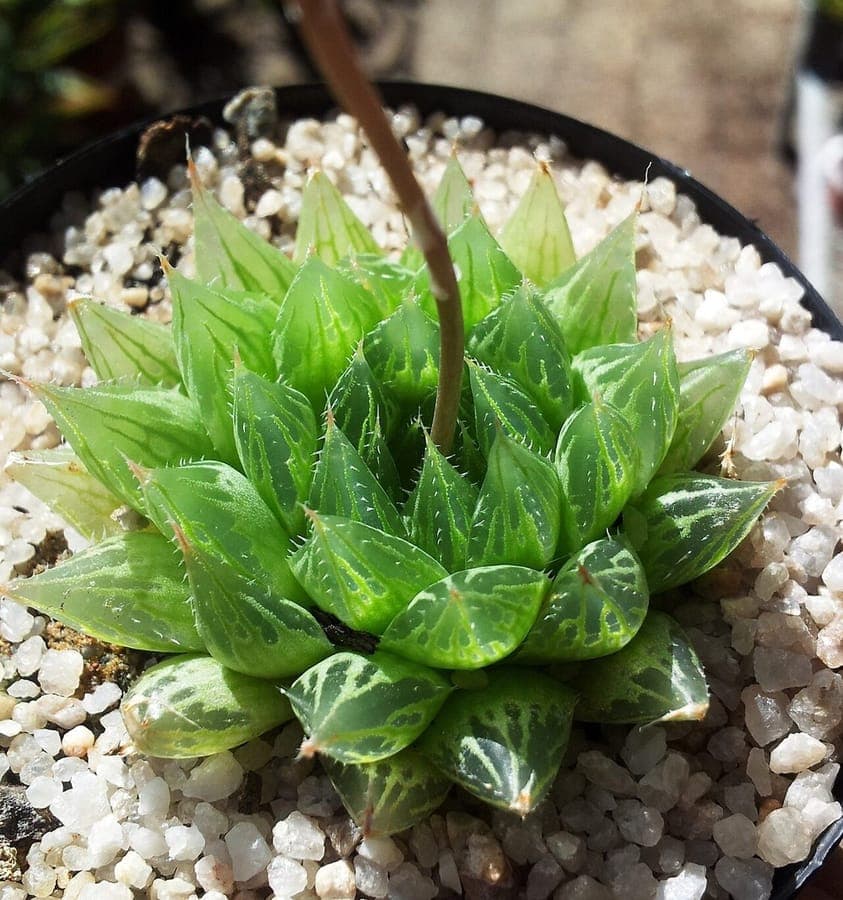
Haworthia cooperi is a small succulent from the Eastern Cape of South Africa, grown above all for its glassy leaves. The upper part of each leaf is translucent, crossed by fine green lines, and succulent growers call these clear tips "windows". Hold the pot up to a bright window and the whole rosette seems to glow from within. It is often sold simply as haworthia, and you will sometimes see it labelled Cooper's haworthia after the man it commemorates, Thomas Cooper, a nineteenth-century English plant collector who worked in the Cape.
The plant belongs to the family Asphodelaceae, alongside aloes and gasterias. It is a variable species with many named forms: var. pilifera has long bristles at the leaf tips, var. truncata has blunt, cut-off leaves, and most plants sold as Haworthia obtusa are now treated as part of this species too. Whatever the label, the care is the same. If you move your pots outdoors in summer, you can use gardenworld.app to have a garden design drawn up for your patio, with a bright but sheltered corner set aside for a table of succulents.
Appearance and flowering
A mature rosette is 5 to 8 cm across and stays low, rarely more than 5 cm tall. The leaves are fat, juicy and pale green, ending in a short, soft point. Fine white bristles run along the margins and the keel. The photo shows them clearly: the plant sits in a black pot dressed with white grit, sunlight catches the clear tips with their network of green veins, and a slender flower stem rises from the centre.
After a few years the plant produces offsets at its base, building into a tight clump of small rosettes that will fill a 12 cm pot. Too much light turns the leaves reddish brown; too little makes the rosettes stretch and the windows lose their sparkle.
Flowering is modest. In late spring and summer a wiry stem 20 to 30 cm long appears, carrying loose, small white flowers with greenish or brownish stripes. They repay a close look rather than impressing from across the room. Cut the stem off at its base once it has finished so the rosette keeps its energy.
Position and light
In the wild, Haworthia cooperi grows half hidden among grasses and low shrubs, sometimes pulled into the soil up to its leaf tips. Only the windows show above the ground, letting light into the leaf. This explains why the plant dislikes harsh, direct sun through glass yet needs plenty of bright, diffused light.
An east-facing window is ideal. A west-facing one works if the pot stands a little back from the glass. On a south-facing sill it needs a net curtain or the shade of a taller plant, otherwise the windows scorch into brown, sunken patches. A north window is usually too dim unless the plant sits right against a large pane. Under a grow light it does very well, with the lamp 20 to 30 cm above the rosettes.
Fresh air matters more than humidity. Damp, stagnant air encourages rot, while dry central heating does no harm. From late May to mid-September it can go outside in a bright spot without midday sun, under cover so that long wet spells do not drown it.
Watering and rest
Nearly every problem with Haworthia cooperi comes from too much water. The plant grows mainly in spring and autumn and slows down in the heat of high summer. During that summer lull, water only when the compost is completely dry, and be sparing.
In the growing seasons, water thoroughly until it runs from the drainage hole, then let the pot dry out completely. Depending on temperature, that means roughly once a week to once a fortnight. Empty the saucer every time. Pour around the edge rather than into the heart of the rosette, as water sitting between the leaves can start rot.
From November to February the plant rests. Keep it somewhere cool and bright at 10 to 15 °C and give a small drink about once a month, just enough to keep the leaves firm. Wrinkled, sunken windows mean thirst. Glassy, soft, darkening leaves mean rot from overwatering.
Feeding is barely needed. A single half-strength dose of cactus fertiliser in April and another in September is plenty.
Free preview
Want to see Haworthia cooperi: care for the window-leaf succulent in your garden? Make a free preview of your design.
Compost and repotting
Use an open, mineral mix: half cactus compost and half coarse grit such as pumice, lava rock or fine gravel of 2 to 6 mm. A top dressing of white grit, as in the photo, keeps the neck of the plant dry and shows off the windows. You can even set the rosettes slightly deeper than usual, with the leaf bases in the grit, much as they grow in nature.
A shallow, wide pot with a generous drainage hole suits it best. Terracotta dries faster than plastic and is the safer choice if you tend to water too often. Repot every two to three years in March or September. Trim away old, shrivelled roots and leave the plant dry for a week afterwards so damaged roots can callus. Haworthias renew their roots every year, so some grey, hollow roots are perfectly normal.
Propagation by offsets and cuttings
The easiest method is division. When repotting, gently pull away offsets that have their own roots and pot them up separately in the same mix. Offsets without roots should dry for two days before being set on barely moist grit, where they root within a few weeks.
Leaf cuttings also work, but slowly. Twist a mature leaf sideways so it comes away cleanly from the stem, let it dry for a few days and lay it on dry compost. Only water once small roots appear. Seed is possible, but haworthias cross readily, so seed from a windowsill plant rarely gives true Haworthia cooperi.
Maintenance calendar
March and April: Growth picks up. Water more regularly, repot where needed and give a half dose of cactus feed in April.
May: If the plant is going outside, harden it off gradually. Start in shade and move it into brighter light after two weeks.
June to August: Flowering and slower growth in hot spells. Water sparingly and protect from midday sun. Cut off spent flower stems.
September and October: Second growing season and a good time to divide and repot. Bring the plant indoors before nights drop below 8 °C.
November to February: Rest in a cool, bright place. Little water, no feed, and an occasional check for mealybugs between the leaf bases.
Temperature and hardiness
Haworthia cooperi is not frost hardy. It tolerates a short, dry spell a few degrees above zero, but frost freezes the watery leaves and they collapse. Keep it above 5 °C in winter, ideally around 10 °C. A cold greenhouse kept above freezing, an unheated bedroom or a stairwell with a good window all make suitable winter quarters.
Summer temperatures up to 30 °C are fine, as long as the plant is not baking on a sunny sill behind glass, where leaf temperatures climb far higher than the room itself.
Toxicity to pets
Good news for cat and dog owners: the ASPCA, the American animal welfare organisation, lists haworthias as non-toxic to cats and dogs. That listing covers the genus as a whole, and Haworthia cooperi is part of it. A cat that chews a leaf may get a mildly upset stomach, as with any plant material, but serious poisoning is not expected.
The real risk is mix-ups. Anyone with a collection of succulents may also have an aloe or a euphorbia on the same sill, and those can cause harm. Keep a label in every pot so you know at once what your pet has been nibbling. The plant is not considered poisonous to people either.
Companion plants
Haworthia cooperi suits a shallow bowl of succulents that share its light and watering needs. Pair it with small crassulas such as Crassula rupestris, with Echeveria elegans for blue-grey contrast, or with Kalanchoe tomentosa for soft, felted leaves. Put the sun-lovers on the brightest side of the bowl and the haworthia on the shadier side.
Avoid planting it with anything that wants regular moisture, such as ferns or calatheas. Their needs pull in the opposite direction, and the haworthia will always be the one that suffers.
Final thoughts
Haworthia cooperi is small, understated and quietly remarkable: a plant you only truly see when light shines through its leaves. Give it bright light without harsh sun, a gritty compost, measured watering in spring and autumn and a cool, dry winter, and it will slowly form a glittering clump that lasts for years. To know the best months for repotting, dividing and preparing for winter, the plant calendar on gardenworld.app sets out the jobs month by month for all your house and patio plants.
Frequently asked questions about Haworthia cooperi
Is Haworthia cooperi winter hardy?
Haworthia cooperi is not frost hardy. It tolerates a short, dry spell a few degrees above zero, but frost freezes the watery leaves and they collapse.
How much water does Haworthia cooperi need?
Nearly every problem with Haworthia cooperi comes from too much water. The plant grows mainly in spring and autumn and slows down in the heat of high summer.

See it in your garden
See Haworthia cooperi in your garden
One photo of your garden and a few questions. You see the result in about a minute.
Try it with a photoIdentify this plant in your own garden. Identify a plant
Similar plants
Crassula rupestris: complete guide
Crassula rupestris
Rosary plant: South African succulent with rope-like stems. Perfect for dry locations. Water-minimal growing guide and heat tolerance info.
Echeveria elegans: complete guide
Echeveria elegans
Echeveria elegans, known as Pearl Echeveria, is a beautiful rosette-forming succulent. Learn complete care guide, watering, soil and ideal locations.
Kalanchoe tomentosa: complete guide
Kalanchoe tomentosa Baker
Panda plant (Kalanchoe tomentosa) is a fuzzy-leaved succulent from Madagascar with woolly foliage and purple flowers. Perfect for living rooms, windowsills, and dry zones.
