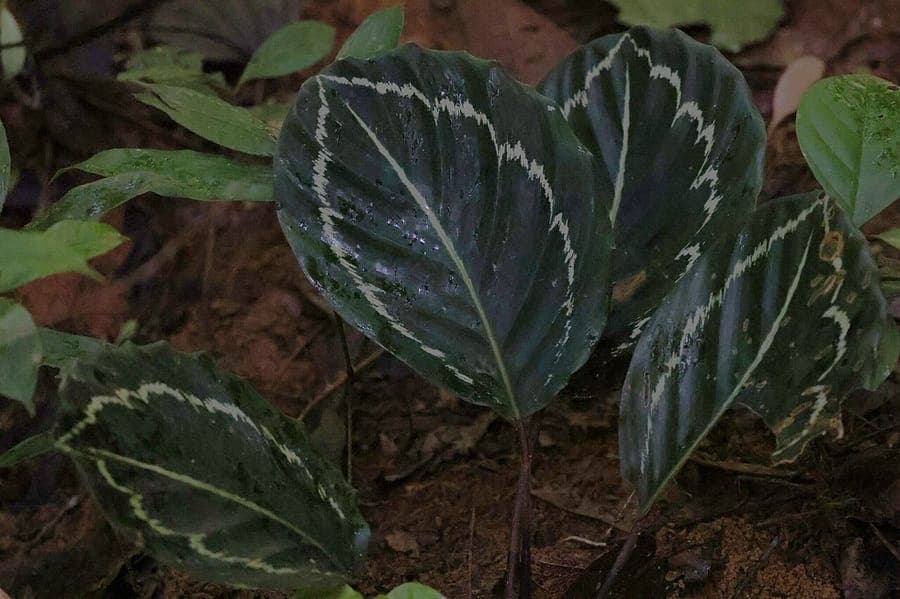
Kathy Richardson / CC BY 4.0, via Wikimedia Commons
Rose-painted calathea (Goeppertia roseopicta): care guide
Goeppertia roseopicta
Want to see Rose-painted calathea (Goeppertia roseopicta): care guide in your garden?
Full design in HD: €7.99
Look after your Rose-painted calathea with the GardenWorld app
Identify plants with your camera and get a care calendar with reminders for this plant.


Overview
Goeppertia roseopicta is the calathea whose leaves look hand-painted. Across a rounded, deep green blade runs a pale, feathered band along the midrib, with a second band forming a ring just inside the leaf edge. On young leaves and in many cultivars that pattern is pink, which explains the name: roseopicta means "painted with rose". It is often called the rose-painted calathea, and in shops it is still nearly always labelled Calathea roseopicta, the name it carried until DNA work in 2012 moved most calatheas into the genus Goeppertia.
It belongs to the arrowroot family (Marantaceae) and grows wild in the understorey of the Amazon rainforest in north-western Brazil. There it lives in deep shade, rooted in decaying leaves, in air that rarely drops below 70% humidity. The photo shows exactly that: a few young leaves of a wild plant pushing up through leaf litter on the forest floor, with the creamy feathering along midrib and margin clearly visible.
What sets it apart from other calatheas is mainly shape and colour. Goeppertia ornata has long, narrow leaves with fine pinstripes, and the orbifolia has broad silver-green bands. Roseopicta carries compact, almost round leaves with a pattern that looks rather like a medallion. If you want your indoor plants and outdoor space to feel connected, you can have a garden design made at gardenworld.app that includes the conservatory or patio.
Appearance and cultivars
Indoors the leaves reach 15 to 25 cm long and are broadly oval to round. The upper surface has a soft sheen; the underside is wine-red to purple. The plant stays compact, usually 30 to 50 cm tall and roughly as wide. New leaves emerge from the centre as a tight scroll, showing their purple underside first, and unfurl fully over a few days.
Most plants on sale are cultivars, often more boldly marked than the wild form:
- 'Dottie': almost black leaves with a vivid pink ring and midrib.
- 'Medallion': a large silver-green centre with a dark green edge.
- 'Rosy': a mostly pink centre with only a narrow green margin.
In all of them the pink fades to a silvery cream as the leaf ages. That is normal and not a sign of trouble. Like every calathea, the leaves fold upwards slightly in the evening and drop open again in the morning. Flowers are rare indoors: small white to pale purple blooms on a short spike close to the compost.
Position in the home
Roseopicta likes a fixed, settled spot. It reacts badly to being moved, to draughts and to big swings in temperature. Choose a room that stays at a fairly even warmth all year, away from radiators, air conditioning and outside doors. A living room or bright bathroom works well; a cold bedroom or draughty hallway does not.
Because the leaves sit low and wide, the pattern shows best on a low table or plant stand where you look down on it slightly.
Light
In the wild this plant gets dappled light through a dense canopy. Indoors that means bright light but no direct sun. One to two metres from an east or north window is ideal, or behind a sheer curtain at a west window. Direct sun bleaches the leaves and leaves dry, brown scorch marks.
In too little light it loses its colour. The pink markings of 'Dottie' and 'Rosy' in particular turn dull, and new leaves come up smaller. Give the pot a quarter turn every few weeks so the plant does not lean towards the window.
Humidity
This is the real challenge. Roseopicta prefers 60% humidity or more, while a heated home in winter often drops below 40%. Dry air shows as brown, crispy leaf edges and leaves that stay curled during the day.
A small humidifier nearby is the most reliable fix. A wide tray of water and pebbles under the pot, or a cluster of plants grouped together, also helps. Misting only works for a few minutes and, with hard water, leaves white marks on the dark leaves, so we would not rely on it.
Free preview
Want to see Rose-painted calathea (Goeppertia roseopicta): care guide in your garden? Make a free preview of your design.
Compost and repotting
Use an airy, humus-rich, slightly acidic mix: about three parts houseplant compost to one part perlite and one part fine bark or coir. It should hold moisture without staying wet. A pot with a drainage hole is essential.
Repot every two years in spring into a pot only 2 to 4 cm wider. That is also the time to divide a large plant: gently tease the clump apart along the natural splits in the rhizome, making sure each piece has a few leaves and roots. Keep the divisions extra warm and humid for a few weeks afterwards.
Watering
Keep the compost evenly and lightly moist, never sodden and never bone dry. Water when the top two centimetres feel dry. In summer that is often twice a week; in winter once a week or less.
Calatheas are sensitive to the salts, fluoride and lime in tap water, which over time show up as brown leaf tips. Rainwater, filtered water or tap water left to stand overnight, at room temperature, is best. Cold water on the roots gives the plant a shock. Limp, drooping leaves mean thirst; yellow leaves with wet compost mean the opposite.
Care and pruning
From April to September, give a half-strength liquid houseplant feed every four weeks. Too much fertiliser burns the roots and also causes brown edges. Pruning is limited to removing old or damaged leaves as close to the base as possible. Brown edges can be trimmed with clean scissors, following the shape of the leaf.
Spider mite is the main pest, especially in dry air. Check the leaf undersides regularly: fine webbing and a dull, speckled surface are the warning signs. Rinse the plant under a lukewarm shower and raise the humidity. Wipe dust off with a damp cloth to keep the leaves glossy.
Care calendar
March to April: repot or divide if needed. Start feeding again at half strength.
May to August: growing season. Regular watering, monthly feed, checks for spider mite. Shade from strong sun.
September to October: reduce feeding, then stop. Get the humidifier ready for the heating season.
November to February: less water, no feed, extra attention to humidity and draughts.
If you would rather not track repotting and feeding yourself, add the plant to the plant calendar at gardenworld.app and you will get a reminder at the right time.
Temperature
Goeppertia roseopicta is not hardy. It does best between 18 and 24°C, ideally not below 16°C at night. Below 15°C the leaves curl, dark patches appear and the plant can go into decline. Frost is fatal.
In summer it could stand outside in full shade and shelter, but in north-western Europe the gap between day and night temperatures is usually too wide. Keeping it indoors is the safer choice.
Toxicity to pets
The ASPCA, the American animal welfare charity that runs its own poison control centre, lists the genus Calathea as non-toxic to dogs, cats and horses. We found no separate entry for this species, but it falls under that listing by its old genus name. A cat that nibbles it is therefore not at risk of poisoning, though eating a lot of leaf may cause a mild stomach upset. The leaves themselves do suffer from chewing, so it is still best kept out of reach.
Companion plants
Group roseopicta with plants that enjoy the same humid air, so they can all benefit from one humidifier. Bird's nest fern (Asplenium nidus) and Phlebodium aureum with its blue-green fronds make a calm backdrop for the patterned leaves. Peace lily (Spathiphyllum wallisii) adds white flowers to the same shady corner, and a Begonia rex brings extra leaf colour. Keep succulents out of the group; they want dry air and plenty of sun.
Final thoughts
Goeppertia roseopicta is not a plant for a forgotten corner, but it is less difficult than its reputation suggests. Soft water, filtered light, a warm spot without draughts and humid air: get those four right and its painted leaves stay beautiful for years. Choose a cultivar you love, give it a permanent spot and then change as little as possible.

See it in your garden
See Rose-painted calathea in your garden
One photo of your garden and a few questions. You see the result in about a minute.
Try it with a photoIdentify this plant in your own garden. Identify a plant
Similar plants
Asplenium nidus: complete guide
Asplenium nidus
Learn all about the Bird's Nest Fern (Asplenium nidus), a stunning tropical houseplant with glossy green fronds. Expert care tips, light requirements and optimal growing conditions.
Phlebodium aureum: complete guide
Phlebodium aureum
Golden polypody is a tropical fern with golden rhizomes and distinctive fan-shaped fronds. Perfect for indoor and warm gardens. Complete care guide.
Peace lily: complete guide
Spathiphyllum wallisii
How to grow a peace lily (Spathiphyllum wallisii): light, watering, repotting, getting it to flower again, and why it is toxic to cats and dogs.
