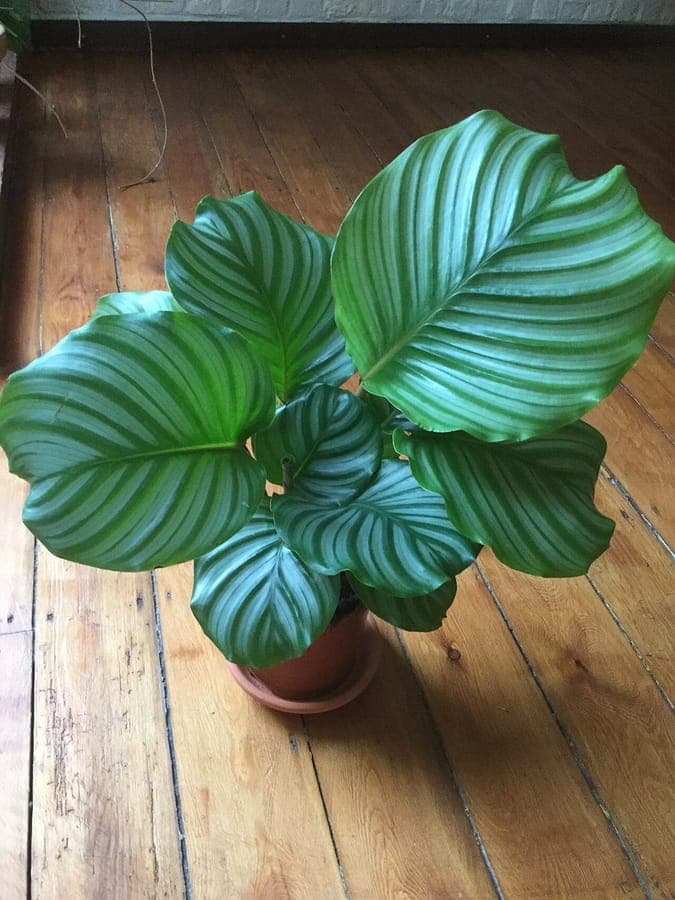
Fregisseur / CC BY-SA 4.0, via Wikimedia Commons
Calathea orbifolia: complete guide
Goeppertia orbifolia
Want to see Calathea orbifolia: complete guide in your garden?
Full design in HD: €7.99
Look after your Calathea orbifolia with the GardenWorld app
Identify plants with your camera and get a care calendar with reminders for this plant.


Overview
Goeppertia orbifolia is one of the most striking foliage plants you can bring indoors. You probably know it as Calathea orbifolia, the name still printed on most plant labels. In 2012, after DNA studies, much of the genus Calathea was moved into Goeppertia, but in shops and living rooms it remains simply "the orbifolia". It has no established English common name of its own.
It belongs to the arrowroot family (Marantaceae), the same family as the familiar prayer plant (Maranta leuconeura). In the wild it grows in the understorey of tropical rainforest in South America, shaded by taller trees, rooted in moist, humus-rich soil and surrounded by air that is almost always close to saturation. That origin explains everything you need to know about its care: filtered light, steady warmth, soft water and high humidity.
It has a reputation for being fussy, and that is partly deserved: it forgives mistakes less readily than a spider plant. Find it the right spot, though, and it will reward you with a plant that looks impressive all year round. With gardenworld.app you can have a garden design drawn up for your patio or balcony, and the same calm green palette lets the orbifolia indoors feel like a natural extension of your outdoor space.
Appearance and growth
The leaves are the whole point. Each one is broadly oval to almost round, reaching 20 to 30 cm across on a mature plant, and is marked with regular silvery-green bands between the side veins on a mid-green background. The margin is gently wavy and the surface has a soft sheen. The leaves sit on long stalks that rise directly from a short rhizome, so the plant forms an open, rounded clump.
Indoors Goeppertia orbifolia usually reaches 60 to 80 cm in height and a similar spread. It grows in spring and summer, producing one new leaf at a time that unfurls from a tightly rolled tube. A healthy plant makes a new leaf every few weeks, while the oldest leaves at the base gradually die back.
Like many members of its family, it moves its leaves. A small joint at the base of each blade lets the plant raise its leaves slightly in the evening and lower them again by day. In the orbifolia this movement is less obvious than in a maranta, but you will notice it. Flowers are rare indoors; when they do appear they are small and white, tucked among green bracts at the base of the plant, and of little ornamental value.
Ideal location
Give it bright, indirect light. A position 1.5 to 2 metres from an east- or north-facing window, or further back from a south or west window behind a sheer curtain, is ideal. Direct sun bleaches and curls the leaves and leaves brown scorch marks. Too little light makes the stalks floppy and the pattern dull.
Choose a warm spot free from draughts. An outside door opened in winter, a window left ajar in autumn or the airflow from air conditioning is enough to cause brown edges and drooping leaves. Keep it away from radiators and wood-burners too: dry heat is its worst enemy. A bathroom with daylight, a kitchen or a place among other plants often works surprisingly well.
Compost and repotting
Use an open, humus-rich compost that holds moisture without becoming compacted. Houseplant compost mixed with about a third perlite and some fine bark or coir is ideal. A slightly acidic pH between 5.5 and 6.5 suits it. A pot with a drainage hole is essential.
Repot every one to two years in spring, when the roots fill the pot, moving up 3 to 5 cm in diameter. This is also the moment to divide a large plant: cut the rhizome with a sharp knife into sections, each with a few leaves and its own roots. Keep the divisions extra warm and humid for a few weeks, for example under a clear plastic bag, until they start growing again.
Free preview
Want to see Calathea orbifolia: complete guide in your garden? Make a free preview of your design.
Watering and humidity
This is where most orbifolias go wrong. From spring to autumn keep the compost evenly and lightly moist. Let the top 2 to 3 cm dry before watering again, but never let the root ball dry out completely. Wet feet are just as dangerous, so always tip away any water left in the saucer after ten minutes. Water a little less in winter.
Water quality matters as well. The plant is sensitive to lime, chlorine and fluoride and responds with brown, crispy leaf tips. Use rainwater, filtered water or tap water left to stand overnight, always at room temperature.
Ideally humidity should stay above 60 %, which an ordinary living room rarely achieves without help. A humidifier nearby is the most effective solution, but a tray of wet clay pebbles or a group of plants together also helps. Misting gives only a short-lived boost and can leave limescale marks on the leaves.
Feed once a month from April to September with a half-strength liquid houseplant fertiliser. Overfeeding burns the roots and also causes brown edges.
Care and pruning
Real pruning is not needed. Cut old, yellow or damaged leaves off as low as possible at the base of the stalk; this keeps the plant fresh and makes room for new growth. Brown tips can be trimmed with clean scissors, following the shape of the leaf without cutting into green tissue.
Wipe the large leaves now and then with a damp cloth so they catch the light and you spot pests early. Red spider mite and thrips are the main culprits, especially in dry air. Check the undersides of the leaves regularly for fine webbing or silvery speckling.
Maintenance calendar
March-April: Start feeding. Repot or divide if needed. Move the plant a little closer to the window as the days lengthen, but out of direct sun.
May-June: Full growth. Water regularly with soft water and keep humidity high.
July-August: Protect from strong sun and from heat above 28 °C. Check weekly for spider mite and thrips.
September-October: Reduce feeding and then stop. Watch out for cold draughts as windows are opened more often.
November-February: Water less and do not feed. Keep away from radiators and take extra care over humidity.
Temperature and hardiness
Goeppertia orbifolia is not hardy and does not tolerate cold at all. It is happiest at 18 to 24 °C all year round. Below 15 °C growth stops and the leaves are soon damaged; one cold night on a windowsill against single glazing can be enough. Do not put it outside in summer either unless nights stay genuinely warm, and then only in deep shade. Sudden swings in temperature upset it more than being a few degrees too warm or too cool.
Toxicity to pets
Good news if you share your home with cats or dogs: Goeppertia orbifolia and the other calatheas are considered non-toxic to pets and to people. A cat nibbling the leaves is not at risk of poisoning, although eating a large amount of any plant material can cause a mild upset stomach. The plant itself will not appreciate it, of course, so keep it out of reach of a cat that likes to chew foliage.
Companion plants
The orbifolia looks wonderful in a group with other plants that want the same warm, humid conditions. A bird's nest fern (Asplenium nidus), with its glossy bright green rosette, makes a strong contrast with the round, striped leaves. A peace lily (Spathiphyllum wallisii) adds white flowers to the same shady corner and enjoys the same watering routine.
For a more playful arrangement, add a Chinese money plant (Pilea peperomioides) with its round leaves, or a spider plant (Chlorophytum comosum) in a hanging pot above. A fishbone fern (Nephrolepis cordifolia) completes the picture with fine, airy fronds. Grouped together, these plants also raise the humidity around one another, which makes a real difference to the orbifolia.
Final thoughts
Goeppertia orbifolia is not a plant for a windowsill above a radiator, but it is a rewarding companion if you give it a settled, warm place in filtered light. Soft water, an evenly moist root ball and humid air: with those three things its large, silver-striped leaves stay clean and beautiful.
Want a reminder of when to feed, repot or ease off the watering? The plant calendar on gardenworld.app shows month by month what your plants need, indoors and out. Find a calm, bright spot for your orbifolia this spring and enjoy every new leaf as it unrolls.
Frequently asked questions about Calathea orbifolia
Is Calathea orbifolia winter hardy?
Goeppertia orbifolia is not hardy and does not tolerate cold at all. It is happiest at 18 to 24 °C all year round.
How much water does Calathea orbifolia need?
This is where most orbifolias go wrong. From spring to autumn keep the compost evenly and lightly moist.
Where does Calathea orbifolia grow best?
Give it bright, indirect light. A position 1.5 to 2 metres from an east- or north-facing window, or further back from a south or west window behind a sheer curtain, is ideal.

See it in your garden
See Calathea orbifolia in your garden
One photo of your garden and a few questions. You see the result in about a minute.
Try it with a photoIdentify this plant in your own garden. Identify a plant
Similar plants
Asplenium nidus: complete guide
Asplenium nidus
Learn all about the Bird's Nest Fern (Asplenium nidus), a stunning tropical houseplant with glossy green fronds. Expert care tips, light requirements and optimal growing conditions.
Peace lily: complete guide
Spathiphyllum wallisii
How to grow a peace lily (Spathiphyllum wallisii): light, watering, repotting, getting it to flower again, and why it is toxic to cats and dogs.
Chinese Money Plant: complete guide
Pilea peperomioides
Chinese Money Plant (Pilea peperomioides) is a trendy houseplant from China featuring distinctive round, mint-green leaves. This Instagram-famous plant has become a favorite for modern homes with its elegant appearance and easy-care nature.
