Chhe (talk) / Public domain, via Wikimedia Commons
Peacock plant (Calathea makoyana): complete guide
Goeppertia makoyana
Want to see Peacock plant (Calathea makoyana): complete guide in your garden?
Full design in HD: €7.99
Look after your Peacock plant with the GardenWorld app
Identify plants with your camera and get a care calendar with reminders for this plant.


Overview
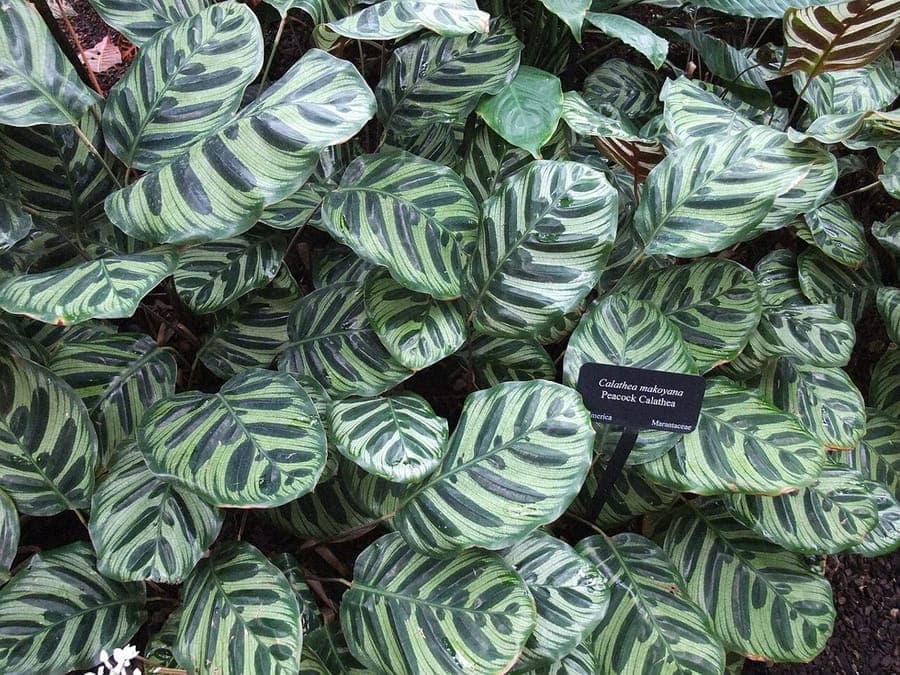
The peacock plant (Goeppertia makoyana) is one of the best-known calatheas and a houseplant classic. Its leaves look as though they were painted with a fine brush: pale green with dark green oval blotches arranged like feathers along the midrib. Turn a leaf over and you will see the same pattern again in purplish red. It is also known as cathedral windows, because light shining through the thin leaves recalls stained glass.
In shops it is usually still labelled Calathea makoyana. Since 2012 the species has officially belonged to the genus Goeppertia, after DNA research showed that the old genus Calathea was really two separate groups. Both names refer to the same plant.
The peacock plant belongs to the arrowroot family (Marantaceae) and is native to eastern Brazil. There it grows in the understorey of humid tropical forest, shaded by taller trees and rooted in loose, humus-rich soil. That origin tells you everything: it wants filtered light, steady warmth, soft water and moist air. Good news for anyone with cats or dogs: it is not poisonous.
Appearance and growth
The leaves are broadly oval, 15 to 30 cm long and thin, almost translucent. On the upper side, creamy green and dark green areas alternate in a pattern reminiscent of peacock feathers. The underside is wine red to purple with the same markings, and the slender leaf stalks are flushed red too. New leaves emerge rolled up like a cigar and often show that red underside as they unfurl.
Indoors the plant usually reaches 40 to 60 cm in height and spread. It grows from a short rhizome and forms a dense, upright clump. In spring and summer it produces a new leaf every few weeks; in winter growth almost stops.
Like its relatives, the peacock plant moves its leaves with the light. In the evening they rise and fold up partly, and in the morning they drop open again, which is why this group is often called prayer plants. Flowers are rare indoors and inconspicuous: small white blooms just above the compost.
Ideal location
Give the peacock plant bright light without direct sun. An east- or north-facing window, or a spot one to two metres from a south- or west-facing window behind a sheer curtain, is ideal. Strong midday sun scorches the thin leaves within hours, leaving pale, papery patches and fading the markings. Too little light is not good either: the stalks become long and floppy and the contrast disappears.
Warmth without draughts matters just as much. A window left ajar in autumn, an outside door that opens often or the airflow from air conditioning will soon cause curled leaves with brown edges. A bright bathroom, a kitchen or a spot within a group of plants often works best.
Compost and repotting
Choose an airy, humus-rich compost that holds moisture but drains freely. Ordinary houseplant compost mixed with a third perlite and some fine bark or coir works well. A slightly acidic pH suits it. Always use a pot with a drainage hole; a decorative pot without one is only suitable as an outer cover.
Repot every two years in April or May, or when roots appear through the bottom of the pot. Choose a pot only 2 to 4 cm wider: in a pot that is too large the compost stays wet for too long. When repotting you can divide a large clump. Cut it with a sharp knife into sections, each with at least three leaves and its own roots, pot them separately and keep them extra warm and humid for a few weeks, for example under a clear plastic bag.
Watering and humidity
From spring to autumn keep the compost evenly moist but never soggy. Test with a finger: when the top 2 cm is dry, water. Do not let the root ball dry out completely, as the leaves will roll up and the edges turn brown. Tip away any water still standing in the saucer after fifteen minutes. In winter water a little less, as growth slows.
The peacock plant is sensitive to lime, chlorine and fluoride in tap water, and brown leaf tips are often the result. Use rainwater, filtered water or tap water that has stood overnight, always at room temperature.
Humid air is the second secret. Aim for 60 % or higher. In a centrally heated home, winter humidity is often only 30 to 40 %, and curling leaves will show it straight away. A humidifier is the best solution. A wide tray of wet clay pebbles beneath the pot, or a group of plants standing together, also helps. Misting barely helps.
Feed every four weeks from April to September with liquid houseplant fertiliser at half strength. Overfeeding causes scorched leaf edges.
Free preview
Want to see Peacock plant (Calathea makoyana): complete guide in your garden? Make a free preview of your design.
Care and pruning
There is no real pruning to do. Cut old, yellowing or damaged leaves off low down at the base. Brown tips can be trimmed with clean scissors, following the natural shape of the leaf and leaving a thin margin of brown.
Wipe the leaves now and then with a soft, damp cloth. This keeps the markings looking their best and helps you spot pests early. Spider mite is the main problem in dry air: look for fine webbing and pale speckles on the undersides of the leaves. Thrips and mealybugs can also appear. If you find them, rinse the plant under a lukewarm shower and raise the humidity.
Maintenance calendar
March-April: Start feeding again. Repot or divide the plant if needed.
May-June: Full growth. Water regularly with soft water and keep an eye on humidity. Keep the plant out of strong sun now it is higher in the sky.
July-August: Humid air is extra important in hot weather. Check for spider mite. The plant can go outside into a sheltered, shady corner of the patio if nights stay above 16 °C, but it is usually happier indoors.
September-October: Stop feeding. Bring it in before the nights turn cool. Watch for draughts once the heating comes on.
November-February: Rest period. Water a little less, but do not let the root ball dry out. Place a humidifier or a pebble tray nearby.
If you want to keep track of your houseplants and garden in one place, the planting calendar on gardenworld.app helps make sure nothing is forgotten.
Temperature and hardiness
Goeppertia makoyana is a tropical plant and not hardy at all. The ideal temperature is between 18 and 24 °C. Below 16 °C growth stops and the leaves start to droop; below about 12 °C the leaves and roots are damaged. In the UK and north-western Europe it therefore belongs indoors all year round, perhaps with a summer outdoors in a warm, sheltered and shady corner.
Avoid large swings between day and night as well. A spot that is warm by day but cools down at night when the heating is turned low is less suitable than one with an even temperature.
Toxicity to pets
Good news for pet owners: the peacock plant is not toxic to cats or dogs. The ASPCA, the American animal welfare organisation that keeps an extensive list of toxic and non-toxic plants, lists calatheas among the safe houseplants. It is not poisonous to people either.
That does not mean your cat should be allowed to graze on it. Large amounts of plant material can cause stomach upsets or vomiting in pets, and a chewed plant soon looks tatty. Place it where playful cats cannot get at it constantly. Fertilisers and pesticides, on the other hand, are often harmful to animals.
Companion plants
The peacock plant looks best in a group of plants with the same needs: warmth, filtered light and humid air. Good partners are the bird's nest fern (Asplenium nidus) with its glossy bright green rosette and the peace lily (Spathiphyllum wallisii) with its white spathes. The spider plant (Chlorophytum comosum), the Chinese money plant (Pilea peperomioides) and the fishbone fern (Nephrolepis cordifolia) fit in well too. All of these are also safe for cats and dogs, so you can create a fully pet-friendly plant corner.
If you would like more calatheas, combine the peacock plant with species that have a different leaf pattern. A round-leaved Goeppertia orbifolia or a low, spreading maranta makes a lovely contrast.
If you also have a patio or balcony, you can create a garden design on gardenworld.app with the same lush, leafy character, so that indoors and outdoors flow into one another.
Final thoughts
The peacock plant is a houseplant for lovers of foliage. With its green brushstrokes and purple undersides, it is a living painting that folds up its leaves every evening. It asks for some attention: bright light without sun, steady warmth, soft water and humid air. Give it that, and you will have a plant that stays beautiful for years and is safe for cats and dogs as well.
Frequently asked questions about Peacock plant
Is Peacock plant winter hardy?
Goeppertia makoyana is a tropical plant and not hardy at all. The ideal temperature is between 18 and 24 °C.
How much water does Peacock plant need?
From spring to autumn keep the compost evenly moist but never soggy. Test with a finger: when the top 2 cm is dry, water.
Where does Peacock plant grow best?
Give the peacock plant bright light without direct sun. An east- or north-facing window, or a spot one to two metres from a south- or west-facing window behind a sheer curtain, is ideal.

See it in your garden
See Peacock plant in your garden
One photo of your garden and a few questions. You see the result in about a minute.
Try it with a photoIdentify this plant in your own garden. Identify a plant
Similar plants
Asplenium nidus: complete guide
Asplenium nidus
Learn all about the Bird's Nest Fern (Asplenium nidus), a stunning tropical houseplant with glossy green fronds. Expert care tips, light requirements and optimal growing conditions.
Peace lily: complete guide
Spathiphyllum wallisii
How to grow a peace lily (Spathiphyllum wallisii): light, watering, repotting, getting it to flower again, and why it is toxic to cats and dogs.
Chlorophytum comosum: complete guide
Chlorophytum comosum
Discover everything about Chlorophytum comosum (spider plant). Learn care requirements, propagation, location and maintenance for thriving indoor plants.
