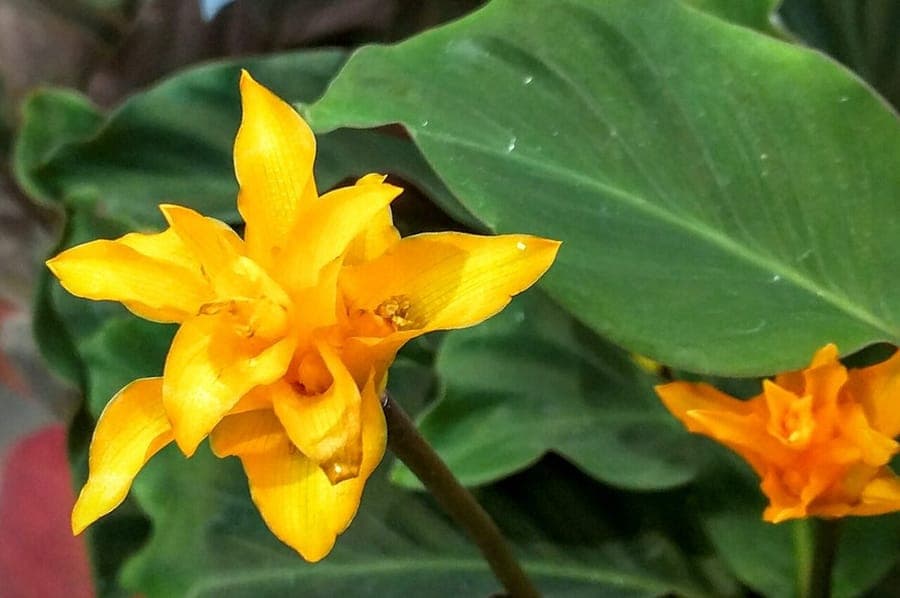
Assianir / CC BY-SA 3.0, via Wikimedia Commons
Eternal flame (Goeppertia crocata): care and flowering guide
Goeppertia crocata
Want to see Eternal flame (Goeppertia crocata): care and flowering guide in your garden?
Full design in HD: €7.99
Look after your Eternal flame with the GardenWorld app
Identify plants with your camera and get a care calendar with reminders for this plant.


Overview
Most calatheas earn their place on the windowsill with painted, striped or blotched leaves. Goeppertia crocata takes a different route. Its foliage is plain and dark, but above it rise bright saffron-orange torches that last for weeks, which is why it is widely sold as eternal flame. Garden centres still label it Calathea crocata, often with the cultivar name 'Tassmania'. Botanists moved it to Goeppertia after DNA studies, but both names refer to the same species.
It comes from the humid forests of eastern Brazil, where it grows in the shady understorey. It belongs to the arrowroot family (Marantaceae), alongside marantas and stromanthes, and shares their tastes: filtered light, steady warmth, soft water and air that never gets too dry. What sets this one apart is flowering, and getting it to flower a second time takes a little cunning.
Appearance and flowering
The plant forms a tidy clump 30 to 45 cm tall. Its leaves are oval to oblong, 15 to 25 cm long, with gently wavy edges. The upper side is deep green with a faint sheen along the veins, the underside a rich purplish red that shows best on young leaves as they unfurl from their tight rolls.
The flower heads sit on slim, reddish-brown stalks that rise just above the foliage. What looks like a flower is really a stack of bracts: overlapping, orange to saffron-yellow scales with ruffled edges, forming a cone-shaped torch around 5 cm long. The true flowers are small, yellow-orange and short-lived, peeping out between the bracts one or two at a time. The bracts keep their colour far longer, typically six to ten weeks with good care, sometimes a little more, before fading and turning brown.
Plants on sale are usually in bud or just opening. The natural season is late winter into spring, but growers time their crops so that you can find eternal flame in flower at almost any time of year.
Position in the home
Choose a permanent spot in a warm room with no draughts. A living room with an east or west window, a bright kitchen or a bathroom with natural light all suit it well. Keep it away from external doors, windows that are often opened and the blast of an air conditioner: cold gusts quickly cause curled leaves and crisp brown edges. Sitting directly above or beside a radiator is just as harmful, because the air there is hot and parched.
Try not to move it about, especially while it is in flower. Calatheas respond to every change in light and temperature by dropping a leaf or letting their stalks sag. Grouping it with other houseplants keeps the air between the pots a little more humid.
Light
Light matters more for this species than for the foliage calatheas, because flowers cost energy. Give it plenty of bright, indirect light: close to an east-facing window, or one to two metres back from a south or west window behind a net curtain. Hot midday sun scorches the leaves and bleaches the bracts early, though an hour of gentle morning sun does no harm.
Too little light shows up as long, floppy leaf stalks and a plant that never sets another bud after its first display. In the darker months a grow light helps, but pay attention to day length, as explained under care below.
Watering
Keep the compost evenly moist. Push a finger into the pot: when the top 2 cm feels dry, it is time to water. Never let the root ball dry out completely, as the flower stalks will flop within a day and the leaves will curl. Water left standing in a decorative pot is just as dangerous, so tip out any surplus after fifteen minutes.
Use rainwater, filtered water or tap water that has stood overnight, at room temperature. Hard water gradually causes brown leaf tips. Water the compost rather than the heart of the plant, and keep water off the bracts: moisture trapped between them leads to rot. In winter you can water a little less, but the rule stays the same: moist, never soggy.
Humidity
Aim for 50 to 60 % relative humidity or more. In a centrally heated home it often drops to around 30 % in winter. A humidifier nearby is the most reliable solution. A wide tray of wet clay pebbles under the pot also helps, provided the base of the pot sits above the water line. Misting is possible, but keep the spray off the flower heads; the effect is gone within minutes.
Free preview
Want to see Eternal flame (Goeppertia crocata): care and flowering guide in your garden? Make a free preview of your design.
Compost and repotting
Use an airy, humus-rich, slightly acidic mix. Standard houseplant compost with a third perlite and a handful of fine bark works well. A pot with a drainage hole is essential.
Do not repot while the plant is in flower. Wait until the last head has faded and ideally do it in spring, choosing a pot only a few centimetres wider. An older, congested clump can be divided at the same time: each piece needs its own roots and at least three leaves. Keep the divisions warm under a clear cover for a few weeks until they start growing again.
Care and pruning
Cut spent flower heads off low down as soon as the bracts turn brown. Remove old yellow leaves at the base. From March to September, feed every three to four weeks with half-strength liquid fertiliser for flowering houseplants.
Getting it to flower again is the real challenge. Goeppertia crocata is a short-day plant: it starts forming flowers after a spell of short days. Commercial growers give their plants several weeks of days with about ten hours of light. At home you can imitate this from autumn onwards by keeping the plant in a room where no lamps are switched on in the evening, or by covering it at dusk. Meanwhile keep the temperature around 20 °C and the humidity high. With a bit of luck, new flower stalks appear a few months later. If not, you still have a handsome foliage plant.
Check under the leaves regularly for spider mite and thrips, which thrive in dry air. A lukewarm shower, with the flower heads shielded, and higher humidity are the first steps if you spot them.
Care calendar
January to February: Water sparingly, no feeding. The natural flowering season begins; keep the plant out of draughts.
March to April: Start feeding. Repot or divide plants that have finished flowering.
May to August: Main period of leaf growth. Water evenly, avoid midday sun and check for spider mite.
September to October: Stop feeding. Begin a short-day treatment if you want a new flush of flowers.
November to December: Keep up the short days, keep the temperature above 18 °C and the air humid. Stay clear of radiators.
For a month-by-month reminder of what to do with all your plants, indoors and out, have a look at the plant calendar on gardenworld.app.
Temperature and overwintering
This is a true houseplant. It is happiest between 18 and 25 °C, and preferably no lower than 16 °C at night. Below 15 °C growth stops and the leaves are soon damaged. In the British or Belgian climate it can never spend the winter outdoors. A sheltered, shady spot outside in high summer is possible, but the swing between day and night temperatures does the flowers no good. It is better off indoors.
Toxicity to pets
Good news for cat and dog owners: the ASPCA, the American animal welfare charity that runs its own poison control centre, lists the genus Calathea as non-toxic to dogs, cats and horses, and Goeppertia crocata falls under that entry. It is not considered poisonous to people either. A cat that chews the leaves may still get a mild stomach upset, as with any plant material, and the bracts are easily damaged, so it is wise to keep the plant out of reach of paws.
Companion plants
Pair Goeppertia crocata with plants that enjoy the same warm, humid conditions. The peace lily (Spathiphyllum wallisii), with its white spathes, makes a fresh contrast with the orange torches. A bird's nest fern (Asplenium nidus) or a blue star fern (Phlebodium aureum) adds a calm green backdrop and helps keep the air moist. The spider plant (Chlorophytum comosum) and an Aglaonema are tough, easy neighbours that round out the foliage. For more pattern, add one of the striped or speckled calatheas.
Final thoughts
Goeppertia crocata is the odd one out among calatheas: a plant for anyone who wants cheerful orange in the depths of winter. Give it bright light without direct sun, soft water, humid air and a warm, draught-proof spot. Coax it into flowering again with short days and you can count yourself an accomplished indoor gardener. And if you are planning changes outside as well, you can have a garden design made on gardenworld.app that suits your home and your taste.

See it in your garden
See Eternal flame in your garden
One photo of your garden and a few questions. You see the result in about a minute.
Try it with a photoIdentify this plant in your own garden. Identify a plant
Similar plants
Peace lily: complete guide
Spathiphyllum wallisii
How to grow a peace lily (Spathiphyllum wallisii): light, watering, repotting, getting it to flower again, and why it is toxic to cats and dogs.
Chlorophytum comosum: complete guide
Chlorophytum comosum
Discover everything about Chlorophytum comosum (spider plant). Learn care requirements, propagation, location and maintenance for thriving indoor plants.
Asplenium nidus: complete guide
Asplenium nidus
Learn all about the Bird's Nest Fern (Asplenium nidus), a stunning tropical houseplant with glossy green fronds. Expert care tips, light requirements and optimal growing conditions.
