
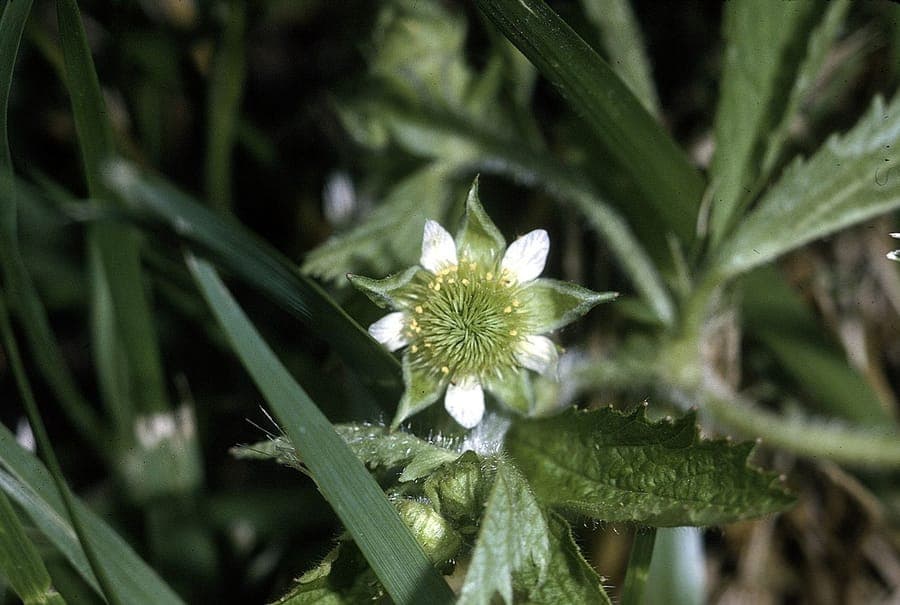
Robert H. Mohlenbrock @ USDA-NRCS PLANTS Database / USDA NRCS. 1995. Northeast wetland flora: Field office guide to plant species. Northeast National Technical Center, Chester. / Public domain, via Wikimedia Commons
Geum laciniatum: complete guide
Geum laciniatum
Want to see Geum laciniatum: complete guide in your garden?
1 minute, no credit card
Overview
Geum laciniatum, commonly known as rough avens or cut-leaved avens, is a herbaceous perennial in the rose family (Rosaceae) native to eastern Canada and the eastern to central United States. The species was first described in 1775 by Scottish botanist John Murray, and it has been cultivated outside its native range as a reliable, low-maintenance plant for naturalistic garden designs. Its common name refers to the rough, hairy texture of its stems and leaf surfaces, a characteristic that sets it apart from the smoother cultivated forms of Geum available in most garden centres.
Unlike the popular Geum hybrids - such as 'Mrs J. Bradshaw' with its vivid scarlet flowers or the compact 'Borisii' with its warm orange blooms - Geum laciniatum has a wilder, more understated character. Its flowers are small and creamy white, but the plant compensates with deeply lobed, architecturally interesting foliage and highly ornamental hooked fruit heads that persist well into autumn. For gardeners who appreciate plants with multiple seasons of interest, rough avens offers a compelling combination of texture, structure and ecological value. At gardenworld.app you can see how wild-type species like this one are used in naturalistic planting designs.
The species forms a multi-stemmed clump with a rapid growth rate in suitable conditions. Given adequate moisture and partial shade - conditions that mirror its native woodland edge habitat - a single plant can expand to a tidy clump 40 to 60 cm wide within two to three seasons. It spreads gently by self-seeding, but is not aggressive enough to become invasive in most garden situations.
Appearance and bloom cycle
The foliage of Geum laciniatum is its most distinctive feature. The leaves are compound, with a large terminal leaflet flanked by several pairs of progressively smaller lateral leaflets. The surface is noticeably rough to the touch due to dense, coarse hairs - hence the common name 'rough avens'. In spring, a basal rosette of leaves emerges close to the ground, followed by erect, branching flower stems that can reach 50 to 80 cm in height by the time flowering begins.
Flowering typically occurs from May through July, occasionally extending into August in cooler or more shaded positions. The individual flowers are modest in size - approximately 1 to 1.5 cm in diameter - with five white to pale yellow petals surrounding a prominent yellow centre composed of numerous stamens. While not as visually dramatic as larger-flowered Geum cultivars, the flowers are attractive to a wide range of small pollinators, including solitary bees, hoverflies and small butterflies.
After flowering, the plant develops its most distinctive feature: the spherical fruiting heads. Each head is composed of numerous achenes, each tipped with a long, hook-tipped style that was once used to disperse the seeds by attaching to animal fur or clothing. These fruiting heads are light brown to tan in colour and remain on the plant through autumn, providing textural interest and serving as a food source for seed-eating birds. The seed heads dry attractively and are sometimes used in dried flower arrangements.
As a true herbaceous perennial, Geum laciniatum dies back to ground level in cold winters. The basal rosette overwinters successfully in most temperate climates, and new growth emerges vigorously in early spring, often as early as late February or March in mild regions.
Ideal location
Geum laciniatum is most at home in partial shade to dappled light. In its natural habitat, it grows along forest edges, beside streams and in moist meadows - environments characterised by filtered sunlight, consistent soil moisture and protection from the harshest afternoon sun. In the garden, a spot beneath a light tree canopy or at the edge of a shrub border replicates these conditions well.
Full sun is tolerable in cooler northern climates provided the soil remains consistently moist, but in warmer or drier conditions, the plant will wilt and decline. North-facing or east-facing borders are well suited. The species is also perfectly suited to planting beside a garden pond, stream or rain garden, where it benefits from the naturally elevated moisture levels of these microhabitats.
Plant at a spacing of 30 to 40 cm from neighbouring perennials. This gives the basal rosette sufficient room to spread without overwhelming smaller companion plants. In a naturalistic meadow planting, tighter spacing of 25 cm can create a denser, more carpet-like effect that effectively suppresses weeds between established clumps.
Soil requirements
The ideal soil for Geum laciniatum is moist, humus-rich and moderately fertile. The plant performs across a pH range of 5.0 to 7.0, tolerating mildly acidic to neutral conditions with equal ease. Strongly alkaline soils - particularly those with a pH above 7.5 - can cause yellowing of the leaves due to iron deficiency (chlorosis) and should be amended with sulphur chips or well-rotted pine bark to lower pH before planting.
Heavy clay soils that remain waterlogged in winter are the most problematic growing medium for this species, as prolonged saturation encourages root rot. Incorporating sharp grit at a ratio of approximately one part grit to three parts existing soil dramatically improves drainage. In free-draining sandy soils, add generous quantities of well-rotted garden compost (approximately 10 litres per square metre) to improve moisture retention.
An annual top-dressing of 5 to 7 cm of well-rotted compost or leaf mould in spring is the single most effective maintenance practice for this plant. It feeds the soil organisms, retains moisture during dry spells, suppresses annual weeds and slowly improves soil structure over successive seasons. Avoid high-nitrogen fertilisers, which encourage leafy growth at the expense of flowering.
Free design
Want to see Geum laciniatum: complete guide in your garden? Make a free design now.
Watering
Consistent moisture is the key to a healthy Geum laciniatum. During the active growing season (March to September), the soil around the plant should never be allowed to dry out completely. An equivalent of 25 to 40 mm of water per week is a reliable target in dry periods, whether supplied by rainfall or supplemental watering.
Water at soil level rather than overhead to minimise leaf wetness, which can encourage fungal problems. Drip irrigation or a soaker hose laid at the base of the plant is ideal. In a typical year with adequate rainfall distributed through the growing season, supplemental watering may only be necessary during prolonged dry spells of more than two weeks. During unusually hot summers - those with temperatures above 28°C for extended periods - daily watering may be needed to prevent wilting.
In autumn and winter, reduce watering significantly. The plant's roots do not tolerate prolonged waterlogging, and a combination of wet soil and freezing temperatures can cause more damage than cold alone. If your garden has poor drainage, consider planting on a gentle mound or raised area where excess water drains away naturally.
Pruning
Geum laciniatum is a low-maintenance perennial that requires only minimal pruning. After the main flush of flowers has finished (typically in July), you can remove spent flower stems at the base if you wish to reduce self-seeding or to keep the plant looking tidy. However, if you want to harvest seed for propagation or allow birds to feed on the hooked seed heads, leave the stems in place until late autumn.
In late winter or very early spring (February to March), remove the previous season's dead foliage by cutting it back to approximately 5 cm above ground level. This allows the new basal rosette to emerge unobstructed and improves air circulation around the crown of the plant. Remove any individual leaves that appear brown, mushy or diseased during the growing season.
Unlike some Geum cultivars that benefit from dividing every three to four years to maintain vigour, Geum laciniatum is quite long-lived and does not generally need frequent division. You may choose to divide large clumps in early spring (March) or early autumn (September) simply to increase your stock of plants.
Maintenance calendar
January–February: No active tasks needed. Check that the mulch layer is intact; add extra material over the crown in very cold spells.
March: Remove dead foliage from the previous season. Apply a 5 cm layer of well-rotted compost around the base. Begin watering if conditions are unusually dry.
April–May: Basal rosettes expand rapidly. Remove competing weeds. Apply an organic slow-release fertiliser if the soil is poor.
June–July: Main flowering period. Remove spent stems if desired. Water regularly during dry periods.
August–September: Decorative seed heads develop. Collect seeds if desired or leave for wildlife. Keep soil lightly moist.
October–November: Foliage begins to die back. Leave some of it in place as light frost protection. Remove any diseased material.
December: Dormant period. No action required.
Winter hardiness
Geum laciniatum is reliably hardy in USDA zones 4 to 8, corresponding to minimum winter temperatures of -34°C to -7°C. In the temperate maritime climates of the British Isles and much of north-western Europe (broadly equivalent to USDA zones 7–8), the plant overwinters without difficulty in all but the most exceptional winters. The basal rosette may look battered after sustained freezing, but it will recover vigorously in spring.
In colder zones (USDA 4–5), a protective mulch of 8 to 10 cm of dry straw or shredded leaves applied over the crown before the first hard frosts is advisable. Remove this mulch gradually in spring - from mid-March onward - to avoid smothering the emerging new growth. On sheltered sites, particularly those at the foot of a south-facing wall, the plant may retain some green foliage through mild winters.
On gardenworld.app you can explore planting designs that make use of reliably hardy perennials like Geum laciniatum to create year-round structure in the garden.
Companion plants
Geum laciniatum is an excellent companion for other moisture-tolerant perennials. Astilbe (false spirea) is a natural partner: its feathery plumes provide a striking textural contrast with the coarse-leaved Geum, and both plants share the same preference for consistently moist, humus-rich soils. Filipendula ulmaria (meadowsweet) is similarly well matched, with its creamy white flower clusters complementing the smaller blooms of Geum laciniatum when both are in flower simultaneously.
For early spring interest before Geum comes into flower, Pulmonaria officinalis (lungwort) and Primula vulgaris (primrose) are excellent companions, filling the border with colour from February onwards. Ajuga reptans (bugle) makes a dense, weed-suppressing mat beneath the Geum rosettes and tolerates the same partial shade conditions.
For a naturalistic meadow effect, combine with Geranium pratense (meadow cranesbill) and Veronica longifolia (long-leaved speedwell). Both are vigorous perennials that complement Geum laciniatum's informal habit and share its ecological value for pollinators. Ferns - particularly Dryopteris filix-mas (male fern) or Polystichum setiferum (soft shield fern) - add architectural structure and provide visual continuity through the winter months when Geum has died back.
Closing thoughts
Geum laciniatum is a rewarding, low-maintenance perennial for gardeners who value ecological integrity and multi-season interest over showy flowers. Its deeply cut foliage, modest spring blooms and highly ornamental hooked seed heads give it an appeal that extends well beyond the flowering season. Suitable for woodland gardens, waterside plantings, naturalistic borders and wildlife-friendly schemes, this North American native deserves wider cultivation in temperate gardens. Look for it at specialist native plant nurseries and garden centres with a strong perennial selection.
Want to see Geum laciniatum: complete guide in your garden? Make a free design now.
Upload a photo, pick a style, and get a photorealistic design with plant list in under a minute.
No credit card required


Similar plants
Siberian crab apple: complete guide
Malus x robusta
Complete guide to the Siberian crab apple (Malus x robusta): location, soil, pruning, winter hardiness and the best companion plants for your garden.
Chinese flowering crabapple (Malus x spectabilis): complete guide
Malus x spectabilis
Meet the Chinese flowering crabapple (Malus x spectabilis): a classic spring bloomer with carmine buds and pink blossom.
Potentilla crassinervia: complete guide
Potentilla crassinervia
Potentilla crassinervia, the Corsican cinquefoil, grows wild on Corsica and Sardinia's peaks. Discover how to grow this hardy alpine rock garden gem.