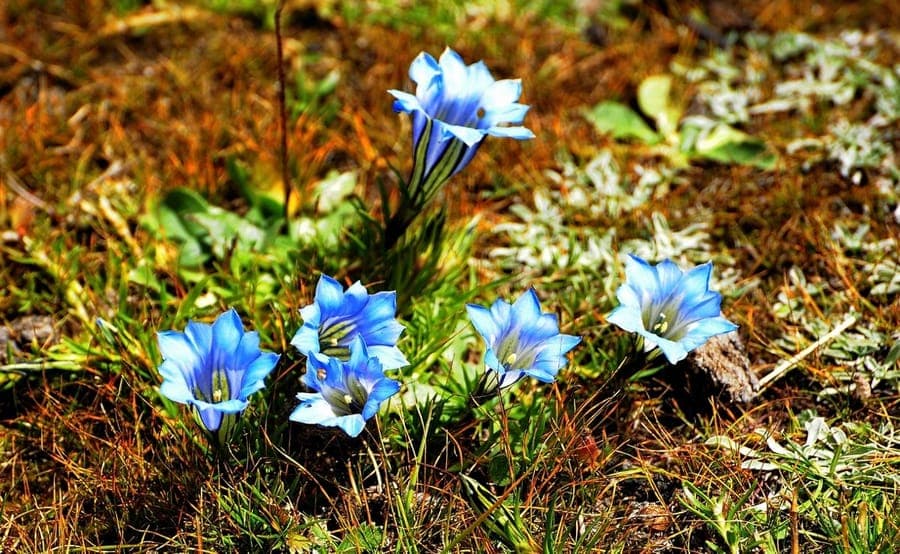
Jan Reurink Camera location29° 52′ 34.2″ N, 92° 31′ 09.6″ E View this and other nearby images on: OpenStreetMap 29.876167; 92.519333 / CC BY 2.0, via Wikimedia Commons
Autumn Gentian: complete guide
Gentiana sino-ornata
Want to see Autumn Gentian: complete guide in your garden?
Full design in HD: €7.99
Look after your Autumn Gentian with the GardenWorld app
Identify plants with your camera and get a care calendar with reminders for this plant.


Overview
The autumn gentian (Gentiana sino-ornata), also known as the showy Chinese gentian, lights up the garden one last time before winter. Just as most perennials are fading, this low plant opens large trumpet flowers in September and October, in a deep, clear blue that few other garden plants can match. It is a plant for the enthusiast: it has firm demands on soil and moisture, but if you meet them it rewards you with a spectacular display every autumn.
The species comes from south-west China, mainly Yunnan and Sichuan, and from south-east Tibet. There it grows in damp mountain meadows at high altitude, among grass and moss, on acidic, humus-rich ground. The Scottish plant hunter George Forrest introduced it to Britain in 1910, and it has been a classic of rock and peat gardens ever since, especially in cool, moist regions such as Scotland. It holds the Royal Horticultural Society's Award of Garden Merit.
The key fact to remember: this gentian cannot tolerate lime. On chalky soil it slowly dwindles and dies. If you have acidic soil, or can build an acid bed, you gain a plant that improves year after year. Besides the blue species you will find the white 'Alba' and the deep blue selection 'Eugens Allerbester' in nurseries.
Appearance and bloom cycle
The plant forms a loose rosette from which prostrate stems 15 to 20 cm long fan out in all directions. The leaves are narrow, linear and 2 to 4 cm long, fresh green and grassy. The whole plant stays low, around 5 to 10 cm tall, and spreads to 20 to 30 cm. The stems root where they touch the ground, so after a few years a single plant becomes a small mat.
A single upright flower appears at the tip of each stem. It is trumpet-shaped, 5 to 6 cm long, and opens into five pointed lobes. The inside is a brilliant blue with a paler throat, while the outside carries striking stripes of dark blue and greenish white. Flowering starts in late August or early September and often continues into November until hard frost arrives. On dull days and in the evening the flowers partly close.
Gentiana sino-ornata is semi-evergreen: it loses some leaves in winter, but the crown remains intact. There are no reports of toxicity to people, dogs or cats, and the plant is not invasive anywhere in Europe.
Ideal location
This gentian likes light but dislikes heat and drought. In cool, moist regions full sun is fine as long as the soil stays cool and damp. In warmer gardens, or where afternoon sun bakes the ground, light shade around midday is better. Morning sun combined with a cool, slightly sheltered spot in the afternoon is the ideal mix.
Plant it at the edge of a heather garden, in an acid rock bed, beside a path among dwarf shrubs or in a trough. Avoid the foot of a hot south-facing wall and areas under trees with greedy roots, where the soil dries out too quickly. Humid air, for instance near a pond, suits it well.
Space plants roughly 20 to 25 cm apart. In groups of three to five the blue makes the strongest impact.
Soil requirements
With this plant the soil is everything. Gentiana sino-ornata needs acidic, lime-free ground with a pH between 5 and 6.5. On chalky, neutral or alkaline soil the leaves turn yellow, growth stalls and the plant dies within a few seasons. If in doubt, test your soil; a simple pH kit from a garden centre gives a quick answer.
The ideal soil is rich in humus, open and moisture-retentive without being waterlogged. A good mix is roughly equal parts leaf mould, peat-free ericaceous compost and fine grit or coarse sand. On sandy soil, work extra leaf mould or pine needles into the top layer. If your ground is chalky or heavy, build a raised acid bed 25 to 30 cm deep, or grow the plant in a wide pan or trough filled with ericaceous compost.
Each spring, mulch with a thin layer of leaf mould or pine needles. This keeps the soil cool and damp and helps it stay acidic.
Free preview
Want to see Autumn Gentian: complete guide in your garden? Make a free preview of your design.
Watering
After lime, drying out is the second great enemy. The soil should stay evenly moist from spring to autumn, especially in July and August when the flower buds are forming. In dry weather, water thoroughly twice a week.
Use rainwater wherever possible. Tap water is hard in many areas and gradually adds lime to the soil, pushing the pH up. In a trough or pot, check the compost every two to three days in summer. In winter, do not leave the plant standing in a soggy, frozen container: moist is good, standing water is not.
Pruning and dividing
This gentian needs no pruning. Leave the foliage in autumn, as it shelters the crown. In spring simply remove brown, dead stems.
Division matters more. After three or four years the centre often weakens, while the stems around the edge root freely. In March or April, lift the plant carefully, tease it apart into small pieces each with a few shoots and roots, and replant them in fresh acid compost. This rejuvenates the plant and gives you plenty of new ones in one go. Slugs love the young foliage, so keep an eye out for them in spring.
Maintenance calendar
March-April: Divide older plants and replant the pieces. Mulch with leaf mould or pine needles. Give a light feed formulated for ericaceous plants if growth looks pale.
May-June: Active growth. Check for slugs and keep the soil moist.
July-August: The critical period for bud formation. Water regularly with rainwater and never let the soil dry out.
September-November: Peak flowering. Enjoy the blue and remove fully faded flowers only if you prefer a tidier look.
December-February: Dormant period. Clear thick layers of fallen leaves so the plant is not smothered, and move pots to shelter in severe frost.
The plant calendar on gardenworld.app lists these jobs month by month, matched to the plants in your own garden.
Winter hardiness
Planted in the ground, Gentiana sino-ornata is hardy enough for Britain, Ireland and the Low Countries, coping with frost to around -15 °C, particularly when snow or a light mulch protects the crown. Published figures range from -10 to -17 °C, so on an exposed, bare site in a hard winter a loose covering of conifer branches is a sensible precaution.
Plants in pots or troughs are more vulnerable because their roots freeze faster. In prolonged frost move them against a house wall or under cover and wrap the container in hessian or bubble wrap. On heavy soil, a sodden winter is a greater risk than cold alone.
Companion plants
Gentiana sino-ornata belongs among other acid-loving plants. Heather (Calluna vulgaris) is the classic partner: both flower from late summer into autumn, and the pink or purple of the heather sets off the blue beautifully. Wintergreen (Gaultheria procumbens) and lingonberry (Vaccinium vitis-idaea) are low evergreen ground covers whose red berries make the blue stand out even more in autumn.
Further back, dwarf rhododendrons and Pieris japonica flower in spring while the gentian is still green. Bog rosemary (Andromeda polifolia) and small ferns complete the picture. Avoid vigorous ground covers that could swamp the gentian.
Final thoughts
Gentiana sino-ornata is not a plant for every garden, but it is one of the finest closing acts of the gardening year. Acidic soil, constant moisture and cool roots are the three conditions. Meet them and every autumn you will have a carpet of brilliant blue trumpets just as the rest of the garden winds down. On gardenworld.app you can have a garden design made that gives an acid bed with heather, wintergreen and gentians a permanent place, even if your soil is naturally chalky. Plant a group of five in spring and you will see your first blue flowers this autumn.
Frequently asked questions about Autumn Gentian
Is Autumn Gentian winter hardy?
Planted in the ground, Gentiana sino-ornata is hardy enough for Britain, Ireland and the Low Countries, coping with frost to around -15 °C, particularly when snow or a light mulch protects the crown.
When and how do you prune Autumn Gentian?
This gentian needs no pruning. Leave the foliage in autumn, as it shelters the crown.
How much water does Autumn Gentian need?
After lime, drying out is the second great enemy. The soil should stay evenly moist from spring to autumn, especially in July and August when the flower buds are forming.
Where does Autumn Gentian grow best?
This gentian likes light but dislikes heat and drought. In cool, moist regions full sun is fine as long as the soil stays cool and damp.
What soil does Autumn Gentian need?
With this plant the soil is everything. Gentiana sino-ornata needs acidic, lime-free ground with a pH between 5 and 6.5.

See it in your garden
See Autumn Gentian in your garden
One photo of your garden and a few questions. You see the result in about a minute.
Try it with a photoIdentify this plant in your own garden. Identify a plant
Similar plants
Heather: complete guide
Calluna vulgaris
Discover how to grow and care for Calluna vulgaris: ideal soil, pruning tips, companion plants and winter care. Perfect for UK and US gardens.
Gaultheria procumbens: complete guide
Gaultheria procumbens L.
Wintergreen is an elegant low shrub with white flowers and glossy bright red berries. Perfect for shaded corners and beautiful woodland gardens today.
Lingonberry: complete guide
Vaccinium vitis-idaea
Master the cultivation of red lingonberries. Detailed guide for compact evergreen berries, traditional food, and winter bird food.
