
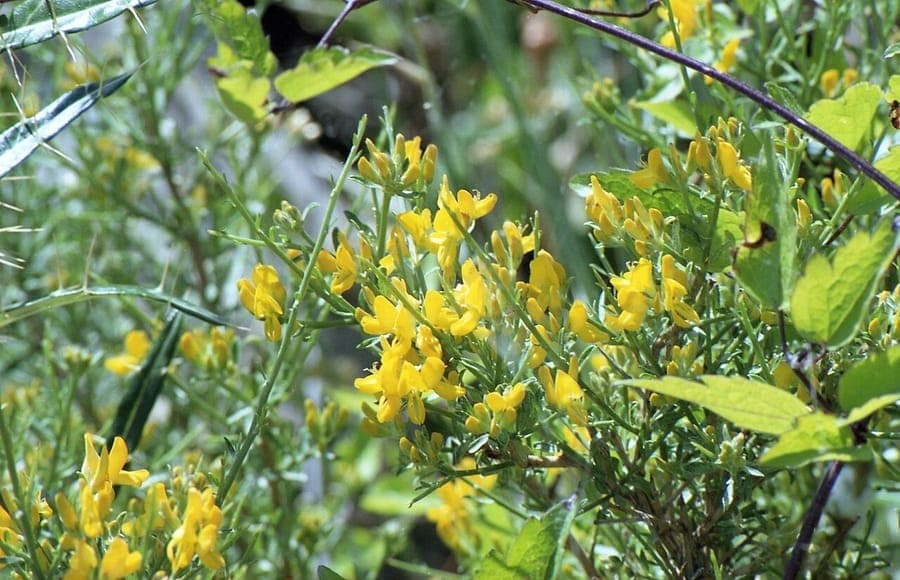
Omar Hoftun / CC BY-SA 3.0, via Wikimedia Commons
Corsican broom: complete guide
Genista corsica
Want to see Corsican broom: complete guide in your garden?
1 minute, no credit card
Overview
Corsican broom (Genista corsica) is a compact subshrub native to Corsica and Sardinia, belonging to the pea family Fabaceae. Despite its modest stature - rarely exceeding 60 cm in height - it earns its place in any garden through an exceptional display of golden-yellow flowers and a resilience that borders on indestructible in the right conditions. Gardeners planning a low-maintenance Mediterranean-style front garden will find this species one of the most rewarding choices available. At gardenworld.app we regularly recommend it for rocky slopes, raised beds, and gravelly borders where other plants struggle to establish. Its wild habitat on rocky hillsides and coastal scrubland in the western Mediterranean means it has evolved to thrive precisely where conditions are harshest: thin soil, high sun, and summer drought.
Appearance and bloom cycle
The plant forms a dense, intricately branched mound of slender green stems. The leaves are tiny - linear to lance-shaped - and in dry conditions they are shed early, leaving the photosynthetic stems to carry on the plant's energy production. This gives the plant a wiry, sculptural look between flowering periods. The flowers appear from March through June depending on location and season. They are a deep, pure gold-yellow, butterfly-shaped (papilionate) in the typical fashion of the pea family, borne in tight clusters along the length of each stem. Bees and other pollinators find them irresistible during the bloom period. After flowering, small hardened seed pods develop, turning brown when ripe in late summer. In autumn and winter the evergreen stem structure retains interest in the garden even without flowers.
Ideal location
Full sun is non-negotiable for Corsican broom. At least six hours of direct sunlight per day is required for good flowering; partial shade leads to a loose, open habit and significantly fewer blooms. A south- or south-west-facing spot, ideally sheltered from cold north-easterly winds in winter, suits it perfectly. It performs well in rock gardens, on dry banks, along pathways, and at the base of south-facing walls where reflected heat is plentiful. Avoid low-lying spots where cold air pools in winter or where water drains slowly after heavy rain. Containers work well provided drainage is exceptional. When planning a Mediterranean-themed front garden, this species pairs naturally with lavender, thyme, and cistus.
Soil
Soil quality in the traditional sense matters less than drainage. Corsican broom demands a freely draining substrate and will not tolerate waterlogged roots, particularly in winter. It prefers a slightly to moderately acidic pH, ideally between 5.0 and 5.5. Sandy, gritty, or rocky soils are ideal. Rich, fertile soils promote lush but soft growth with fewer flowers and reduced drought tolerance. If planting in clay-heavy soil, excavate generously and back-fill with a mix of the original soil, coarse sand, and fine gravel. For container growing, mix standard potting compost with perlite or grit at a 2:1 ratio and choose a container with good drainage holes. Feeding is generally unnecessary in poor soils; in containers, a single application of low-nitrogen fertilizer in early spring is sufficient.
Watering
Once established, Corsican broom is exceptionally drought tolerant and requires minimal supplemental watering. During the first growing season after planting, water regularly but moderately to help the root system develop. After that, established plants cope well with extended dry spells. In the winter months the soil should be allowed to dry out between waterings; overwatering in cool, wet conditions is the primary cause of plant loss. Rain usually provides adequate moisture in temperate climates during the growing season. In containers, always check the moisture level before watering and ensure the drainage hole is clear. If rainfall is heavy for extended periods, consider moving potted specimens under cover or to a less exposed spot.
Free design
Want to see Corsican broom: complete guide in your garden? Make a free design now.
Pruning
Prune immediately after flowering finishes in June, before new growth hardens off. Remove spent flower clusters and cut back each stem by approximately one third to maintain a compact, tidy shape. Do not cut into wood older than two years: unlike many shrubs, Corsican broom does not regenerate reliably from old wood, and hard renovation pruning often leads to bare patches or plant death. For young plants in their first two years, a light shaping after the first bloom encourages better branching. A sharp, clean pair of secateurs is the right tool - hedge shears on a setting that does not follow individual stems will leave ragged wounds. Consistent but gentle annual pruning maintains the plant's shape and extends its productive life considerably.
Maintenance calendar
January - February: check that drainage around the plant is functioning; remove any debris that traps moisture. March: first flowers open; no intervention needed, simply enjoy the display. April - May: peak flowering period; watch for pollinators. June: blooming finishes; prune now, cutting stems back by one third. July: recovery period; water sparingly if the weather is very hot and dry. August: summer dormancy; withhold fertilizer and keep watering minimal. September: new side-shoot growth visible; a light top-dressing of potassium-rich fertilizer is optional. October: growth slows; do not prune now. November: protect with a layer of dry mulch if hard frost is expected; cover with fleece in colder regions. December: inspect for frost damage; ensure drainage around roots is clear of standing water.
Winter hardiness
Corsican broom tolerates short periods of frost down to approximately -10 to -12 degrees Celsius, placing it in USDA hardiness zones 7 to 8. In most of central and northern Europe, this means it survives average winters comfortably, but an exceptionally hard winter with prolonged freezing temperatures can cause damage or death. A sheltered south-facing position next to a wall, fence, or building offers significant protection by moderating temperature extremes. Root protection with a generous layer of dry mulch - bark chips or dry leaves - reduces freeze depth in the soil. Wet cold is more damaging than dry frost; ensuring excellent drainage is the single most important winter precaution. In colder gardens, potted specimens can be moved to an unheated greenhouse or shed for the coldest months. At gardenworld.app we find that plants sited against a warm wall generally overwinter without any additional protection.
Companion plants
Corsican broom sits naturally alongside other drought-tolerant Mediterranean species. Lavender (Lavandula angustifolia) makes an obvious companion, offering complementary flower colours of purple and gold, identical growing conditions, and a similar low-maintenance profile. Thyme (Thymus spp.) works beautifully as a low ground cover between broom plants, its tiny flowers attracting the same pollinators. Rosemary adds structural contrast with its upright form and blue spring flowers. Cistus species share the rocky, sun-baked habitat and combine well visually. For a late-season note of colour, try planting Sedum or Sempervivum at the base; they require no additional water and provide year-round textural interest. Other broom relatives such as Genista tinctoria or Spartium junceum extend the yellow flowering season across the garden.
Closing
Corsican broom is a genuinely underused plant that rewards the gardener who chooses it wisely. Give it a hot, sunny, well-drained spot with impoverished soil and it will repay that minimal investment with decades of reliable spring colour. The golden flower display in April and May, the attractive wiry structure in winter, and the ecological value for early-season pollinators all make this species a model plant for the modern low-maintenance garden. Look for it at specialist nurseries and good garden centres. At gardenworld.app you can explore companion plant ideas and garden design options to make the most of this beautiful Mediterranean shrub in your own outdoor space.
Want to see Corsican broom: complete guide in your garden? Make a free design now.
Upload a photo, pick a style, and get a photorealistic design with plant list in under a minute.
10,000+ gardens designed already
No credit card required


Similar plants
Dyer's broom: complete guide
Genista tinctoria
Dyer's broom (Genista tinctoria) is a flowering shrub that thrives in sunny, well-drained soils. Perfect for dry garden areas, low-maintenance borders, and pollinator-friendly landscapes.
European broom: complete guide
Cytisus scoparius
Learn how to grow and care for European broom (Cytisus scoparius): ideal conditions, pruning, companion plants and seasonal calendar.
Spanish broom: complete guide
Spartium junceum
Discover Spanish broom, a beautiful yellow bloomer for sunny gardens. Learn how to grow, maintain and maximize blooming of this Mediterranean shrub.