
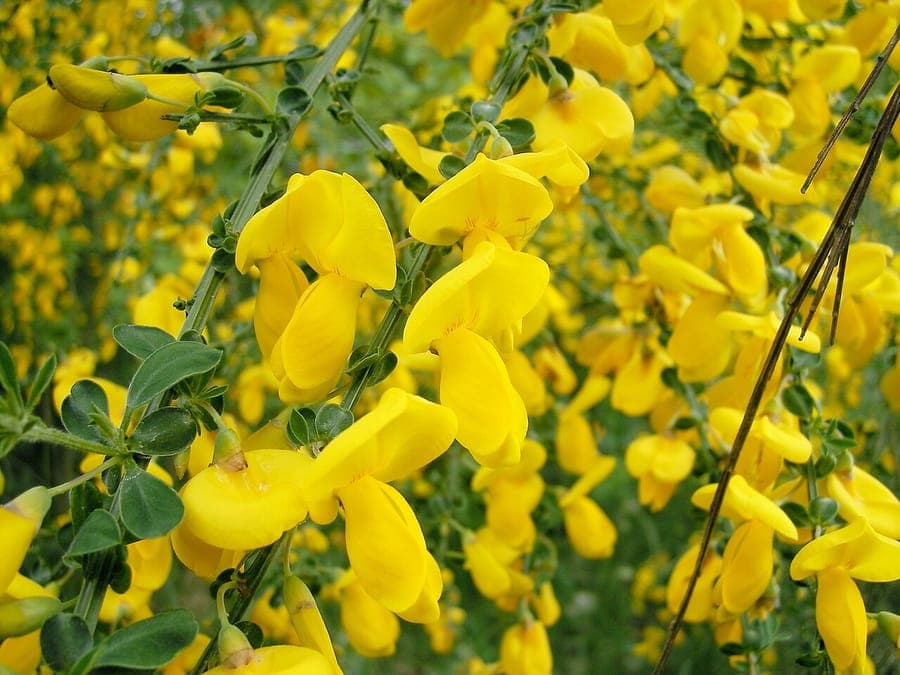
Danny S. / CC BY-SA 3.0, via Wikimedia Commons
European broom: complete guide
Cytisus scoparius
Want to see European broom: complete guide in your garden?
1 minute, no credit card
Overview
Cytisus scoparius, commonly known as European broom, is a fast-growing deciduous shrub that brings bold color and structure to gardens across temperate zones. Native to central and western Europe, including France, Austria and Belgium, it thrives in open, dry areas with poor soil - a trait that makes it perfect for challenging garden spots. As a member of the Fabaceae family, it fixes nitrogen in the soil, improving fertility over time.
This upright shrub typically reaches 1.5 to 2.5 meters in height with a spread of about 1 to 1.5 meters. It's fully hardy in USDA zones 6 to 8 (-20°C to -10°C), making it suitable for most of the UK, northern Europe and parts of the northern US. While it can self-seed aggressively in the wild, in a managed garden setting it's well-behaved and easy to control.
On gardenworld.app you can design a layout that integrates broom into a sunny, low-water garden scheme. Its upright form and bright blooms make it ideal for dry slopes, gravel gardens or naturalistic plantings.
Appearance & bloom cycle
The standout feature of European broom is its vibrant yellow flowers, which appear in dense racemes along the previous year's stems. Blooming occurs from late May through June, depending on your region. Each flower is pea-shaped and slightly fragrant, attracting bees and other pollinators. Some cultivars offer deeper yellow, orange or even red-tinged blooms, such as 'Moonlight' or 'Firefly'.
After flowering, the plant develops slender, dark green stems that turn woody with age. Seed pods form in summer and dry out by late summer, eventually bursting open with an audible snap, scattering seeds up to a meter away. If you want to prevent self-seeding, deadhead the flower clusters before the pods set.
The leaves are trifoliate, small and sparse, giving the plant an airy, open appearance. In hot, dry summers, it may partially defoliate - not a sign of disease, but a natural adaptation to drought.
Ideal location
European broom thrives in full sun - aim for at least 8 hours of direct sunlight daily. A south- or southeast-facing slope, gravel bed or dry bank is ideal. Avoid shady or humid areas, where it becomes leggy and prone to fungal issues.
It works particularly well in modern, low-maintenance landscapes. Use it as a structural accent in a xeriscape garden, or combine it with boulders and drought-tolerant perennials. On gardenworld.app you can experiment with virtual plantings to see how broom fits into your garden's sunniest corner.
Soil requirements
Well-drained, sandy or gravelly soil is best. Cytisus scoparius prefers a pH between 5.5 and 7. It grows well in poor, infertile soils - in fact, too much organic matter or fertilizer can reduce flowering. Avoid heavy clay soils unless amended with grit or sand to improve drainage.
If planting in acidic soils below pH 5.5, a light application of garden lime can help, but don't overdo it. Rich compost or manure should be avoided entirely.
Free design
Want to see European broom: complete guide in your garden? Make a free design now.
Watering
Once established, European broom is highly drought-tolerant. Young plants in their first growing season need regular watering - about once a week during dry spells, giving 10 liters per plant. After the first year, supplemental watering is rarely needed, unless facing prolonged drought.
Never let the roots sit in water. Overwatering leads to root rot. Water deeply but infrequently, and use gravel mulch to reduce evaporation and suppress weeds.
Pruning
Pruning is key to maintaining shape and encouraging flowering. Cut back flowered stems immediately after blooming, ideally by late June. Cut just above a strong outward-facing bud. Avoid cutting into old, leafless wood - broom doesn't regenerate well from old stems.
For older plants, rejuvenate by removing one-third of the oldest stems at ground level each year. This promotes vigorous new growth. Use sharp bypass pruners to avoid tearing the stems.
Maintenance calendar
- January: Check for winter damage, remove broken branches
- February: No action needed
- March: Light fork over soil, avoid fertilizing
- April: Water young plants if dry, watch for weeds
- May: Bloom begins, do not prune
- June: Peak flowering, prune immediately after
- July: Seed pods develop, remove if self-seeding is unwanted
- August: No special care needed
- September: Leave fallen debris as natural mulch
- October: None
- November: No action
- December: Protect young plants with bracken or brushwood in harsh winters
Winter hardiness
Hardy to USDA zone 6 (-20°C). In milder zones, it overwinters without issue. In colder areas, young stems may die back, but the plant usually recovers from the base. In regions with heavy snow, avoid piling salt-laden snow near the base.
The biggest threat in winter isn't cold, but wet soil. Ensure the planting site drains well to prevent root rot.
Companion plants
Choose companions with similar needs: full sun, dry soil, low fertility. Try lavender (Lavandula angustifolia), thrift (Armeria maritima), or rock rose (Helianthemum nummolarium). These create a harmonious, low-water planting scheme.
For contrast, add fine-textured grasses like Festuca glauca or Deschampsia cespitosa. These soften the broom's rigid form and extend seasonal interest into autumn.
Closing
European broom is a resilient, low-maintenance shrub that delivers high impact with minimal effort. Its bright spring display and architectural form make it a standout in sunny borders. Once established, it asks for little - just the right plant for gardeners who value beauty without the fuss.
Before planting, check compatibility with your site conditions on gardenworld.app. Use the platform to build a drought-resistant planting plan where broom plays a leading role.
Want to see European broom: complete guide in your garden? Make a free design now.
Upload a photo, pick a style, and get a photorealistic design with plant list in under a minute.
No credit card required


Similar plants
Tall Silky Lupine: complete guide
Lupinus elatus
Tall silky lupine is a fast-growing Californian perennial with silvery foliage and blue-purple flower spikes, ideal for a prairie-style garden.
Garfield Lupine: complete guide
Lupinus garfieldensis
The Garfield lupine is a rare, fast-growing American perennial for alkaline, dry grassland gardens, with striking blue flower spikes.
Lupinus elegans: complete guide
Lupinus elegans
Lupinus elegans, the elegant lupine, is a spectacular blooming plant from Mexico with blue flower spikes. Care, cultivation and garden use.