
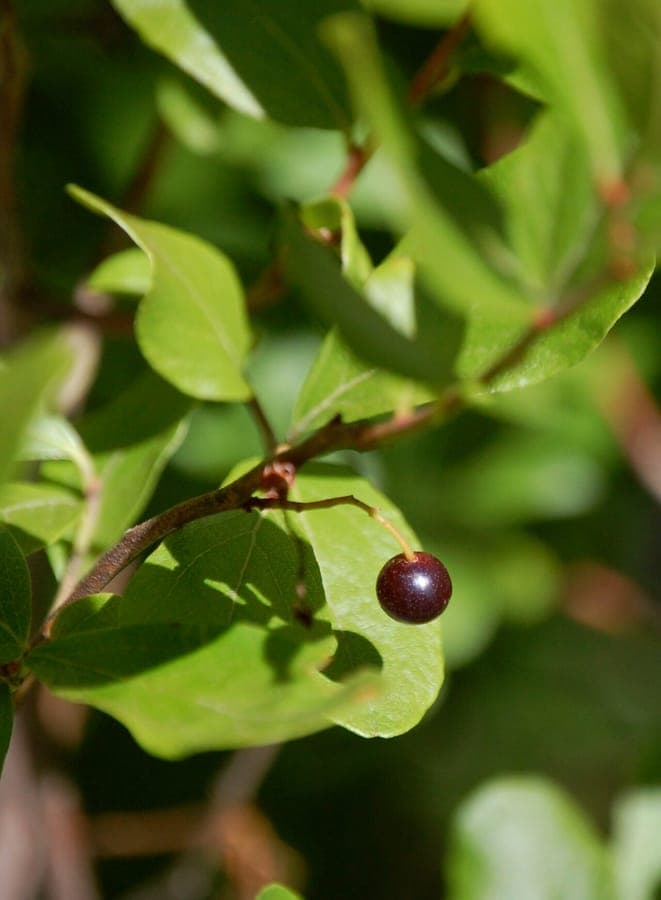
Steven G. Johnson / CC BY-SA 3.0, via Wikimedia Commons
Black huckleberry: complete guide
Gaylussacia baccata
Want to see Black huckleberry: complete guide in your garden?
1 minute, no credit card
Overview
Black huckleberry (Gaylussacia baccata) is a slow-growing, deciduous shrub in the heath family (Ericaceae), native to the eastern half of North America. Its range spans from Manitoba and Newfoundland in the north to Georgia, Alabama, and Arkansas in the south, covering much of the northeastern United States and eastern Canada. The species grows naturally on dry, acidic, sandy or rocky soils in open pine and oak forests, forest edges, and heathlands - precisely the lean, sun-dappled conditions where blueberries and heathers thrive.
The genus Gaylussacia contains about 45 to 50 species, virtually all native to North and South America. It is named after the French chemist Joseph Louis Gay-Lussac (1778–1850). Gaylussacia baccata was previously known as Gaylussacia resinosa and Vaccinium resinosum, among other synonyms, but the current name is now the accepted and stable designation.
Black huckleberry differs from the closely related blueberry (Vaccinium) in two easily observed ways: its leaves are dotted with small, yellowish resin glands that glint in backlit conditions (the earlier name resinosa - meaning 'resinous' - referenced this), and its fruits contain ten large, bony seeds rather than the numerous tiny seeds found in blueberries. It is this hard-seed crunch that earned it the folk name 'crackleberry' in parts of New England.
For European gardeners, black huckleberry is a little-known but rewarding addition to the acid garden. It delivers a crop of black, sweet berries with a rich, slightly resinous flavour in August and September, followed by outstanding autumn foliage in shades of red, orange, and burgundy comparable to the best azaleas.
Appearance & bloom cycle
Black huckleberry is a densely branched, multiple-stemmed shrub typically growing 30 to 90 cm tall, occasionally reaching 120 cm on ideal sites. Growth rate is genuinely slow: expect increases of only a few centimetres per year. The multi-stemmed form produces several upright main branches from the base, creating a rounded, bushy silhouette.
Leaves are alternate, elliptic to oval, 2 to 5 cm long, with both surfaces dotted with tiny yellowish resin glands. Summer foliage is mid- to dark green; in autumn it transitions to vivid reds, oranges, and deep burgundy - a colour display that rivals that of Enkianthus and Fothergilla in quality.
Flowers open in April to May, emerging with or just ahead of the new leaves. They are bell- to urn-shaped, 5 to 8 mm long, white to pale pink or reddish, and hang in small racemes along the previous year's branches. The pendant blooms are characteristic of the Ericaceae and attract bumblebees and solitary bees.
Berries ripen from August to September: round, glossy black with a slight bluish bloom, 6 to 10 mm in diameter. The flesh is sweet and aromatic with a slightly resinous depth of flavour, but firm-textured due to the ten large, hard seeds inside. In North American folk cooking, huckleberries have long been prized for jams, pies, syrups, and infused spirits. Many bird species - thrushes, pheasants, grouse, and waxwings among them - eagerly consume the ripe fruit and disperse the seeds.
Ideal location
Black huckleberry is most at home in a sunny to partly shaded position with acid, well-drained soil. In its native range it occupies dry, infertile, sandy or rocky slopes in open pine-oak woodland and heath margins - lean conditions where richer-soiled competitors cannot thrive. In cultivation it performs better on moderately poor, acid soil than on fertile garden ground, where excessive growth can produce soft, frost-susceptible shoots.
In garden use, suitable positions include: the sunny to part-shaded border alongside rhododendrons, azaleas, and blueberries; the edge of a heather garden; or an open clearing in a light conifer garden. Group planting spacing: 60 to 90 cm centre to centre, allowing plants to grow into a cohesive, shrubby mass over five to ten years. As a specimen plant in a heather bed, allow 100 cm of space.
Avoid positions with alkaline soil, heavy clay, or permanent wet feet. Once established, the shrub is notably drought-tolerant, but young plants can struggle if planted into dry conditions without adequate initial watering.
Soil requirements
Like all Ericaceae, black huckleberry demands acid soil: pH 4.5 to 6.5, ideally 5.0 to 5.5. On neutral or alkaline soils, iron-deficiency chlorosis develops and growth stalls. Soil amendment is necessary in gardens where pH is too high.
The ideal substrate is light, sandy to sandy-loam, low to moderately organic, free-draining, and lime-free. Heavy clay is unsuitable without significant modification. Before planting in sandy soil, incorporate 20 to 30% ericaceous compost through the top 30 cm. On clay, construct a raised bed using a substrate of 60% sharp sand, 30% ericaceous compost, and 10% fine grit.
Annual mulching with pine needle compost or chipped pine bark (5 cm layer) maintains soil acidity, retains moisture, and protects the shallow root system. Never apply garden lime or dolomite nearby. Use only acid-type slow-release fertilisers formulated for rhododendrons and blueberries - once per year in early spring. High-nitrogen synthetic feeds promote soft growth vulnerable to late frost.
Free design
Want to see Black huckleberry: complete guide in your garden? Make a free design now.
Watering
Black huckleberry is relatively drought-tolerant once established, but requires regular watering during the first two to three years after planting to develop a strong root system. Rainwater or soft water is strongly preferred, as hard tap water raises soil pH over time.
In the first growing season: water weekly during dry spells (May–September), keeping soil evenly moist but never waterlogged. In the second year, reduce to fortnightly watering. Established plants (three years and older) are largely self-sufficient in most temperate climates and can bridge two to three weeks of drought.
During berry development (August–September), adequate soil moisture is important for fruit size, quality, and flavour. Drought in this period can result in smaller, less juicy berries. A soaker hose at the base of the planting is the most efficient delivery method, keeping foliage dry and delivering moisture directly to the roots.
Supplemental watering in winter is rarely necessary, but check soil moisture during prolonged dry frost periods.
Pruning
Black huckleberry is a moderate grower that requires little pruning. It naturally forms a compact, rounded shrub with little tendency to outgrow its space or overwhelm neighbours. Routine maintenance involves:
Establishment pruning (first three years): In spring (March–April), remove any dead stems and dried-out wood completely to encourage new growth from the base and build a sound branch structure.
Maintenance pruning (mature plant): Every two to three years in early spring, a light tidy-up can be given: cut back over-long, weak, or crossing branches to within 10 to 15 cm of their origin to keep the plant compact and productive. Never remove more than one third of total branch volume at once.
Renovation: Very old specimens (15 years or more) that have lost vigour can be cut hard in early spring to 10 cm above ground level. The plant regenerates vigorously from the root stock but takes two to three years to return to full productivity.
Berries are borne on the previous year's wood, so avoid pruning all one-year-old stems in late winter if a harvest is desired.
Maintenance calendar
January–February: Dormancy. Inspect for frost damage. No pruning required.
March: Remove dead or damaged branches. Apply 5 cm pine needle mulch. Give a light feed with acid-type slow-release fertiliser.
April–May: Flowering period. Bell-shaped flowers appear along branches. Water once a week during dry spells. Check soil moisture.
June–July: Berry development. Maintain light, even soil moisture. No pruning.
August–September: Berries ripen: glossy black, ready to harvest. Pick by hand when fully black and easily detached. Expect to share the crop with birds.
October: Autumn colour. Leaves turn from green through red, orange, and burgundy. No maintenance needed - enjoy the display.
November: Leaf fall. Leaves can be left as additional mulch around the plant base.
December: Winter dormancy. No active maintenance.
Winter hardiness
Black huckleberry is a robustly cold-hardy shrub. In its native North American range it survives temperatures of -30 °C and lower. On the USDA hardiness scale, the species falls in zones 3 to 7, making it suitable for virtually all of northern and western Europe including the Netherlands, Belgium, Germany, France, and the UK.
In Atlantic European gardens (USDA zones 7 to 8), black huckleberry is fully reliable through winter without protection. Being deciduous, it loses its leaves in autumn and enters full dormancy. In spring, the buds break reliably and produce fresh growth. Young plants in their first winter benefit from a 8 to 10 cm mulch of dry leaves or straw around the root collar to prevent frost penetration, but established plants need no protection.
A sheltered position on the leeward side of a hedge or wall reduces wind desiccation of young shoots following late frost, which can cause superficial tip dieback. This is not a serious problem and the plant regenerates easily.
Companion plants
Black huckleberry is a natural fit in an acid-soil garden or heather planting alongside:
- Vaccinium corymbosum (highbush blueberry): close Ericaceae relative with identical soil requirements; blue berries beside the black huckleberries for a varied autumn harvest; both show outstanding autumn colour.
- Rhododendron cultivars (medium to tall): large, flowery structural shrubs above the more compact Gaylussacia; both root systems thrive in the same acid, humus-enriched soil.
- Calluna vulgaris (heather, various cultivars): same pH requirements; late-summer flowering in August–September coincides with ripening huckleberries for a doubly ornamental display.
- Kalmia angustifolia (sheep laurel): compact, acid-loving shrub with pink-red flowers in May–June; well-matched in scale and climate requirement to Gaylussacia.
- Betula nana (dwarf birch): small northern European birch species thriving on the same poor, acid soils; yellow autumn colour contrasts beautifully with the red-orange of Gaylussacia.
- Arctostaphylos uva-ursi (bearberry): prostrate, acid-tolerant, evergreen groundcover as a carpet layer beneath the taller Gaylussacia shrubs.
Avoid companions that require alkaline or neutral soil: roses, lavender, clematis, and common hydrangeas are incompatible neighbours.
For planting plans combining berry-producing acid-soil shrubs and heather-garden companions, visit gardenworld.app for tailored garden design ideas. More articles on acid-loving shrubs and berry gardens are available at gardenworld.app.
Conclusion
Black huckleberry is an uncommon but highly rewarding shrub for the European acid garden: slow-growing, drought-tolerant once established, spectacular in autumn colour, and productive as a berry crop. Provide the right acidic soil at pH 4.5 to 6.5 and a sunny to partly shaded position, and this low-maintenance shrub will return that investment many times over - with glossy black berries for table and wildlife alike, brilliant autumn foliage, and a reliable, compact presence in the heather border for decades.
Want to see Black huckleberry: complete guide in your garden? Make a free design now.
Upload a photo, pick a style, and get a photorealistic design with plant list in under a minute.
10,000+ gardens designed already
No credit card required


Similar plants
Zenobia pulverulenta: complete guide
Zenobia pulverulenta
Everything about Zenobia pulverulenta (honeycup): siting, acid soil, pruning and the fragrant white bells, in this complete care guide.
Dwarf huckleberry: complete guide
Gaylussacia dumosa
Everything about dwarf huckleberry (Gaylussacia dumosa): acidic soil, partial shade, pruning and care for this compact North American berry shrub.
Drooping leucothoe: complete guide
Leucothoe fontanesiana
Everything about drooping leucothoe (Leucothoe fontanesiana): shade tolerance, soil, watering, pruning, hardiness and companion plants.