
Jomegat / CC BY-SA 3.0, via Wikimedia Commons
Creeping snowberry: complete guide
Gaultheria hispidula
Want to see Creeping snowberry: complete guide in your garden?
1 minute, no credit card
Overview
Creeping snowberry (Gaultheria hispidula) is a low-growing, evergreen subshrub in the heath family (Ericaceae), native to subarctic and boreal North America. Its range extends from Nunavut, Labrador, and Newfoundland in the far north, south through Quebec, Ontario, and the Maritime Provinces, into the northeastern United States as far as Maryland and West Virginia, and westward to Manitoba, Saskatchewan, Alberta, British Columbia, and the Pacific Northwest states of Washington and Idaho.
The genus Gaultheria includes approximately 170 species distributed across North and South America, East Asia, and Australasia. The most widely grown garden species in Europe is Gaultheria procumbens (eastern teaberry or checkerberry), known for its bright red winter berries and wintergreen fragrance. Creeping snowberry is a more modest cousin: its white berries are smaller and its habit lower and more delicately prostrate, but it is equally valuable ecologically and visually distinctive in the right garden setting.
The species has a rich history of synonymy - it has been known as Chiogenes hispidula, Gaultheria serpyllifolia, Chiogenes serpyllifolia, and several other names - but the current accepted name Gaultheria hispidula, based on Bigelow's 1824 description, is stable and widely used in botanical literature. The specific epithet hispidula (Latin for 'slightly bristly') refers to the fine, stiff hairs that cover the young stems and petioles.
In garden use, creeping snowberry is an excellent choice for acid-soil groundcover plantings in shaded positions under conifers, in peat gardens, on shaded rockeries, and alongside acid-loving companions such as blueberries and rhododendrons. Its slow growth requires patience but ultimately rewards the gardener with a dense, finely textured carpet of glossy dark-green leaves dotted with white berries in autumn.
Appearance & bloom cycle
Creeping snowberry is unmistakably a ground-hugging plant. Stems rarely exceed 5 to 10 cm in height but spread freely along the soil surface via slender stolons that can extend 30 to 60 cm or more. Young stems are covered in characteristic small, reddish-brown, stiff hairs, giving them a bristly texture to the touch - the feature encoded in the species name hispidula.
Leaves are small, oval to broadly elliptic, typically 5 to 12 mm long, with a glossy dark-green upper surface and paler underside. They are arranged alternately along the stems and have a leathery, firm texture. Crushed or bruised leaves emit a faint but distinct wintergreen fragrance, the result of methyl salicylate present in the leaf tissue - a trait shared across the entire Gaultheria genus.
Flowers appear from April to June (sometimes into July on cooler, higher-elevation sites). They are tiny, urn- to bell-shaped, white to faintly pink, and hang individually or in small clusters from the leaf axils along the stems. Each flower measures just 3 to 5 mm - remarkably small even by Ericaceae standards. Pollination is carried out by small bees and hoverflies attracted to the pendant, nectar-rich blooms.
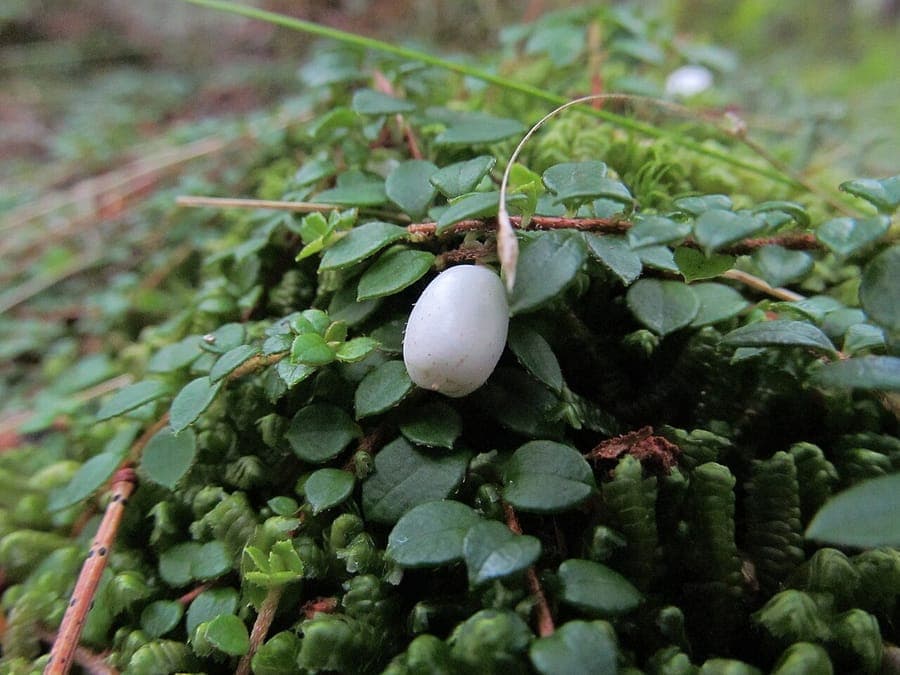
Fruits ripen from August to October: round, white, fleshy berries measuring 5 to 8 mm in diameter. They have a mild, wintergreen-tinged flavour and are eagerly eaten by thrushes, woodpeckers, and other woodland birds that aid seed dispersal. The white berries stand out beautifully against the dark-green foliage and represent the plant's most ornamental feature. The common name 'maidenhair berry' refers to the delicate appearance of the fruiting plant, while 'moxieplum' is an older vernacular used in parts of New England.
Growth is genuinely slow. Expect new plants to spread by only a few centimetres per year during the first two to three seasons. Once established, the pace picks up slightly but remains characteristically unhurried. This is a plant for the patient gardener, not one seeking rapid coverage.
Ideal location
In the wild, creeping snowberry occupies cool, moist, partially shaded habitats: mossy rock outcrops and rotting logs in conifer forest, wet forest margins, sphagnum bogs, and the shaded banks of boreal lakes and streams. It is closely associated with sphagnum moss and often grows through thick moss carpets.
In garden conditions, the ideal position is shaded to partially shaded, sheltered from direct afternoon sun. Beneath conifers (spruce, fir, pine), under the north-facing side of hedges or buildings, or in a peat garden are all suitable. A north or northeast aspect is preferable. Direct summer sun, particularly afternoon sun, dries the soil rapidly and risks scorching and desiccating the small leaves.
Plant spacing for groundcover use: 15 to 25 cm apart. Closer spacing (15 cm) achieves a closed canopy faster given the plant's slow growth rate. In rock garden crevices or between stepping stones in a shaded, acid-soil garden, individual plants can be used as accent specimens.
Soil requirements
Creeping snowberry demands strongly acid soil with pH 4.0 to 6.5, with optimal performance between pH 4.5 and 5.5. This is similar to the requirements of blueberries (Vaccinium species), azaleas, and rhododendrons. On neutral or alkaline soils, the plant will develop chlorosis (yellowing from iron deficiency) and decline.
In gardens with neutral soil, full bed preparation is necessary before planting: excavate to 30 cm depth and replace the soil with a mixture of 50% ericaceous compost or sphagnum peat and 50% sharp sand or perlite. This creates a fast-draining yet moisture-retentive, acidic substrate. Never use garden lime or alkaline fertilisers near the planting.
Watering with hard tap water (high in calcium) will gradually raise soil pH. Rainwater or collected soft water should be used whenever possible. Annual mulching with pine needle compost, chipped pine bark, or fresh sphagnum moss maintains soil acidity, retains moisture, and insulates the shallow root system from temperature extremes.
The root system is fine, fibrous, and shallow - avoid deep cultivation around established plants. Surface mulching is sufficient routine maintenance.
Free design
Want to see Creeping snowberry: complete guide in your garden? Make a free design now.
Watering
Creeping snowberry requires consistently moist but well-drained soil. Prolonged waterlogging, where roots sit in standing water for days, causes root rot and plant death. The ideal soil feel is that of a well-wrung sponge: damp throughout but never sodden.
In summer, during warm and dry conditions, water once or twice a week to maintain soil moisture. Always use rainwater or soft water to avoid calcium build-up. Drip irrigation or a soaker hose at the base of the planting is ideal - overhead watering that keeps foliage persistently wet can encourage fungal issues on the fine-textured leaves.
In spring and autumn, when evaporation rates are low, watering every two weeks is typically sufficient. In winter, supplemental watering is usually unnecessary, but during prolonged dry frosts, water lightly with soft water to prevent desiccation of the evergreen leaves.
Newly planted specimens need attentive care for the first two growing seasons until roots are well established. Mature, established plants are more tolerant but still benefit from consistent moisture, particularly in summer.
Pruning
Creeping snowberry requires almost no pruning. Its naturally low, spreading habit does not require shaping or restraining. After winter, inspect the planting for dead or frost-damaged stems and cut these cleanly back to the base with sharp secateurs. This encourages fresh growth from the base.
On older, dense plantings where stems have become congested and tangled, a light renovation in March or April - carefully pulling out old woody stems and mulching bare patches - can refresh the planting. Avoid hard pruning, as this species recovers slowly from severe cutting.
Berries are borne on the current year's growth, so avoid removing flowering shoots in late spring if autumn fruit is desired. The best approach is minimal intervention: leave the plant undisturbed unless dead or clearly diseased tissue is visible.
Maintenance calendar
January–February: Frost monitoring. During prolonged cold, dry spells, water lightly with soft water to prevent desiccation of evergreen leaves. Otherwise leave undisturbed.
March: Remove winter-damaged stems, cutting cleanly to the base. Apply a fresh 3 to 5 cm mulch of pine needle compost or sphagnum moss. Check soil pH and amend with sulphur if it has risen above 5.5.
April: Buds begin to swell. Maintain consistent soil moisture. Inspect for any signs of iron chlorosis (yellow leaves) - treat with chelated iron if needed.
May–June: Flowering period. Tiny white blooms appear along stems. Water with rainwater; avoid alkaline tap water.
July–August: Fruit development. White berries begin forming. Maintain moisture and shade during summer heat.
September–October: Berries fully ripe - the plant's most ornamental phase. Light maintenance only.
November: Growth ceases. No pruning. Refresh mulch if thin.
December: Dormant. Monitor soil moisture during dry frost periods.
Winter hardiness
Creeping snowberry is exceptionally winter hardy, shaped by its subarctic origins. On the USDA scale, it falls in zones 2 to 6, capable of surviving temperatures as low as -40 °C in its native range. In Western European climates (broadly USDA zone 6 to 8), the plant overwinters without any protection whatsoever.
In gardens across the Netherlands, Belgium, Germany, and France (USDA zones 7 to 8), creeping snowberry is fully reliable in winter. The evergreen leaves may discolour slightly or show marginal scorch under conditions combining hard frost with dry, bright sunshine and wind, but recover fully when temperatures moderate. Positioning the plant in a sheltered, north-facing spot beneath a tree canopy largely eliminates this risk.
In exceptionally severe winters, a light covering of pine branches (5 to 10 cm) placed over the plant in December provides straightforward protection. In most mild Atlantic winters, this is unnecessary.
Companion plants
Because of its specific acid soil requirement, creeping snowberry pairs best with other ericaceous and acid-tolerant plants in a consistent, low-pH planting scheme:
- Vaccinium myrtillus (bilberry) or Vaccinium corymbosum (highbush blueberry): identical growing conditions; blue berries provide colour contrast to the white snowberries; joint autumn fruit display for birds.
- Low-growing rhododendron cultivars (e.g., 'Ramapo', 'Sneezy', 'Dora Amateis'): provide structure and spring flower colour above the creeping Gaultheria; shed acid needles as natural mulch.
- Calluna vulgaris (heather, various cultivars): same pH requirements; late-summer flowering coincides beautifully with ripening white berries.
- Picea abies 'Nidiformis' (bird's nest spruce): slow-growing dwarf conifer providing shade and acid needle mulch above the Gaultheria.
- Oxalis acetosella (wood sorrel): finely textured shade perennial for the same wet, acid, woodland floor; white spring flowers and clover-like leaves complement Gaultheria beautifully.
- Sphagnum moss: not a conventional garden plant but an ideal companion to maintain moisture and soil acidity around Gaultheria stems in a peat garden setting.
For planting inspiration and garden designs incorporating acid-loving groundcovers, visit gardenworld.app to explore tailored design options. More articles on ericaceous plants and peat garden design are available at gardenworld.app.
Conclusion
Creeping snowberry is a rewarding choice for the patient, detail-oriented gardener who wants something genuinely unusual: a rare, slow-growing, evergreen groundcover with charming white autumn berries for the most acidic, shaded corner of the garden. Its requirements are specific - acid soil at pH 4.0 to 6.5, consistent moisture, shade, and ideally soft rainwater - but gardeners who can meet these conditions will be rewarded with a dense, glossy carpet that earns its keep visually, ecologically, and year-round.
With its extraordinary cold hardiness (USDA zones 2 to 6, well within European growing conditions), its support for pollinators in spring and birds in autumn, and its restrained, refined aesthetic, Gaultheria hispidula deserves a place in every serious acid-soil garden.
Want to see Creeping snowberry: complete guide in your garden? Make a free design now.
Upload a photo, pick a style, and get a photorealistic design with plant list in under a minute.
10,000+ gardens designed already
No credit card required


Similar plants
Zenobia pulverulenta: complete guide
Zenobia pulverulenta
Everything about Zenobia pulverulenta (honeycup): siting, acid soil, pruning and the fragrant white bells, in this complete care guide.
Dwarf huckleberry: complete guide
Gaylussacia dumosa
Everything about dwarf huckleberry (Gaylussacia dumosa): acidic soil, partial shade, pruning and care for this compact North American berry shrub.
Drooping leucothoe: complete guide
Leucothoe fontanesiana
Everything about drooping leucothoe (Leucothoe fontanesiana): shade tolerance, soil, watering, pruning, hardiness and companion plants.