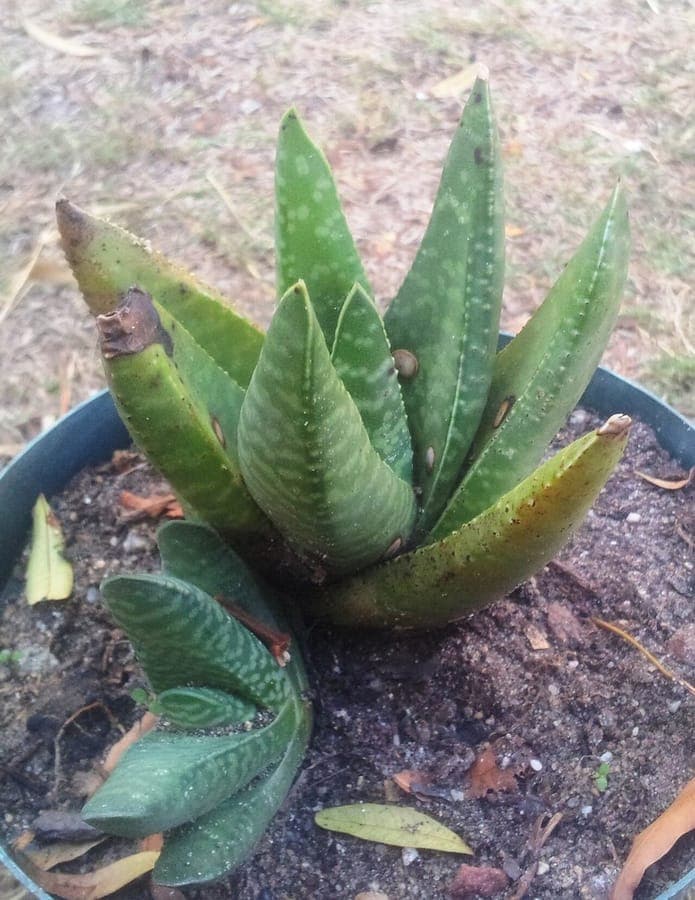
Abu Shawka / CC BY-SA 4.0, via Wikimedia Commons
Keeled gasteria (Gasteria carinata): complete guide
Gasteria carinata
Want to see Keeled gasteria (Gasteria carinata): complete guide in your garden?
Full design in HD: €7.99
Look after your Keeled gasteria with the GardenWorld app
Identify plants with your camera and get a care calendar with reminders for this plant.


Overview
Gasteria carinata is a compact South African succulent that deserves a place on far more windowsills. It is related to the aloes and haworthias but has a character of its own: thick, hard, tongue-like leaves dotted with white speckles, with a ridge running along the underside. That ridge gives the plant its name, since carinata means "keeled". In English it is known as keeled gasteria or Bredasdorp gasteria, after a town in its native range.
In the wild it grows in the south of the Western Cape, roughly between Hermanus and Mossel Bay, on rocky ground in fynbos and renosterveld. It often tucks itself into the lee of shrubs or boulders, partly shaded from the harsh sun. That explains why it does so well indoors: where many succulents stretch and fade in a dim room, a gasteria stays compact and healthy.
It is an excellent plant for beginners and for anyone without a sunny south-facing window. It grows slowly, forms a small cluster of rosettes after a few years and needs very little attention. If you would like to see how plants like this fit into a wider plan for your home and garden, you can have a garden design made on gardenworld.app, with room for patio and indoor plants too.
Appearance and flowering
The leaves are triangular to lance-shaped, thick and stiff, ending in a sharp point. They are dark to olive green, covered in small white dots or tubercles that often line up in transverse bands, giving a faintly striped look. The upper surface is slightly channelled, and mature plants carry a clear keel underneath. Young plants usually arrange their leaves in two rows; older ones form a spiral rosette. Each rosette stays small, from a few centimetres to around 15 cm tall, but the plant produces offsets freely and builds up a dense clump.
There are several varieties. The typical Gasteria carinata var. carinata has keeled, rough, tuberculate leaves. Var. verrucosa has upright leaves in two ranks, densely covered with white tubercles, and is sometimes treated as a separate species. Nurseries also sell local forms under their own names.
The flowers are the hallmark of the whole genus. They hang from a long, slender stem that can reach about half a metre and usually appear in spring and early summer in cultivation. Each bloom is a curved tube of around 2 cm, pink to orange-red with a greenish tip, swollen at the base. That bulging shape gave the genus its name: gaster is Greek for stomach.
Light and position
Give Gasteria carinata bright light without hours of harsh midday sun. An east- or west-facing window is ideal, and a north-facing one works too. Behind a south-facing window, keep it half a metre back or behind a sheer curtain. Too much sun shows as leaves turning red, bronze or yellowish; that is a stress response and fades once the plant gets a little more shade.
In summer it can go outside in a sheltered spot with morning sun or light shade, for example under a garden table or in the shadow of larger pots. Avoid hollows where rainwater collects. It is happy at normal room temperature all year and does not need high humidity.
Watering and rest
Gasterias store water in their leaves and can go weeks without a drink. During the growing season, from March to October, water thoroughly once the potting mix has dried out completely. In a living room that usually means every two to three weeks, depending on pot size and warmth. Tip away any water left in the saucer.
In winter the plant barely grows. If it sits somewhere cool, around 10 to 15 °C, give it a small drink once a month at most. In a warm room it may need a little more. Wrinkled, thinning leaves mean it is thirsty. Glassy, soft leaves or a rotting base mean too much water, which is by far the most common mistake.
Free preview
Want to see Keeled gasteria (Gasteria carinata): complete guide in your garden? Make a free preview of your design.
Potting mix and repotting
Use an open mix of cactus compost with at least a third mineral grit such as pumice, lava rock or coarse sand. Gasterias have fairly thick, fleshy roots that like to spread sideways, so a wide, shallow pot works well. Terracotta dries out faster than plastic and is the safer choice.
Repot every two to three years in spring, or as soon as the clump fills the pot. That is also the best time to separate offsets. Wait a week before watering after repotting. Feed two or three times during the growing season with a well-diluted cactus fertiliser; more is unnecessary.
Grooming and pruning
No real pruning is needed. Cut spent flower stems off at the base and gently pull away dried lower leaves. Wipe dust off the leaves with a soft, dry brush. Now and then, check between the leaf bases for mealybugs, small white fluffy pests that you can remove with a cotton bud dipped in a little alcohol.
Propagation
Gasteria carinata is easy to multiply. The quickest method is division: in spring, separate an offset that already has its own roots and pot it up on its own. An offset without roots should first be left to dry for a few days.
Leaf cuttings also work well with gasterias. Snap or cut a healthy leaf as close to the base as possible, let it dry for a week, then lay it on or push the base lightly into a dry mix of sand and cactus compost. Roots appear after a few weeks, followed by a tiny rosette at the base. Only water once roots have formed. Seed is another option: fresh seed germinates fairly easily in a warm, bright spot.
Care calendar
March to April: growth resumes. Repot, divide offsets, take leaf cuttings.
May to June: flowering time for many plants. Move outside to a sheltered, partly shaded spot if you like.
July to August: water thoroughly when the mix is dry. Watch for scorch in strong sun.
September to October: last feed. Bring indoors before the first cold nights.
November to February: rest period. Bright, cool or at room temperature, little water.
The plant calendar on gardenworld.app can send you a reminder when it is time to repot or cut back on watering.
Winter hardiness
Gasteria carinata is not hardy. It may survive a brief, dry dip to around freezing, but frost damages the leaves. Keep it frost-free in winter, preferably no colder than 5 °C. A cool, bright room or a frost-protected greenhouse is ideal, though an ordinary living room is perfectly fine. A cooler winter does encourage flowering the following spring.
Toxicity for pets
There are no known cases of poisoning in cats or dogs from Gasteria carinata, and gasterias are generally regarded as harmless. Official, well-documented data are lacking, though. Err on the side of caution: a cat that chews the tough leaves may still end up with an upset stomach, if only from the fibre. Ideally keep the plant out of reach of pets that nibble, and ask your vet if you are in any doubt.
Companion plants
Gasteria carinata looks good in a bowl or on a shelf alongside other succulents that do not need full sun. The blue-green rosettes of Aloe striata and the small, spiny rosettes of Aloe humilis suit it well, as does Crassula ovata as a taller accent. The felted leaves of Kalanchoe tomentosa offer a soft counterpoint to the rough, speckled leaves. Choose plants with the same watering rhythm, so the whole bowl dries out evenly.
Final thoughts
Gasteria carinata is a small, tough succulent that does exactly what you want from a houseplant: it looks good all year and asks for very little. Give it light without fierce midday sun, an open potting mix and water only when the pot is dry. In return you get a growing cluster of speckled rosettes and, with a little luck, its graceful, stomach-shaped flowers every spring.
Frequently asked questions about Keeled gasteria
Is Keeled gasteria winter hardy?
Gasteria carinata is not hardy. It may survive a brief, dry dip to around freezing, but frost damages the leaves.
How much water does Keeled gasteria need?
Gasterias store water in their leaves and can go weeks without a drink. During the growing season, from March to October, water thoroughly once the potting mix has dried out completely.

See it in your garden
See Keeled gasteria in your garden
One photo of your garden and a few questions. You see the result in about a minute.
Try it with a photoIdentify this plant in your own garden. Identify a plant
Similar plants
Aloe striata: complete guide to the coral aloe
Aloe striata
Discover everything about Aloe striata, the beautiful coral aloe with striped leaves. Care tips, location and advice for successful growth in your garden.
Dwarf hedgehog aloe: complete guide
Aloe humilis
Discover dwarf hedgehog aloe (Aloe humilis), a compact South African succulent with red-tinted foliage and yellow flowers. Care and growing guide.
Jade plant: complete guide
Crassula ovata
Discover how to care for Crassula ovata: ideal lighting, watering, and seasonal care. A low-maintenance succulent perfect for homes and gardens on gardenworld.app.
