
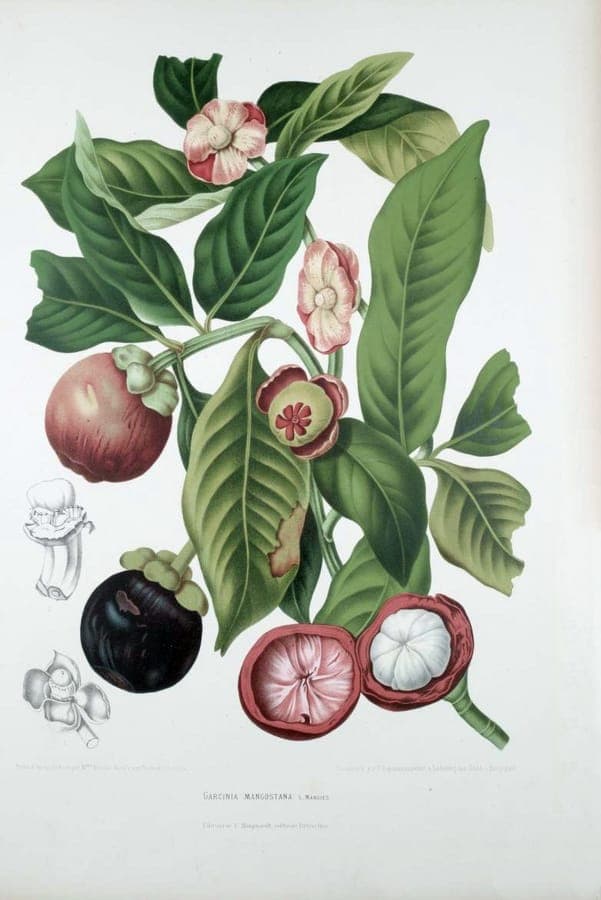
Berthe Hoola van Nooten (1817-1892), Pieter De Pannemaeker (lithographer) / Public domain, via Wikimedia Commons
Mangosteen: complete guide
Garcinia mangostana
Want to see Mangosteen: complete guide in your garden?
1 minute, no credit card
Overview
The mangosteen (Garcinia mangostana), native to the rainforests of peninsular Malaysia and Borneo, has been celebrated for centuries as one of the world's finest fruits. Its deep purple rind conceals segments of snowy-white flesh with a flavour that balances rich sweetness with a delicate, lychee-like acidity. Queen Victoria is said to have offered a substantial reward to anyone who could deliver her fresh mangosteens - hence the enduring title "queen of fruits". Outside the tropics, growing this tree demands a heated glasshouse or conservatory kept at tropical temperatures year-round. The challenge is real, but so is the reward for committed growers. On gardenworld.app you can design tropical conservatory spaces and exotic garden rooms to showcase specimen plants like this one.
Appearance and fruiting cycle
Garcinia mangostana is a slow-growing, pyramidal tree reaching 6 to 25 metres in its natural habitat, but typically stays under 3 to 4 metres in a container or glasshouse setting. The leaves are large, leathery, and distinctively glossy on the upper surface - deep green and attractively ornamental even without fruit. They are oval to elliptic, typically 20 to 25 cm long. The flowers are fleshy, yellowish-green with reddish margins, and appear in small clusters at shoot tips. Flowering may not occur until 5 to 10 years after planting, even in ideal conditions - the mangosteen is notoriously patient. The fruit itself is the main attraction: a smooth, dark purple sphere 5 to 7 cm in diameter, its thick rind enclosing four to eight white flesh segments each containing a seed. In cultivation outside the tropics, fruiting can take considerably longer than in the natural range.
Ideal location
Mangosteen is strictly tropical and is rated for USDA hardiness zones 10b to 12 only - temperatures below 4 degrees Celsius damage the plant and any frost will kill it. In the United Kingdom, the Netherlands, Belgium, and similar climates, this tree must remain in a heated glasshouse or large conservatory at all times. Night temperatures should not fall below 10 to 13 degrees Celsius; daytime temperatures of 25 to 35 degrees Celsius are ideal. The tree tolerates direct sun but young plants benefit from light shading during the hottest midday hours. Relative humidity should be kept at 80 per cent or above to replicate the tropical rainforest environment. Moving containers outdoors during warm summers is possible when night temperatures consistently exceed 15 degrees Celsius, but any hint of cold should prompt immediate return indoors.
Soil
The mangosteen prefers deep, moisture-retentive but well-draining, slightly acid to mildly acid sandy or loamy soil with a pH of 5.0 to 6.5. For container culture, a mixture of three parts quality potting compost, two parts perlite or coarse sand, and one part well-rotted organic matter works well. Add a slow-release organic fertiliser at the rate recommended on the packet. Strongly alkaline or calcareous soils are unsuitable and cause leaf chlorosis. Because the tree develops a deep root system, always use tall, deep containers - minimum 50 cm depth for established specimens. Repot every two to three years in spring as growth resumes.
Free design
Want to see Mangosteen: complete guide in your garden? Make a free design now.
Watering
Consistent moisture is key: the soil should remain evenly moist but never waterlogged. Waterlogging causes root rot which is extremely difficult to reverse in this species. Water thoroughly when the top 3 to 4 cm of the growing medium feels dry, allowing excess to drain freely from the base. In a warm, sunny glasshouse during summer, daily watering may be necessary. Use rainwater or low-lime tapwater where possible, as the tree is sensitive to high calcium levels. Regular misting of the foliage raises ambient humidity and prevents leaf-edge browning.
Pruning
The mangosteen's naturally neat, pyramidal habit means pruning requirements are minimal. Remove dead, diseased, or crossing branches as needed. Any significant pruning is best carried out immediately after the fruit harvest or at the very start of the new growing season in early spring. Never remove more than 20 per cent of the canopy at one time, as the tree responds slowly to drastic intervention. Branches growing strongly inward toward the centre or rubbing against others are the primary candidates for removal.
Maintenance calendar
January to February: maintain minimum temperatures; water sparingly during the relative rest period. March: new growth begins - ideal time for light pruning and repotting young trees. April to May: raise temperature to summer levels; begin monthly liquid feeding with a balanced organic fertiliser. June to August: peak growing period; maintain high humidity; water daily; containers may go outdoors if nights are warm enough. September to October: transition to cooler conditions; reduce watering frequency; begin lowering temperatures gradually. November to December: cooler rest period; keep above 12 degrees Celsius; water sparingly to avoid root rot.
Winter hardiness
The mangosteen is one of the most cold-sensitive fruiting trees in cultivation worldwide. It cannot tolerate frost of any kind and suffers lasting damage at temperatures below 4 degrees Celsius. In the British Isles, the Low Countries, and all of northern continental Europe, the tree is entirely tender and must be kept under heated glass at all times throughout the year. Specialist tropical nurseries and some garden centres with a tropical plant department occasionally stock young plants; online suppliers focusing on exotic fruits are often the most reliable source.
Companion plants
In a tropical glasshouse, the mangosteen suits placement alongside other slow-growing tropical fruit trees such as banana (Musa species), carambola (Averrhoa carambola), and soursop (Annona muricata). Large tree ferns like Dicksonia antarctica and Cyathea species fill the lower levels and contribute to humidity. Epiphytic orchids and bromeliads mounted on bark slabs add further tropical character. In a smaller conservatory, the mangosteen in a large container combines well with other tender exotics such as Plumeria, Hibiscus rosa-sinensis, and Passiflora. Visit gardenworld.app to plan a tropical conservatory layout that integrates specimen trees with complementary planting.
Closing thoughts
Growing a mangosteen in a cool-climate garden is one of the most ambitious projects a glasshouse enthusiast can undertake. The slow pace of growth, the demand for consistent tropical conditions, and the years of waiting before first fruit are considerable hurdles. Yet the tree is genuinely beautiful at every stage of its life - the glossy foliage, the intriguing flowers, and ultimately the extraordinary fruit justify every effort. Seek young plants from specialist tropical nurseries and treat this as a long-term investment in an extraordinary living specimen.
Want to see Mangosteen: complete guide in your garden? Make a free design now.
Upload a photo, pick a style, and get a photorealistic design with plant list in under a minute.
10,000+ gardens designed already
No credit card required


Similar plants
Muskwood: complete guide
Guarea guidonia
Everything about muskwood (Guarea guidonia): tropical origins, appearance, cultivation in conservatories and warm gardens, care and companions.
American licorice: complete guide
Glycyrrhiza lepidota
Everything about American licorice (Glycyrrhiza lepidota): cultivation, location, soil, care and companion planting in your garden.
Creeping snowberry: complete guide
Gaultheria hispidula
Complete guide to creeping snowberry (Gaultheria hispidula): acid soil, moisture needs, companion plants and care across all seasons.