
Wikimedia Commons / Public domain, via Wikimedia Commons
American licorice: complete guide
Glycyrrhiza lepidota
Want to see American licorice: complete guide in your garden?
1 minute, no credit card
Overview
American licorice (Glycyrrhiza lepidota) is a robust, herbaceous perennial in the legume family (Fabaceae), native to the vast grasslands and prairies of North America - from the Canadian provinces of Alberta, British Columbia, Manitoba, Ontario, and Saskatchewan southward through more than 30 US states to the arid borderlands of northeast Mexico. Frederick Pursh first formally described the species in 1813 in his landmark Flora Americae Septentrionalis.
The species belongs to the same genus as the commercially important common licorice (Glycyrrhiza glabra) of Mediterranean origin, though it is a distinct species adapted to continental, semi-arid conditions. The species epithet 'lepidota' is Latin for 'scaly' or 'covered with scales,' a reference to the glandular, resinous dots that cover the stems, petioles, and leaflets - a distinctive tactile feature.
Many Indigenous peoples of the Great Plains and Pacific Northwest made extensive use of this plant. Several nations chewed the sweet roots as a licorice substitute; young stems were peeled and eaten raw in spring; leaves served as fodder for horses; and root decoctions were taken for respiratory complaints. The hooked, burr-like seed pods were used as toys by children and the roots provided a natural sweetener in communities where cane sugar was unavailable.
For gardeners, American licorice offers something genuinely different: an upright, architecturally interesting perennial with creamy-white flower spikes that bloom from June to August, followed by burr-covered seed pods that add winter interest. Discover how this plant can anchor a drought-resilient border by browsing garden design ideas on gardenworld.app.
Appearance & bloom cycle
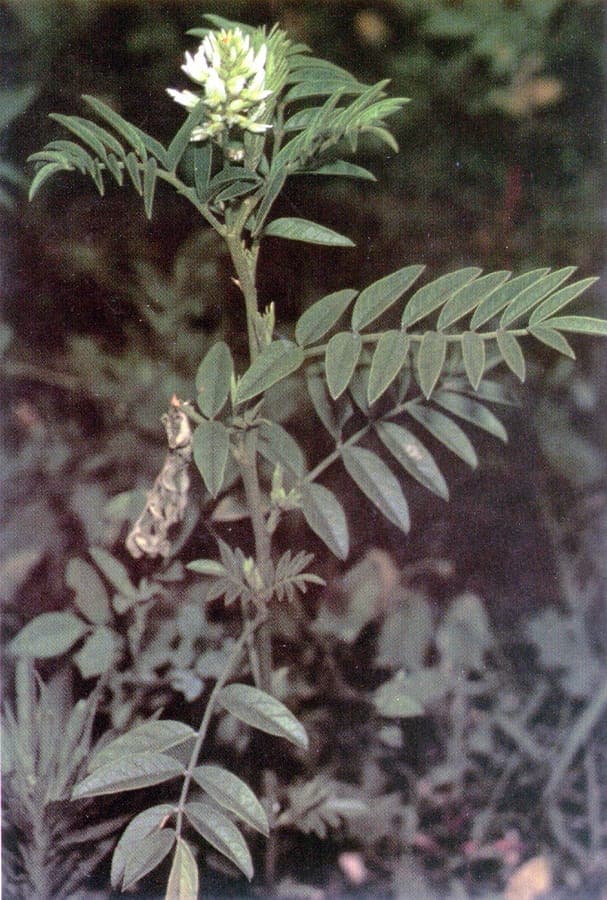
American licorice grows as a strongly upright, freely branching herb reaching 60 to 120 cm in height. The stems are firm and angular, covered with fine grey hairs and the characteristic resinous scales. The root system is extensive: deep, fleshy rhizomes that can penetrate 1–2 metres into the soil and spread laterally to form sizeable colonies over time.
Leaves are pinnately compound, each with 11 to 19 oblong leaflets of 2–4 cm length. The upper surface is deep green and slightly sticky, the underside paler with more pronounced venation. The overall leaf can reach 15–20 cm in length, giving the plant a lush, full-bodied appearance reminiscent of Astragalus or Vicia species.
Bloom time runs from June to August. Flowers are produced in dense, erect racemes of 4–8 cm. Individual flowers are white to pale yellow, pea-shaped (papilionaceous) with a standard, two wing petals, and a keel. They carry a faint sweet fragrance and attract bumble bees, solitary bees, and various butterfly species.
Following flowering, clusters of 1–2 cm spiny brown seed pods develop. The hooked spines function as an effective dispersal mechanism, attaching readily to clothing, animal fur, and feathers. The pods remain on the plant through winter, adding textural interest to the winter garden and providing seeds for birds such as goldfinches.
Ideal location
American licorice thrives in open, full-sun positions with at least 6 hours of direct sunlight daily. The plant performs poorly in deep shade, where stems become drawn and bloom is significantly reduced. A south- or west-facing open border, a sunny slope, or a gravel garden setting all suit it well.
This species is particularly well-suited to dry, windswept positions that challenge most other perennials. On its native prairies, Glycyrrhiza lepidota endures summer heat above 35 °C, strong desiccating winds, and weeks without rainfall - conditions that would kill less resilient plants. This makes it genuinely valuable in contemporary gardens designed to minimize irrigation dependency.
Avoid positions with standing water after rain, heavy tree shade that creates drip lines, or poorly drained compacted soil. A gentle slope to assist drainage is beneficial. Container growing is not generally recommended given the deep rhizome habit.
Soil requirements
American licorice is exceptionally adaptable in its soil preferences. It tolerates loam, clay, and sandy substrates across a wide pH range of 5.5 to 8.0 - from mildly acid to mildly alkaline. This breadth of tolerance makes it useful in situations where other perennials struggle.
The most important soil characteristic is drainage: the plant dislikes waterlogged conditions. On heavy clay, work in a generous quantity of compost and coarse grit through the top 30 cm before planting to improve permeability. On poor sandy soil, the plant performs excellently without amendment.
As a member of the Fabaceae, American licorice forms a symbiotic relationship with nitrogen-fixing bacteria in root nodules. This means the plant effectively fertilises itself and can thrive on nutrient-poor soils where most flowering perennials would struggle. It is an excellent choice for disturbed ground, roadside plantings, and low-maintenance naturalistic borders. Space plants 60–90 cm apart to accommodate lateral rhizome spread.
Free design
Want to see American licorice: complete guide in your garden? Make a free design now.
Watering
Once established, American licorice is a genuinely drought-tolerant plant requiring minimal supplemental watering. The deep, fleshy rhizomes access moisture from lower soil horizons and sustain the plant through extended dry periods without visible stress.
During the first growing season after planting, consistent watering is important to help the plant develop its root system. Water two to three times per week in warm, dry weather, ensuring the soil stays lightly moist at a depth of 20 cm. A soaker hose or drip line positioned around the base is ideal, delivering water directly to the root zone and reducing the risk of fungal leaf problems from overhead watering.
From the second year onward, irrigation can be drastically reduced. In the UK, Belgium, and the Netherlands, rainfall is generally sufficient through most summers. Only during prolonged heat spells - three weeks or more above 28 °C without rainfall - is supplemental watering necessary. When watering is required, soak the root zone thoroughly once a week rather than applying light, frequent applications that encourage shallow rooting.
Pruning
American licorice requires minimal pruning. The key intervention is cutting all above-ground stems back to 5–10 cm above soil level in early spring, just as new growth buds become visible. This practice encourages more compact growth, prevents the plant from becoming leggy, and stimulates a more prolific bloom.
During the growing season, removing spent flower racemes is optional. Deadheading can encourage a modest second flush of bloom later in the season and prevents any unwanted self-seeding, though self-seeding is rarely invasive. However, the spiny seed pods are ornamentally attractive and can be left in place through winter for texture and as bird food.
Removing an established plant is considerably more involved than routine pruning, as the deep rhizomes regenerate from fragments. A digging fork or soil auger is needed to remove as much of the root system as possible. Small root pieces that remain will likely produce new shoots the following spring.
Maintenance calendar
February–March: Cut all above-ground stems to 5–10 cm. Apply a 2–3 cm layer of well-composted organic material around the base. This is the primary maintenance operation of the year.
April–May: New growth emerges. Water during dry spells to support establishment. Check lateral spread of rhizomes if the plant is in a restricted planting area; install root barriers 30 cm deep if containment is desired.
June–August: Peak bloom period. Enjoy the white flower spikes. Remove spent racemes if a tidy appearance is preferred, or leave them for pod development. Water during extreme heat events.
September–October: Seed pods ripen to brown. Above-ground growth begins to die back. Leave stems standing for winter structure and wildlife value.
November–January: No maintenance required. Rhizomes overwinter reliably underground. In exceptional cold below -20 °C, a light mulch layer of 5 cm dry leaves provides additional insulation, though this is rarely necessary in northwest European gardens.
Winter hardiness
American licorice is exceptionally cold-hardy. It is rated for USDA zones 3 through 8, tolerating winter temperatures as low as -40 °C. In the context of UK and northwest European gardens - where winters rarely fall below -15 °C - no winter protection whatsoever is needed.
Above-ground stems die back completely in autumn, but the deep rhizomes remain fully viable through even the coldest winters and break into strong new growth each spring. This reliable regeneration pattern makes the plant particularly suitable for gardens where continuity across years matters.
In sheltered urban gardens, stems may remain standing later into autumn before the first hard frost terminates the season. The first sustained frost of around -5 °C will generally end active growth for the year.
Companion plants
American licorice combines effectively with other drought-tolerant, sun-loving perennials. The following pairings work particularly well in garden centre sourced plantings across north-western Europe:
- Echinacea purpurea (purple coneflower): overlapping bloom period in pink-purple contrasting beautifully with the white licorice spikes. Plant 60–80 cm apart.
- Perovskia atriplicifolia (Russian sage): silver-blue flower spires complement the white blooms, and both thrive in dry, alkaline conditions.
- Baptisia australis (false indigo): blue flowers in May–June precede the licorice bloom, maintaining interest across the summer. Both reach 80–120 cm and have a similarly upright habit.
- Liatris spicata (blazing star): purple spikes in August–September when licorice is forming its seed pods. The colour transition through the season is visually satisfying.
- Solidago rugosa (rough-stemmed goldenrod): golden plumes in August–September, similarly tough, low-maintenance, and adapted to open, dry positions.
Avoid moisture-loving neighbours such as Astilbe, Ligularia, or Rodgersia, whose water requirements are fundamentally incompatible with the dry-adapted nature of American licorice.
Conclusion
American licorice is a plant for gardeners who value botanical authenticity, ecological function, and genuine low-maintenance credentials. Its combination of drought resistance, ornamental flower spikes, intriguing seed pods, and extraordinary cold hardiness makes Glycyrrhiza lepidota a rewarding perennial for the naturalistic border, prairie-style planting, or any garden designed to minimise water use.
Explore how American licorice could feature in your own garden design at gardenworld.app - personalised layouts, plant combinations, and expert design visualisations are just a few clicks away. More articles on drought-tolerant and prairie-inspired perennials are available at gardenworld.app.
Want to see American licorice: complete guide in your garden? Make a free design now.
Upload a photo, pick a style, and get a photorealistic design with plant list in under a minute.
10,000+ gardens designed already
No credit card required


Similar plants
Tall Silky Lupine: complete guide
Lupinus elatus
Tall silky lupine is a fast-growing Californian perennial with silvery foliage and blue-purple flower spikes, ideal for a prairie-style garden.
Garfield Lupine: complete guide
Lupinus garfieldensis
The Garfield lupine is a rare, fast-growing American perennial for alkaline, dry grassland gardens, with striking blue flower spikes.
Lupinus elegans: complete guide
Lupinus elegans
Lupinus elegans, the elegant lupine, is a spectacular blooming plant from Mexico with blue flower spikes. Care, cultivation and garden use.