
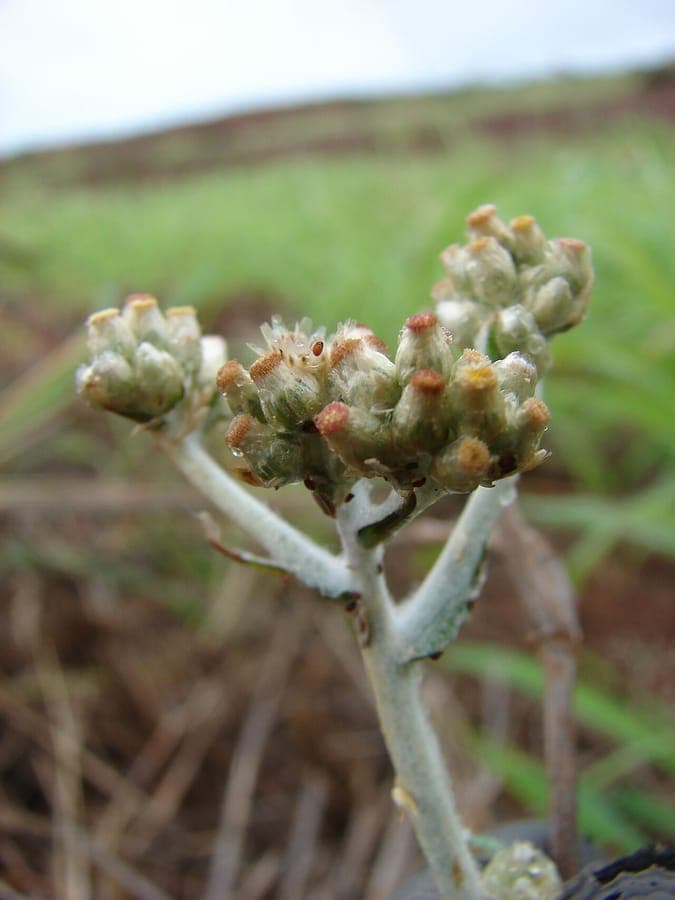
Forest & Kim Starr / CC BY 3.0, via Wikimedia Commons
Spoonleaf purple everlasting: complete guide
Gamochaeta purpurea
Want to see Spoonleaf purple everlasting: complete guide in your garden?
1 minute, no credit card
Overview
Gamochaeta purpurea, known in English as spoonleaf purple everlasting, purple cudweed or American cudweed, is a herbaceous plant in the large Asteraceae family. The species name 'purpurea' is Latin for purple, referring to the distinctive purple-tinged bracts around the tiny flower heads that give this plant its most striking visual character. Originally described by Carl Linnaeus as Gnaphalium purpureum and later reclassified into the genus Gamochaeta by the Argentine botanist Angel Cabrera in 1961, this species has a vast native range spanning from eastern Canada south through the entire eastern United States, Mexico, Central America, the Caribbean and most of South America. Through human activity it has also naturalised widely across Europe, Africa, Australia and much of Asia. In its native range it is a common plant of open, disturbed ground - fields, roadsides, sandy clearings and open woodlands. For gardeners seeking a low-growing, woolly-textured plant for dry sunny conditions, Gamochaeta purpurea offers distinctive character with minimal fuss. Explore naturalistic garden designs that incorporate wildflowers like this one at gardenworld.app.
Appearance and bloom cycle
Gamochaeta purpurea is an annual or sometimes biennial herb that forms a basal rosette of spoon-shaped leaves - the 'spoonleaf' common name refers precisely to this characteristic leaf outline, which broadens toward the tip like a spoon. The basal leaves are broad, grey-green and densely covered in white woolly hairs, giving the plant a soft, felted appearance that catches the light attractively. Stem leaves are narrower and taper gradually upward. Flower stems reach typically 15 to 40 centimetres in height, standing upright or slightly arching. The small flower heads are clustered in a spike-like or raceme-like inflorescence at the top of the stem. Each individual flower head is tiny - no more than four to five millimetres across - but the surrounding bracts and involucre scales show clear purple-brown colouring that gives the species its name. The true inner florets are white to pale pink. Depending on climate and location, flowering occurs from spring through early summer, and in warmer regions can extend further into the year. After flowering, the plant produces light plumed fruits dispersed by the wind.
Ideal location
Gamochaeta purpurea thrives in open, fully sunny to lightly shaded positions. In its natural range it grows on open, disturbed soils including grasslands, roadsides, field margins, wasteland and open pine woodlands. The species is a classic pioneer that establishes readily where the vegetation cover is thin or open. In the garden it suits a gravel garden, a dry border, a paving joint planting or as a filler in open patches in a naturalistic plant community. The plant is excellent for hot, dry summer conditions that stress less resilient species. At gardenworld.app you will find extensive inspiration for naturalistic garden designs that incorporate pioneer plants and native wildflowers in coherent compositions.
Soil
Gamochaeta purpurea is undemanding in terms of soil quality and in fact thrives on lean, dry to moderately moist substrates. In the wild it is found on sandy, loamy or lightly clay-bearing soils across a broad pH range from slightly acid to slightly alkaline. Rich, heavily composted garden soil is unnecessary and may actually promote excessive leafy growth at the expense of flowering. A free-draining, light soil with little organic matter is ideal. In heavy or compacted clay, drainage can be improved by working coarse sand into the planting area. The plant shows some tolerance for slightly saline or compacted conditions, making it suitable for challenging spots in the garden.
Watering
Once established, Gamochaeta purpurea is highly drought tolerant and needs little supplementary watering. During the germination and establishment phase regular but moderate watering is helpful. Once settled the plant withstands extended dry spells without damage. In a free-draining, dry garden bed, additional summer watering is almost never necessary. During prolonged heat, a light weekly watering can support growth without over-pampering the plant. Overwatering in poorly draining soil is the greatest risk to the root system. Natural rainfall is sufficient for established plants in a typical temperate climate.
Free design
Want to see Spoonleaf purple everlasting: complete guide in your garden? Make a free design now.
Pruning
As an annual or biennial, Gamochaeta purpurea does not require the regular pruning cycle that perennial plants need. After flowering, the stem can be cut back to prevent seed spread in the garden, or left to self-seed freely for the following year. At the end of the season, dried stems can be removed to keep the garden tidy. If the plant overwinters as a biennial, the flower stem of the second year can be cut back after blooming. Young basal rosettes are best left undisturbed through winter. No structural pruning programme is needed.
Maintenance calendar
January-February: if overwintering as a biennial, basal rosettes remain green; no action needed. March: in mild weather stems begin to elongate; check whether the plant has successfully overwintered. April: stems become noticeably taller; in warmer regions flowering may already begin. May: flowering period in temperate regions; purple-tinged flower heads appear on the spikes. June: peak of flowering; seeds begin to ripen on the lower part of the spike. July: seeds disperse by wind; leave the plant standing for self-seeding or cut stems before seed release. August: annual specimens die back after seeding. September: young seedlings may appear on suitable open ground nearby. October-November: no action required. December: frost kills annual specimens; biennial rosettes survive mild winters at sheltered positions.
Winter hardiness
In temperate European climates Gamochaeta purpurea behaves as an annual or occasionally biennial plant. Annual specimens die after setting seed in summer or autumn. Biennial plants survive mild winters in the basal rosette stage and flower in their second year. Light frosts down to around -5 degrees Celsius are generally tolerated. Severe or prolonged frost kills above-ground parts. The plant originates from warmer climatic zones (USDA zones 7 to 11) but functions successfully in cooler gardens through its annual life cycle. Seed survives winter in the soil reliably and germinates the following spring when conditions are suitable.
Companion plants
Gamochaeta purpurea fits well into naturalistically composed plant communities of open, dry habitats. Good companions include annual and biennial wildflowers, low grasses and other composites with similar site preferences. Consider low-growing members of the Erigeron genus (fleabanes), small Helichrysum species, short drought-tolerant grasses such as Bouteloua gracilis, and other low pioneer species. In a gravel garden or wildflower meadow setting the plant works well as a self-sown filler between larger perennials. Avoid pairing with vigorous spreading perennials that shade out this compact plant. Seek additional plant material at specialist wildflower seed suppliers or nurseries focusing on North American native plants. For complete planting designs incorporating wildflowers, gardenworld.app provides professional design inspiration and plant combination ideas tailored to naturalistic gardens.
Closing
Gamochaeta purpurea is a modest but botanically interesting plant with a wide geographic distribution and distinctive small purple-tinged flower heads. As a pioneer of open, dry habitats it has a natural character well suited to gravel gardens, wildflower plantings and naturalistic borders. Its drought tolerance, minimal soil requirements and capacity for self-seeding make it an easy-care addition to the right setting. The plant is not typically stocked by mainstream garden centres; seek it through specialist wildflower seed suppliers or botanical garden plant sales. For design inspiration that incorporates wildflowers like this everlasting into coherent garden compositions, visit gardenworld.app for professional planning tools and comprehensive plant combination guidance.
Want to see Spoonleaf purple everlasting: complete guide in your garden? Make a free design now.
Upload a photo, pick a style, and get a photorealistic design with plant list in under a minute.
10,000+ gardens designed already
No credit card required


Similar plants
Hairy goldenaster: complete guide
Heterotheca villosa
Full guide to Heterotheca villosa: site, soil, watering, and care for this tough prairie perennial with long-lasting golden-yellow flowers.
Cutleaf daisy: complete guide
Erigeron compositus
Full guide to growing Erigeron compositus: ideal site, soil, watering, pruning, and companion plants for this alpine daisy.
Subalpine fleabane: complete guide
Erigeron peregrinus
Full guide to growing Erigeron peregrinus: purple blooms, moist soils, ideal site, winter hardiness, and companion plants for this alpine daisy.