
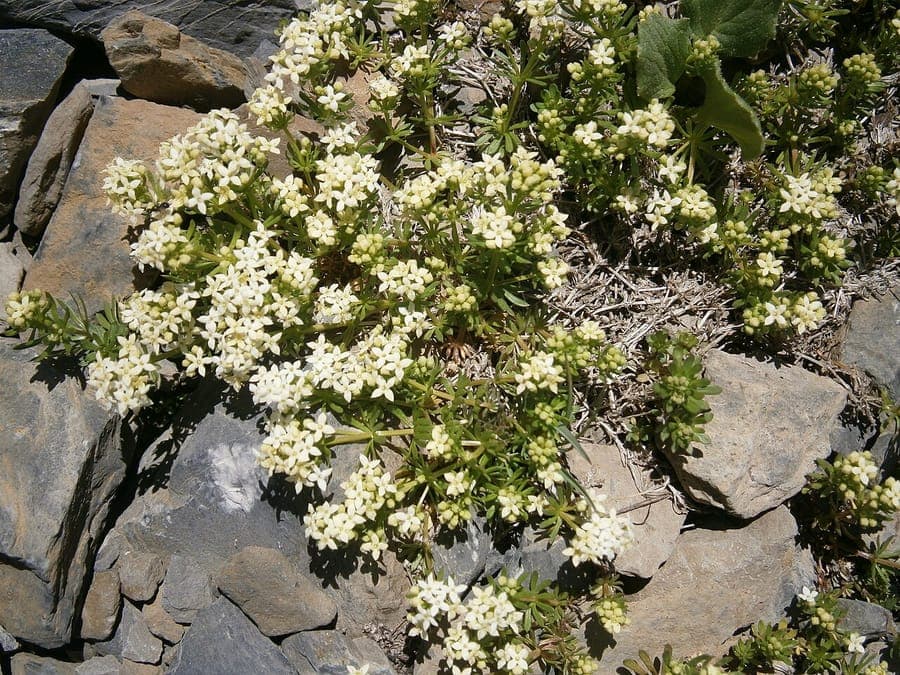
Meneerke bloem / CC BY-SA 3.0, via Wikimedia Commons
Swiss bedstraw: complete guide
Galium megalospermum
Want to see Swiss bedstraw: complete guide in your garden?
1 minute, no credit card
Overview
Galium megalospermum, commonly called Swiss bedstraw or large-seeded bedstraw, is a perennial alpine herb belonging to the Rubiaceae family. The species name 'megalospermum' comes from the Greek 'mega' (large) and 'sperma' (seed), a direct reference to the notably large seeds that distinguish this species from most other bedstraws in the European mountain flora. The plant was first formally described by the Italian-Swiss botanist Carlo Allioni in 1773, making it one of the earlier alpine plants to receive scientific description. It is native to the Alps across five countries: Switzerland, Austria, France, Germany and Italy, growing typically on calcareous, stony substrates at high elevations. For gardeners seeking to bring authentic Alpine character to a rock garden or mountain planting scheme, this little-known species is a rewarding and distinctive choice. Inspiration for complete garden designs incorporating alpine plants is available at gardenworld.app.
Appearance and bloom cycle
Galium megalospermum forms open, loosely spreading stems that may stand slightly upright or recline against surrounding rocks and plants. Like all bedstraws, the stems are characteristically square in cross-section. The leaves are arranged in whorls of six to eight, slightly broader and more numerous per whorl than in related species like G. cespitosum. Individually, the leaves are narrow and lance-shaped, a similar shape across the genus. The flowers are white and star-shaped, small in the typical Galium manner, appearing throughout July and August with a faint sweet scent on warm days. After flowering, the plant produces the large, distinctive seeds from which the species takes its name - these are among the largest seeds in the entire European Galium flora. The seeds bear tiny hooked hairs that assist dispersal by catching on animal fur or clothing. The plant remains evergreen through winter and spreads moderately.
Ideal location
Galium megalospermum grows best in an open, fully sunny to lightly shaded position. In its natural Alpine habitat it occurs on calcareous, rocky mountain meadows, along paths and in rock crevices, typically between 800 and 2200 metres above sea level. In the garden it is well suited to a rock garden, a dry stone wall, a gravel garden or a dedicated alpine bed with good drainage. Full sun is well tolerated, and light partial shade near a low shrub or rock is also acceptable. Avoid fully shaded positions and locations prone to waterlogging. The plant is well suited to naturalistic planting designs that mirror mountain landscapes; gardenworld.app provides inspiration for such garden compositions.
Soil
A dry to moderately moist, free-draining, mineral-rich soil is ideal for this species. In its natural range Galium megalospermum colonises calcareous, lean mountain soils with a neutral to slightly alkaline pH between 6.5 and 7.5. Heavy clay soil is completely unsuitable. When planting, always mix coarse sand, grit or crushed stone into the garden soil or compost to improve drainage significantly. A lean planting mix of equal parts garden soil, coarse sand and horticultural grit works well. Rich, humus-heavy soil encourages soft, floppy growth and raises the risk of fungal root diseases. A surface mulch of coarse gravel around the plant helps keep the soil surface dry and deters competition from weeds.
Watering
Once established, Galium megalospermum is drought-tolerant and manages well without supplementary watering. In the first few weeks after planting, regular but moderate watering encourages rooting and establishment. After that period, natural rainfall is more than adequate in most temperate climates. Overwatering is the main cause of plant failure: prolonged wet roots, especially in winter, lead to root rot. In a well-drained rock garden or gravel bed, additional summer watering is almost never needed. During extreme, prolonged drought, light weekly watering can reduce visible stress without saturating the root zone. Always water at the base to keep the foliage dry.
Free design
Want to see Swiss bedstraw: complete guide in your garden? Make a free design now.
Pruning
Galium megalospermum requires very little pruning. After flowering in August, spent flowering stems can be cut back to roughly one third of the plant's total height. This encourages a fresh flush of foliage in late summer and keeps the plant compact and tidy. Avoid hard cutting back to ground level as the plant recovers more slowly from severe pruning and becomes more susceptible to early autumn frosts. In early spring, once the last frosts have passed, any dead or frost-damaged stems can be carefully removed. No further structured pruning is required. In a correctly dimensioned planting position the plant manages itself naturally.
Maintenance calendar
January-February: rest period; no action required, the plant remains evergreen. March: check for frost damage and remove dead stems once temperatures rise consistently above freezing. April: new shoots emerge at the base; top up surrounding gravel if the soil surface has become compacted or if erosion has occurred. May-June: growing season underway; remove competing weeds promptly. July-August: flowering period; white flowers appear and the plant is at its most decorative. Early August: lightly trim spent flower stems. September: growth slows; the distinctive large seeds ripen. October-November: no special care required. December: for young specimens, a thin layer of grit can be applied as an additional moisture buffer around the base.
Winter hardiness
As a true Alpine plant, Galium megalospermum is exceptionally winter hardy and comparable to the hardiest mountain plants in the European flora. In its natural Alpine habitat across Switzerland, Austria and adjacent regions it survives severe winter frosts and months under snow without any damage. In garden conditions the species is rated at USDA hardiness zones 5 to 8, meaning temperatures down to -28 degrees Celsius present no problem for established plants. In temperate climates across northern Europe and the British Isles the plant is fully hardy without any protection. The key condition, as with all alpine plants, remains drainage: standing water combined with frost is more damaging than cold alone. A free-draining gravel bed is the best insurance against winter losses.
Companion plants
Galium megalospermum associates well with a wide range of other alpine and rock garden plants. Good companions include low-growing pinks (Dianthus species), small stonecrops (Sedum album, S. acre), houseleeks (Sempervivum), creeping thyme (Thymus serpyllum), mountain avens (Dryas octopetala) and pasque flowers (Pulsatilla). These plants share similar requirements for a sunny, lean, free-draining position. Avoid pairing with vigorous ground-covering spreaders such as Ajuga or large ornamental grasses that may shade out the bedstraw. Seek companion plants at specialist alpine nurseries for the best selection. For complete planting schemes and design inspiration built around Alpine mountain flora, visit gardenworld.app to explore professional tools and plant combination ideas suited to your outdoor space.
Closing
Galium megalospermum is a botanically distinctive plant that earns its place in any well-considered rock garden or alpine planting through a combination of attractive white summer flowers in July and August, notably large decorative seeds, and outstanding winter hardiness to USDA zone 5. Its low maintenance demands and drought tolerance make it a practical as well as beautiful choice for lean, mineral-rich garden sites. The species is rarely found at mainstream garden centres; seek it out at specialist alpine plant nurseries or through botanical garden plant sales. For broader design inspiration and professional garden planning tools that can incorporate mountain plants like this one, gardenworld.app is an excellent starting point.
Want to see Swiss bedstraw: complete guide in your garden? Make a free design now.
Upload a photo, pick a style, and get a photorealistic design with plant list in under a minute.
10,000+ gardens designed already
No credit card required


Similar plants
Pyrenean bedstraw: complete guide
Galium cespitosum
Full growing guide for Galium cespitosum, the Pyrenean tufted bedstraw: location, soil, watering and care in rocky gardens.
Bluntleaf bedstraw: complete guide
Galium obtusum
Full guide to bluntleaf bedstraw (Galium obtusum): wet-site planting, soil pH, companion plants and year-round care tips.
Forest bedstraw: complete guide
Galium circaezans
Everything about forest bedstraw (Galium circaezans): cultivation, shade requirements, soil conditions and care for this elegant woodland perennial.