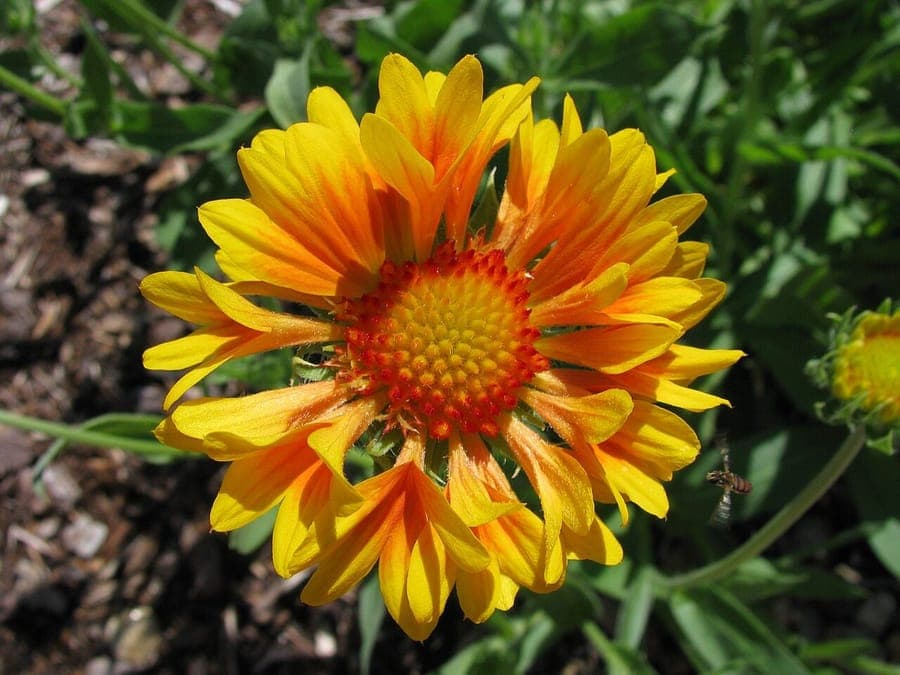
Captain-tucker / CC BY-SA 3.0, via Wikimedia Commons
Blanket flower (Gaillardia × grandiflora): complete guide
Gaillardia × grandiflora
Want to see Blanket flower (Gaillardia × grandiflora): complete guide in your garden?
Full design in HD: €7.99
Look after your Blanket flower with the GardenWorld app
Identify plants with your camera and get a care calendar with reminders for this plant.


Overview
Few perennials flower for as long or as cheerfully as blanket flower. From June until the first frosts it keeps producing new daisies in fiery yellow, orange and red, often with a darker centre and paler tips to the petals, as if someone had thrown a bright woven blanket over the border. Almost every blanket flower you find in a garden centre belongs to Gaillardia × grandiflora.
Gaillardia × grandiflora is a cross between two North American species: the perennial Gaillardia aristata from the prairies and the annual Gaillardia pulchella from the southern United States. The hybrid arose in European nurseries in the nineteenth century and combines the toughness of one parent with the long flowering and vivid colouring of the other. It belongs to the daisy family (Asteraceae) and is named after Gaillard de Charentonneau, an eighteenth-century French magistrate with a passion for botany.
Depending on the cultivar, plants reach 25 to 70 cm tall and 30 to 50 cm across. Popular varieties include 'Kobold' (also sold as 'Goblin', low, red with a yellow edge), 'Burgunder' (wine red), 'Arizona Sun' (compact, red and yellow), 'Fackelschein' (tall, red and yellow) and 'Oranges and Lemons' (orange and lemon yellow, as in the photo). One thing to know from the start: blanket flower is a short-lived perennial. Expect three or four years unless you follow the advice below.
Appearance and bloom cycle
The flower heads are 6 to 10 cm across. Around a domed or flat centre of tiny disc florets sit broad ray petals with three small teeth at the tip. In most cultivars the rays are red at the base and yellow at the edge, but there are also all-yellow, orange and burgundy forms. After flowering a round, bristly seed head remains, which looks quite charming in the late border.
The leaves are grey-green and lance-shaped, sometimes lobed, and softly hairy like the stems. The plant forms a loose clump. Flowering starts in June and, if you deadhead regularly, carries on well into October. Bees, bumblebees and butterflies visit the open flowers readily, which makes it a fine choice for a pollinator-friendly garden.
A word of caution: the sap and hairs can irritate the skin of sensitive people, as with several other members of the daisy family. Wear gloves if you are cutting a lot of stems. No serious poisoning of people or pets is known; a dog or cat that chews the leaves may at most suffer a mild upset stomach.
Ideal location
Blanket flower is a true sun lover. Give it the hottest spot in the garden, with at least six to eight hours of sun a day. In shade the stems become weak and flowering is poor. A sunny border, a gravel garden, the edge of a patio or a bank are all ideal. It also does well in a large container on a sunny balcony.
Space plants 30 to 40 cm apart. Taller cultivars may flop in an exposed spot, while lower varieties such as 'Kobold' and 'Arizona Sun' stay compact and need no staking. It shrugs off heat, wind and even salty coastal air.
Soil requirements
Gaillardia × grandiflora grows best in free-draining, moderately fertile to poor soil. Sandy soil and light loam are ideal. On heavy, wet clay it is particularly short-lived because the roots rot over winter. Improve such soil with coarse grit or plant on a slightly raised spot.
Over-rich soil is not ideal either. With plenty of manure or compost the clumps grow soft, fall open and flower less. A neutral to slightly alkaline soil is perfect. Plant in spring, from April to June, so the roots are well established before winter.
Free preview
Want to see Blanket flower (Gaillardia × grandiflora): complete guide in your garden? Make a free preview of your design.
Watering
After its first growing season blanket flower is very drought tolerant. Water young plants weekly during their first year whenever it does not rain. After that, water only in long spells of drought and heat, and then do it thoroughly.
Too much water does more harm than too little, especially in autumn and winter. Containers dry out faster; check them every few days and let the compost dry a little between waterings. Always ensure good drainage.
Pruning
Two pruning moments make all the difference. Throughout summer, regularly snip off faded flowers down to a leaf or a new bud. This keeps the plant flowering and reduces self-seeding.
The second moment is less well known but more important for longevity. In late August or early September cut the whole plant back to about 10 to 15 cm. This prompts it to make fresh basal rosettes before winter, and those come through the cold far better than an exhausted plant that has flowered right up to the frost. You lose a few weeks of colour but often gain an extra year or two.
To propagate, divide a clump in spring or take root cuttings in winter. Seedlings of cultivars rarely resemble the parent, although they sometimes produce pleasant surprises.
Maintenance calendar
March-April: Remove dead leaves. Divide older clumps if they are going bare in the middle.
May: Plant new specimens. Protect young shoots from slugs.
June-July: Flowering begins. Deadhead every week.
August: Keep deadheading. Water in prolonged dry spells.
Late August-September: Cut back to 10 to 15 cm to help the plant live longer.
October-November: Leave the new basal leaves in place. Do not cover the plant with wet leaves.
December-February: Dormancy. Make sure no water collects around the crown.
You will find a plant calendar on gardenworld.app that sets out these jobs month by month for your own garden.
Winter hardiness
On dry, well-drained soil Gaillardia × grandiflora is hardy to about -20 °C. Cold itself is rarely the issue; wet combined with cold is. In damp winters on clay many blanket flowers die, while on sandy soil or in a gravel garden they overwinter without trouble.
A thick mulch tends to do more harm than good because it holds moisture. A thin layer of gravel around the base helps. Move potted plants against a sheltered wall or under an overhang in winter so the root ball does not become sodden.
Companion plants
The warm colours of blanket flower look superb with blue and purple. Woodland sage (Salvia nemorosa) and lavender are classic partners that enjoy the same sunny, dry spot. Threadleaf tickseed (Coreopsis verticillata) and yarrow (Achillea millefolium) reinforce the summery yellows and oranges, while purple coneflower (Echinacea purpurea) adds a different daisy shape in the same style.
Ornamental grasses such as fountain grass (Pennisetum alopecuroides) lighten the picture and keep the border interesting into winter. For a prairie-style scheme, let Verbena bonariensis rise up between the blanket flowers. Avoid planting it next to anything that needs a lot of water.
Final thoughts
Gaillardia × grandiflora is a plant for anyone who loves colour but has no time for a demanding border. Sun, soil that does not stay wet and a cut back in late August are all it needs for months of flowers. Accept that it will not live for ever, and top up now and then with a new plant or a seedling.
If you would like to see how blanket flowers work alongside grasses and blue flowers in a summer border, have a garden design made on gardenworld.app tailored to your plot and its aspect. That way you will have a corner of the garden that glows like a summer evening from June to October.
Frequently asked questions about Blanket flower
Is Blanket flower winter hardy?
On dry, well-drained soil Gaillardia × grandiflora is hardy to about -20 °C. Cold itself is rarely the issue; wet combined with cold is.
When and how do you prune Blanket flower?
Two pruning moments make all the difference. Throughout summer, regularly snip off faded flowers down to a leaf or a new bud.
How much water does Blanket flower need?
After its first growing season blanket flower is very drought tolerant. Water young plants weekly during their first year whenever it does not rain.
Where does Blanket flower grow best?
Blanket flower is a true sun lover. Give it the hottest spot in the garden, with at least six to eight hours of sun a day.
What soil does Blanket flower need?
Gaillardia × grandiflora grows best in free-draining, moderately fertile to poor soil. Sandy soil and light loam are ideal.

See it in your garden
See Blanket flower in your garden
One photo of your garden and a few questions. You see the result in about a minute.
Try it with a photoIdentify this plant in your own garden. Identify a plant
Similar plants
Woodland sage: complete guide
Salvia nemorosa
Everything about Woodland Sage (Salvia nemorosa): planting, care, pruning and combinations. Expert tips for months of blue-violet flower spikes.
Whorled tickseed: complete guide
Coreopsis verticillata
Discover whorled tickseed, a long-blooming perennial with thread-like foliage. Comprehensive guide covering cultivation and garden applications.
Purple coneflower: complete guide
Echinacea purpurea
Everything about Purple Coneflower (Echinacea purpurea): planting, care, pruning and combinations. Expert tips for a thriving prairie-style garden.
