
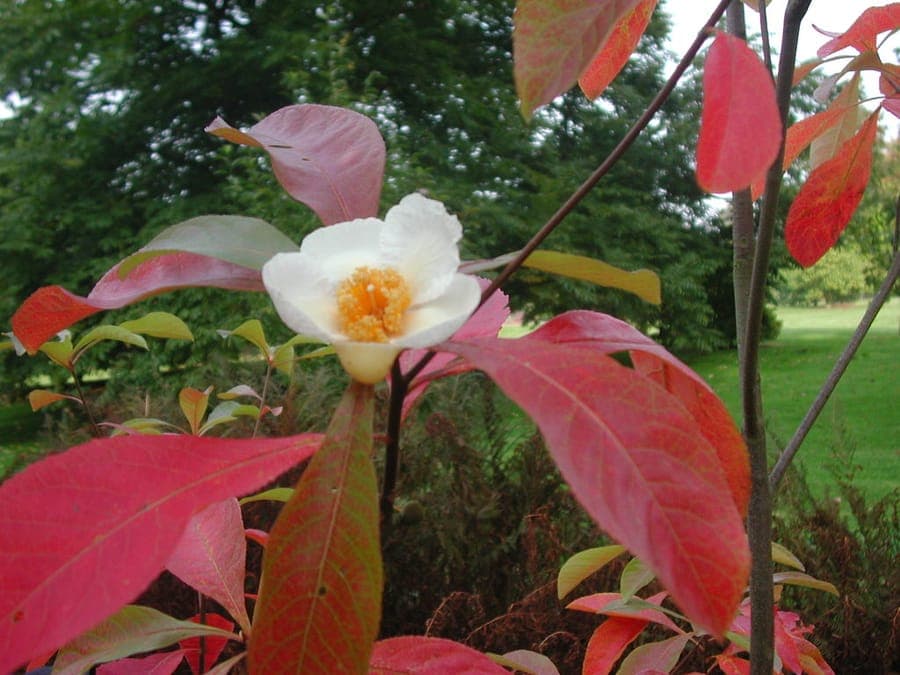
Francine Riez / CC BY-SA 3.0, via Wikimedia Commons
Franklin tree: complete guide
Franklinia alatamaha
Want to see Franklin tree: complete guide in your garden?
1 minute, no credit card
Overview
Franklinia alatamaha is arguably the most historically poignant garden tree you can grow: it is extinct in the wild. Originally native to a tiny area along the Altamaha River in Georgia, USA, it was last observed in its natural habitat in 1803. Every specimen growing in gardens and arboreta around the world today descends from cuttings collected by the Philadelphia botanist John Bartram and his son William in the late eighteenth century. The genus was named in honour of Benjamin Franklin, friend of the Bartrams and one of America's Founding Fathers.
For the gardener, Franklinia offers a combination of virtues that few shrubs can match. It blooms in August and September - unusually late for a woody plant - with large, cupped, creamy white flowers 6 to 8 cm across, while the leaves are simultaneously beginning their autumn transformation into shades of orange, scarlet, and deep crimson. This overlap of late bloom and autumn colour is unique among ornamental trees. The flowers carry a faint fragrance reminiscent of camellia or tea, an association that makes botanical sense: Franklinia belongs to the Theaceae, the same family as Camellia sinensis, the tea plant.
gardenworld.app offers tailored garden designs that feature rare ornamental shrubs like Franklinia as focal points, integrated within seasonal planting schemes that carry interest from spring through to winter.
Appearance and flowering cycle
Franklinia grows as a multi-stemmed large shrub or small tree with a single rounded crown. Mature specimens reach 3 to 6 metres in height and 2 to 4 metres in width. Young plants have an upright, almost fastigiate form that gradually opens and becomes more rounded with age. The bark is grey, lightly furrowed with a fine, almost corky texture that provides ornamental interest in winter.
The leaves are alternate, oblong-elliptic, 10 to 15 cm long and 4 to 6 cm wide. The upper surface is a glossy dark green; the underside is paler and finely pubescent. In summer the foliage is clean and attractive without any particular drama, forming the backdrop for the late-season flowering. From mid-August onwards, buds open to reveal the distinctive cupped flowers with five broad white petals surrounding a prominent central cluster of golden stamens. Individual flowers last only a few days, but a succession of buds means flowering continues for six to eight weeks.
As flowering progresses, the foliage transitions rapidly: the leaves colour from dark green through orange to vivid scarlet or crimson, creating the remarkable effect of bloom and colour change happening simultaneously. This autumn display is among the most spectacular of any temperate garden shrub. The small round fruits, approximately 1.5 cm in diameter, are brown, woody capsules that persist on the bare branches through winter.
Ideal location
Franklinia requires a position in full sun to light dappled shade. In full sun the plant flowers most prolifically; in partial shade flower production declines but the plant remains healthy. Shelter from strong, desiccating wind is important: the large leaves are susceptible to scorch on exposed sites, and the flower buds can drop prematurely in cold autumn winds.
In most British and European garden situations, Franklinia is most successful as a specimen shrub in a sheltered, south-facing position - alongside a warm wall or in the lee of a building. As the centrepiece of a mixed border surrounded by late-summer perennials, Franklinia creates a focal point that lasts from August through October. A grouping of three plants spaced 2.5 to 3 metres apart provides a larger-scale effect in bigger gardens.
Franklinia tolerates urban conditions, including moderate air pollution, reasonably well. It is available from specialist garden nurseries and occasionally from larger garden centres. When buying, look for container-grown plants with a well-established root system rather than bare-root stock, as Franklinia resents root disturbance.
Soil requirements
Franklinia has specific soil requirements that largely determine whether the plant thrives or merely survives. It demands moist, well-drained, humus-rich, acidic to slightly acid soil with a pH of 5.5 to 7.0 - the optimum being 6.0 to 6.5. On calcareous or alkaline soils, the plant develops interveinal chlorosis as iron and manganese become unavailable, and growth slows dramatically. If your garden soil is alkaline, growing Franklinia in a large raised bed filled with ericaceous compost mixed with topsoil and generous quantities of well-rotted leaf mould is the most reliable solution.
Soil texture is equally critical. Franklinia needs a medium to light loam that retains adequate moisture without becoming waterlogged. Prolonged wet conditions encourage Phytophthora root rot, one of the primary causes of plant failure. On free-draining sandy soils, abundant organic matter and regular irrigation are essential. When planting, dig a hole at least twice the width of the root ball and incorporate a generous mix of garden compost, rotted leaf mould, and some ericaceous planting compost to achieve the right balance of moisture retention and acidity.
Fertilise modestly with a slow-release organic fertiliser in April, and apply a deep mulch layer of 8 to 10 cm of composted bark or leaf mould across the entire root zone each spring to conserve moisture and maintain soil acidity.
Watering
Franklinia is more demanding of consistent soil moisture than its sturdy appearance suggests. The root system is relatively shallow and prone to drought stress in summer. During the first two to three years after planting, water twice a week in dry weather, ensuring the soil is thoroughly moistened to at least 30 cm depth each time. A thorough, infrequent watering is far more beneficial than frequent shallow sprinkles.
Once established - typically after two to three years - Franklinia can tolerate short dry spells of two to three weeks, provided the roots are protected by a generous mulch layer. During August and September, when flowering is at its peak, consistent soil moisture is critical for maximum flower production. Drought stress during this period dramatically reduces the number of flowers that open each week.
Overwatering is also harmful: waterlogged roots in poorly draining soil invite the Phytophthora infections mentioned above. Always water at the base of the plant, never overhead, to keep foliage dry and reduce fungal disease risk.
Free design
Want to see Franklin tree: complete guide in your garden? Make a free design now.
Pruning
Franklinia requires minimal pruning and actually prefers to be left largely to its own devices. The plant naturally develops an attractive multi-stemmed or single-trunk form that does not need regular shaping. In early spring - February to early March, before growth resumes - remove any dead wood, damaged branches, and any shoots growing inward that impede air circulation through the crown.
If you prefer a single-stemmed small tree rather than a multi-stemmed shrub, remove all competing stems in the first two to three years, retaining a single dominant leader. This creates a more formal, tree-like habit but loses some of the natural, multi-stemmed elegance.
Never prune in summer or early autumn. Franklinia forms its flower buds for the following year during August and September of the current year. Late pruning removes these buds and severely reduces flowering the next season. The rule is simple: prune only during dormancy, never after early April.
Maintenance calendar
March: Remove dead or winter-damaged wood. Replenish the mulch layer to 8 to 10 cm around the root zone, keeping a 10 cm gap around the base of the stems to prevent crown rot. Apply a slow-release organic fertiliser.
April: Check soil pH and adjust if necessary with sulphur or ericaceous fertiliser. Last chance for any corrective pruning before growth begins.
May to July: Monitor soil moisture closely during dry periods. Water thoroughly twice a week if there is no significant rainfall. Hand-weed the mulch area to prevent competing roots from exploiting the rich soil.
August to September: Peak flowering season. Continue regular watering. Enjoy the remarkable simultaneous display of white flowers and developing autumn colour.
October to November: Autumn colour at its finest. After leaf fall, the brown seed capsules persist on bare branches. Apply no further fertiliser after this point.
December to February: Winter dormancy. After severe frost events, check the bark for frost cracks. Young plants in their first two winters may benefit from a protective wrapping of horticultural fleece around the stems during prolonged hard frost.
Winter hardiness
Franklinia alatamaha is rated hardy to USDA zones 5 to 9, surviving temperatures down to approximately -20 degrees Celsius. In most of the UK and the milder parts of western Europe (equivalent to zone 8 or above), established Franklinia plants overwinter reliably without protection. However, young plants in their first two years are considerably more vulnerable than mature specimens and may suffer stem damage below -10 degrees Celsius before they are well-rooted.
A sheltered microclimate - beside a south-facing wall, for example - is doubly valuable in winter: it both reduces the severity of frost at the plant's position and protects against desiccating cold winds that can cause the bark to desiccate and split. In exceptionally cold winters with prolonged temperatures below -10 degrees Celsius, wrapping the main stems of young plants in horticultural fleece or hessian provides meaningful protection.
Early autumn frosts in October can occasionally be more damaging than midwinter frosts, because the plant has not yet completed its transition to dormancy and the leaves still contain substantial moisture. A sharp -5 degree Celsius frost in mid-October can cause rapid leaf death and places unnecessary stress on the plant. Choosing a sheltered position reduces this risk significantly.
Companion plants
Franklinia's late-season bloom and spectacular autumn colour make it an outstanding centrepiece for borders designed to peak in late summer and autumn. The following companions are particularly effective:
Hydrangea paniculata 'Grandiflora': The large white panicles emerge slightly ahead of Franklinia and provide a visual bridge into the autumn season. Space 2.5 to 3 metres apart.
Aster × frikartii 'Mönch': Soft blue flowers from late August through October provide cool colour contrast against the white blooms and scarlet foliage of Franklinia. One of the finest late-season perennials.
Fothergilla major: Another acid-soil shrub with outstanding autumn colour (yellow, orange, scarlet) and fragrant white bottle-brush flowers in spring. Nearly identical soil requirements to Franklinia.
Callicarpa bodinieri var. giraldii 'Profusion': Vivid purple berries in autumn add a surprising colour note alongside Franklinia's red foliage. Space 1.5 metres from Franklinia.
Geranium macrorrhizum: Used as ground cover under Franklinia's canopy, this evergreen perennial keeps the root zone cool and moist. Pink flowers in May to June complete the spring display.
For more ideas on combining Franklinia with late-season perennials, visit gardenworld.app and explore personalised planting designs created by garden professionals.
Closing
Franklinia alatamaha carries a weight of history that few garden plants can equal: gone from the wild for more than two centuries, surviving only because a handful of cuttings were taken at the right moment by the right people. In the garden, it rewards attentive cultivation with a late-season display that combines white flowers and autumn colour in a way nothing else can replicate. Give it the right conditions - acid, humus-rich soil, shelter, consistent moisture - and Franklinia will be the plant that every visitor to your garden asks about.
Want to see Franklin tree: complete guide in your garden? Make a free design now.
Upload a photo, pick a style, and get a photorealistic design with plant list in under a minute.
10,000+ gardens designed already
No credit card required


Similar plants
Camellia crapnelliana: complete guide
Camellia crapnelliana
Discover Crapnell's camellia, a rare and elegant Asian plant with glossy green foliage and white blooms. Perfect guide for cultivation success.
Camellia granthamiana: complete guide
Camellia granthamiana
Discover Grantham's camellia, known as the poached egg camellia with pure white blooms. Perfect guide for exotic plant enthusiasts.
Yellow Camellia: complete guide
Camellia petelotii
Discover the Golden Camellia with its rare yellow blooms. Learn how to grow this Asiatic shrub for exotic garden beauty and winter color.