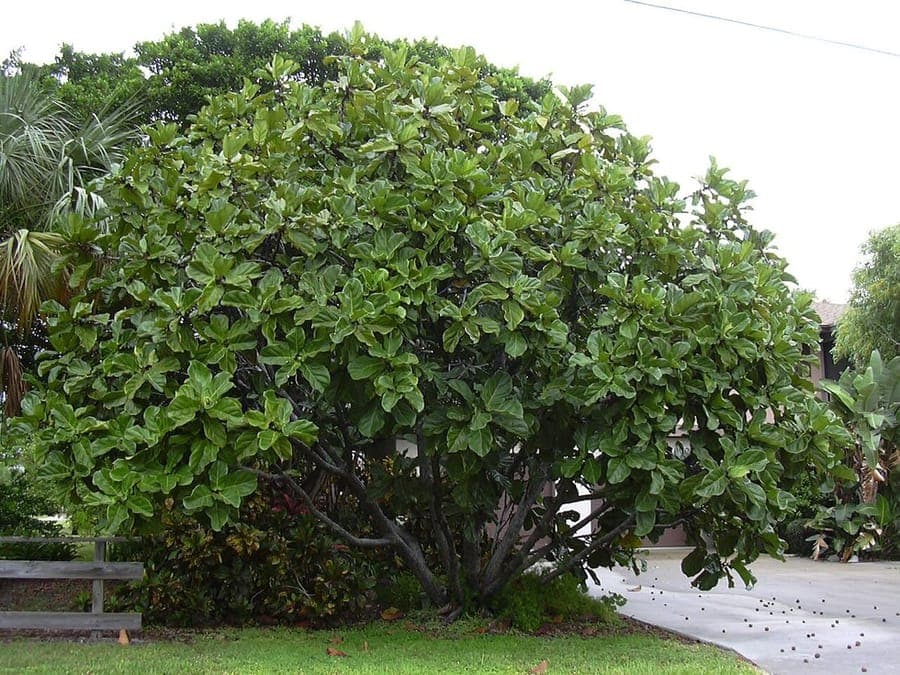
Forest & Kim Starr / CC BY 3.0, via Wikimedia Commons
Fiddle-Leaf Fig: complete guide
Ficus lyrata
Want to see Fiddle-Leaf Fig: complete guide in your garden?
Full design in HD: €7.99
Look after your Fiddle-Leaf Fig with the GardenWorld app
Identify plants with your camera and get a care calendar with reminders for this plant.


Overview
Over the past decade the fiddle-leaf fig (Ficus lyrata) has become the statement houseplant. It fills interiors magazines, coffee shops and countless living rooms, and it is easy to see why: huge, wavy leaves on a slender trunk give any room instant presence. It also has a reputation for being a diva. That is only half true. A fiddle-leaf fig is not difficult so much as predictable. It wants plenty of light, a permanent spot and a steady watering rhythm. Give it those and it will grow happily for years.
Ficus lyrata belongs to the mulberry family (Moraceae) and comes from the lowland rainforests of West and Central Africa, from Sierra Leone to Cameroon. There it often starts life as an epiphyte high in another tree and becomes a tree of 12 to 15 metres. In tropical gardens, as in the photo, it forms a broad, multi-stemmed crown. Indoors it usually reaches 1.5 to 3 metres.
Besides the standard form you will find 'Bambino', a compact selection with smaller leaves that suits a windowsill or side table. Large plants are often sold trained as a standard, with a bare trunk and a head of leaves at the top.
Appearance and foliage
The leaves take their name from their shape: broad at the tip, pinched in the middle, like the body of a violin. They grow 25 to 45 cm long, stiff and leathery, with a wavy margin and pale, deeply sunken veins. Young leaves are a fresh green and darken as they mature.
You will not see flowers or fruit indoors. As with all figs, the tiny flowers are hidden inside a fig that only one specific wasp can pollinate. You are growing this plant purely for its leaves and silhouette.
Small red or brown specks on young leaves are usually oedema: the plant received a sudden flood of water after a dry spell and some cells burst. It disappears once watering becomes more regular. Large brown patches spreading from the edge or the centre of a leaf are more serious and point to root rot caused by soggy compost.
Be aware that, like all figs, Ficus lyrata contains a white latex sap that can irritate skin. The leaves are mildly toxic to cats and dogs, causing drooling and vomiting if chewed.
Position indoors
Light is everything for a fiddle-leaf fig. Put it in the brightest spot you have, ideally no more than a metre from a large window. An east- or west-facing window is perfect; a south-facing one works too, with a sheer curtain against the harshest midday sun in summer. A few hours of direct morning sun actually does it good. In a dim corner it barely grows, drops its lower leaves and starts to lean.
It prefers temperatures between 18 and 24 °C and ideally no lower than 15 °C in winter. It dislikes draughts from an outside door and hot air from radiators. Ordinary humidity of 40 to 60 % is enough.
The golden rule: move it as little as possible. A fiddle-leaf fig adjusts its leaves to the light where it stands. Shift it elsewhere and it often responds by shedding a few leaves. Do give it a quarter turn every two or three weeks so it keeps growing upright.
Potting mix and repotting
Choose an airy houseplant mix that holds moisture yet lets excess water drain quickly. Two parts compost, one part perlite and one part fine bark is a good recipe. A pot with a drainage hole is essential.
Repot young plants every other spring and older ones every two to three years, or when roots appear through the drainage hole. Go up only about 5 cm in pot width. A much larger pot stays wet and is the quickest route to root rot. If the plant is too big to repot, refresh the top layer of compost each spring.
Free preview
Want to see Fiddle-Leaf Fig: complete guide in your garden? Make a free preview of your design.
Watering
Regularity matters more than quantity. Water when the top 3 to 5 cm of compost is dry, then water thoroughly until it runs out of the bottom, and let the pot drain well. In summer that is often every week to ten days; in winter every two to three weeks.
Do not wait until the leaves droop, but do not water out of habit while the compost is still moist either. A finger test or a simple moisture meter helps. Use water at room temperature.
Wipe the large leaves with a damp cloth every fortnight. They stay glossy and catch more light.
Feed every two to three weeks from April to September with a liquid fertiliser for foliage plants, and stop in autumn and winter. The plant calendar at gardenworld.app shows you month by month what your plants need, houseplants included.
Pruning
A fiddle-leaf fig often grows on a single stem with few side branches. For a fuller plant, cut off the tip in spring just above a leaf. One or more side shoots usually break below the cut. Dab away the sap with kitchen paper.
Another technique is notching: with a sharp knife, make a small cut a few millimetres deep just above a dormant bud on the trunk. This encourages that bud to grow without removing the tip. It does not always work, but it is worth a try on a bare trunk.
The removed tip can be rooted in water or in moist compost with perlite. At 22 to 25 °C and high humidity it roots in six to eight weeks. Remove damaged or brown leaves with clean scissors, close to the stem.
Care calendar
March to April: Growth starts again. Repot if needed, prune or notch, and begin feeding.
May to June: New leaves unfurl. Check the compost weekly and water regularly.
July to August: Full growth. Protect from fierce midday sun through glass. Check the leaves for spider mite and mealybugs, especially in warm, dry weather.
September to October: Last feed in September. Light levels fall; if necessary move the plant a little closer to the window, then leave it be.
November to February: Rest period. Water less, do not feed and keep the plant away from radiators and cold glass. Losing one or two lower leaves is normal.
Temperature and winter
Ficus lyrata is a tropical plant and not frost hardy. It suffers below 10 °C and will not survive frost. Indoors, cold windowsills and winter transport are the main risks. If you buy one in winter, have it wrapped well and put it straight into its permanent spot at home.
Putting it outdoors for summer is possible but rarely a good idea for this plant: the move, the wind and the fluctuating temperatures often cost it leaves. If you do, wait until nights stay above 15 °C, let it acclimatise in shade first and bring it back in before September turns cool.
Companion plants
A large fiddle-leaf fig looks best as a specimen with some space around it. In a group, pair it with plants of different leaf shapes. The Swiss cheese plant (Monstera deliciosa) and the bird of paradise (Strelitzia reginae) create a lush jungle feel alongside Ficus lyrata.
Low, understated plants look good at its feet, such as the ZZ plant (Zamioculcas zamiifolia) or the spider plant (Chlorophytum comosum). A Dracaena fragrans adds a narrow, upright accent. Choose companions that also enjoy bright light and keep them in separate pots.
Want to carry the green mood from indoors to outdoors? At gardenworld.app you can have a garden design made that ties in with your interior and patio.
Final thoughts
The fiddle-leaf fig rewards consistency. Choose one bright spot, water regularly but only when the compost is dry, and otherwise leave it alone. Follow those simple rules and Ficus lyrata will grow into an impressive indoor tree that remains the centrepiece of your living room for years.
Pruning
Frequently asked questions about Fiddle-Leaf Fig
When and how do you prune Fiddle-Leaf Fig?
A fiddle-leaf fig often grows on a single stem with few side branches. For a fuller plant, cut off the tip in spring just above a leaf.
How much water does Fiddle-Leaf Fig need?
Regularity matters more than quantity. Water when the top 3 to 5 cm of compost is dry, then water thoroughly until it runs out of the bottom, and let the pot drain well.

See it in your garden
See Fiddle-Leaf Fig in your garden
One photo of your garden and a few questions. You see the result in about a minute.
Try it with a photoIdentify this plant in your own garden. Identify a plant
Similar plants
Monstera deliciosa: complete guide
Monstera deliciosa
Discover the fruit-salad plant (Monstera deliciosa) - a popular houseplant with characteristic holes in leaves. Professional care and growing tips for success.
Strelitzia reginae: complete guide
Strelitzia reginae
Strelitzia reginae is a beautiful plant from the Strelitziaceae family. Discover everything about cultivation and care in this guide.
ZZ plant: complete guide
Zamioculcas zamiifolia
Discover Zamioculcas zamiifolia, the easy-care money plant from Africa. Growing and care tips for indoors.
