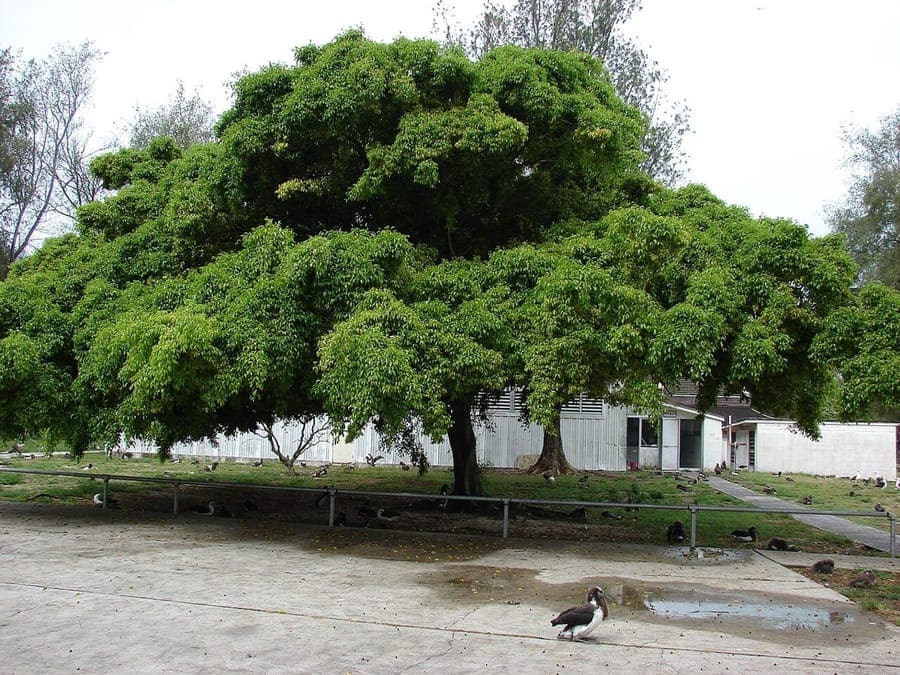
Forest and Kim Starr / CC BY 3.0 us, via Wikimedia Commons
Weeping fig (Ficus benjamina): complete guide
Ficus benjamina
Want to see Weeping fig (Ficus benjamina): complete guide in your garden?
Full design in HD: €7.99
Look after your Weeping fig with the GardenWorld app
Identify plants with your camera and get a care calendar with reminders for this plant.


Overview
The weeping fig (Ficus benjamina) has been one of Europe's best-known houseplants for decades. It stands in living rooms, surgeries, offices and hotel foyers, and for good reason: its gracefully arching branches and glossy leaves bring a room to life without taking up much floor space. It belongs to the fig and mulberry family (Moraceae) and grows wild across South-East Asia, India, southern China and northern Australia.
In its native habitat Ficus benjamina becomes a substantial tree of 20 to 30 metres with a broad crown and aerial roots, much like the specimen in the photograph above. Indoors it stays far more modest, usually 1 to 2.5 metres tall depending on pot size and how often you prune. The weeping fig has a reputation for being slightly temperamental, mainly because it drops leaves whenever something in its surroundings changes. Once you understand its habits, though, it will reward you for many years. At gardenworld.app you can have a garden design made, and anyone who also gardens indoors soon finds the same questions coming up: how much light, which spot, which neighbours.
Appearance and growth
The leaves of Ficus benjamina are oval to elliptic, 5 to 12 cm long, with a distinct pointed tip, a so-called drip tip that lets rainwater run off quickly in the rainforest. The surface is glossy, and new growth is often a fresher green than older leaves. The branches droop in an elegant arc, which gives the plant its common name. The trunk is pale grey and smooth; nurseries often grow several young stems together and plait them, which makes an attractive feature.
Position in the home
Light matters more than anything else for a healthy weeping fig. It wants a bright spot, ideally close to an east- or west-facing window. A south-facing window works too, provided the strong midday sun in summer is softened by a sheer curtain. In a dim position more than about 2 metres from the window, the plant gradually sheds its inner leaves and becomes sparse. Variegated cultivars need even more light to keep their markings.
More important than the perfect spot is a permanent one. A weeping fig responds to being moved, turned or caught in a draught by dropping leaves. Choose its position carefully and then leave it there. Keep it away from an outside door that opens often in winter, from above a radiator and from the airflow of an air conditioner. The ideal room temperature is 18 to 24 °C. Below 15 °C it stops growing, and below 10 °C it starts to suffer damage.
Humidity in a heated home is often low in winter. Humidity of 50% or more helps prevent spider mite and crispy leaf edges. A tray of water and pebbles under the pot, or a humidifier nearby, already makes a difference. From May to September the plant may go outside on a sheltered, lightly shaded patio, as long as night temperatures stay above 12 °C. Give it a week in partial shade first, otherwise the leaves will scorch.
Compost and repotting
Use a good, open houseplant compost, ideally with about a fifth perlite or fine clay granules added for better drainage. The pH can be slightly acidic to neutral (6 to 7). A pot with drainage holes is essential, because standing water in the bottom of a decorative cover pot is the quickest route to root rot.
Repot young plants every one or two years and older specimens every three years. The best time is March or April, just before growth starts. Choose a pot no more than 4 to 5 cm wider than the old one: a weeping fig in an oversized pot stays wet for too long. Large plants that can no longer be repotted benefit from a top dressing each spring: scrape away the top 5 cm of compost and replace it with fresh.
Free preview
Want to see Weeping fig (Ficus benjamina): complete guide in your garden? Make a free preview of your design.
Watering and feeding
Water regularly, but let the top 2 to 3 cm of compost dry out between waterings. During the growing season that usually means once a week; in winter, when light levels drop, every 10 to 14 days. Push a finger into the compost to check, and only water when it feels dry. Never leave water standing in the saucer: tip it away after fifteen minutes.
Both overwatering and underwatering lead to leaf drop, which makes the cause tricky to pin down. Yellow leaves falling off usually point to wet roots, while dry, crisp leaves suggest drought or very dry air. Use water at room temperature, since icy tap water shocks the roots. Soft water, such as collected rainwater, prevents white marks on leaves and compost.
From April to September feed every two weeks with a liquid houseplant fertiliser at half strength. Stop feeding from October to March. Dusting the leaves now and then, or rinsing them under a lukewarm shower, keeps them clean and helps photosynthesis.
Pruning
A weeping fig takes pruning well. You can keep it in shape, limit its height or encourage a bare plant to branch again. Prune preferably in spring, just before or as growth begins. Cut just above a leaf or bud, and one or two new shoots will appear there. Long, wayward branches can also be shortened in summer.
Wear gloves, because the sap can irritate the skin, and put old newspaper under the plant to catch drips. If a cut keeps bleeding, dab it with a damp cloth; the sap usually seals itself within a few minutes. Tip cuttings of 10 to 15 cm root readily in a mix of compost and perlite under a clear plastic bag at around 22 °C.
Care calendar
January–February: resting period. Water sparingly, do not feed, and check the undersides of the leaves for spider mite and scale insects.
March–April: repot or refresh the compost. Prune into shape before new growth starts. Begin feeding at half strength.
May: growth picks up. If you want to move the plant outdoors, wait until after the last cold nights and let it acclimatise in shade first.
June–August: water weekly and feed fortnightly. Protect from fierce midday sun behind glass. Shower the leaves occasionally.
September: bring the plant indoors once night temperatures drop below 12 °C. Some leaf drop after the move is normal.
October–December: less water, no feeding. Keep the plant away from radiators and provide extra humidity.
Temperature and overwintering
Ficus benjamina is not hardy in north-western Europe. It cannot survive frost outdoors, and below 5 °C its leaves and young shoots die back. It is therefore strictly a houseplant or a summer patio plant. It does not need a cool winter rest; an ordinary living room at 18 to 21 °C is fine as long as it gets enough light.
Toxicity to people and pets
The milky sap of the weeping fig contains ficin and furocoumarins among other compounds. In sensitive people it can irritate the skin, particularly if the skin is then exposed to sunlight. Ficus benjamina is also a well-known indoor allergen: proteins from the sap attach to household dust, and people with a latex allergy react to it more often. If you find yourself sneezing or with watery eyes near the plant, it may be the cause.
The plant is mildly toxic to cats and dogs. Chewing leaves or twigs leads to irritation of the mouth and stomach, drooling, vomiting and sometimes diarrhoea. Serious poisoning is rare, but keep the plant out of reach of curious rodents, birds and kittens, and contact your vet if your pet has eaten a large amount. Young children are also best kept away from the leaves.
Companion plants
A weeping fig looks its best as a focal point in a corner, with lower houseplants at its feet. The spider plant (Chlorophytum comosum) and the peace lily (Spathiphyllum wallisii) enjoy a similar position and fill the lower layer nicely. A Swiss cheese plant (Monstera deliciosa) adds contrast with its large, split leaves, while a Dracaena fragrans contributes a strong vertical line.
Final thoughts
Ficus benjamina is a classic that deserves its place. Give it a bright, permanent spot away from draughts, water only when the surface has dried, and keep it out of reach of pets. With those three habits your weeping fig will stay green and graceful for years.
Want to know when to repot, feed or prune? The plant calendar at gardenworld.app shows what your plants need month by month, indoors and out. That way you never miss a task and your weeping fig keeps its full, cascading crown.
Pruning
Frequently asked questions about Weeping fig
When and how do you prune Weeping fig?
A weeping fig takes pruning well. You can keep it in shape, limit its height or encourage a bare plant to branch again.
How much water does Weeping fig need?
Water regularly, but let the top 2 to 3 cm of compost dry out between waterings. During the growing season that usually means once a week; in winter, when light levels drop, every 10 to 14 days.

See it in your garden
See Weeping fig in your garden
One photo of your garden and a few questions. You see the result in about a minute.
Try it with a photoIdentify this plant in your own garden. Identify a plant
Similar plants
Monstera deliciosa: complete guide
Monstera deliciosa
Discover the fruit-salad plant (Monstera deliciosa) - a popular houseplant with characteristic holes in leaves. Professional care and growing tips for success.
Peace lily: complete guide
Spathiphyllum wallisii
How to grow a peace lily (Spathiphyllum wallisii): light, watering, repotting, getting it to flower again, and why it is toxic to cats and dogs.
Dracaena fragrans: complete guide
Dracaena fragrans
Discover fragrant dracaena (Dracaena fragrans), a popular houseplant from tropical Africa, elegant and easy to care for.
