
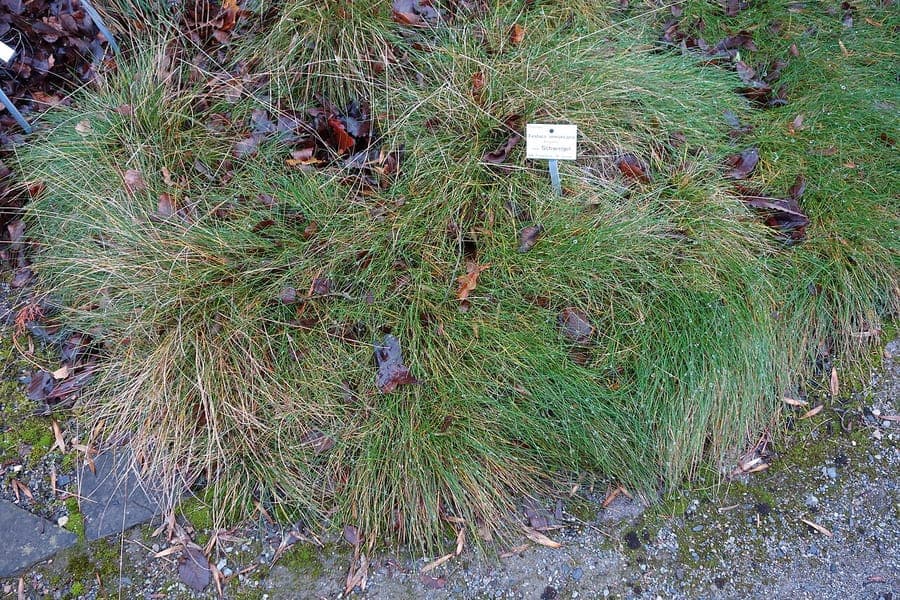
Daderot / CC0, via Wikimedia Commons
Breton Fescue: complete guide
Festuca armoricana
Want to see Breton Fescue: complete guide in your garden?
1 minute, no credit card
Overview
Breton Fescue (Festuca armoricana) is a refined ornamental grass from the Poaceae family. This plant is native to northern France, especially Brittany and Channel regions. It is a compact, low-growing grass ideal for borders, garden edging, and groupings in modern gardens with minimal maintenance.
Appearance and Bloom
Breton Fescue forms dense, neat tufts of fine, elegant foliage in a subtle gray-green hue. The plant reaches only 15-30 centimeters in height and spread, making it perfect for small spaces. The flowers are inconspicuous, greenish, appearing in June and July in fine plumes above the foliage.
Ideal Location
This plant thrives in full sun to semi-shade. It loves stony slopes, border fronts, and dry garden corners where water retention is minimal. The plant is extremely cold-hardy and suitable for nearly all European climates.
Soil
Breton Fescue grows in lean to moderately fertile soils with excellent drainage. Overly wet soils can lead to rot. A pH of 5.5 to 7.5 is suitable. Gritty, sandy soils are ideal. This plant is highly adaptive and grows even on difficult soils.
Watering
Once established, Breton Fescue is very drought-tolerant. Regular watering is only needed during the first few months. In very dry summers, supplemental water may be given, but this is rarely necessary. Avoid waterlogging.
Free design
Want to see Breton Fescue: complete guide in your garden? Make a free design now.
Pruning
Minimal pruning is necessary. In spring, dead foliage from the previous year may be removed. Some gardeners cut the plant back to ground level after bloom, though this is not necessary. Avoid heavy cutting.
Maintenance Calendar
Spring (March-May): Remove dead foliage from previous year. Summer (June-August): Water during dry periods. Autumn (September-November): Minimal care. Winter (December-February): No care needed.
Winter Hardiness
Breton Fescue is extremely cold-hardy to USDA zone 4. The plant withstands frost, snow, and extreme cold well. This is one of the most winter-hardy grass species.
Companion Plants
Excellent companions include: Showy Stonecrop (Sedum spectabile), Common Yarrow (Achillea millefolium), and Carthusian Pink (Dianthus carthusianorum). These plants share preference for dry, well-drained sites.
Closing
Breton Fescue is a refined, low-maintenance grass for modern, contemporary gardens. Its fine texture and gray tone add refinement to borders and groupings. Seek this plant from nurseries in France or via online grass suppliers.
Explore more plant guides at gardenworld.app/en and gardenworld.app/nl
Want to see Breton Fescue: complete guide in your garden? Make a free design now.
Upload a photo, pick a style, and get a photorealistic design with plant list in under a minute.
No credit card required


Similar plants
Sporobolus pungens: complete guide
Sporobolus pungens
Sporobolus pungens is a stoloniferous Mediterranean coastal grass with outstanding salt and drought tolerance, perfect for seaside and dry gardens.
Mediterranean aegilops: complete guide
Aegilops biuncialis
Everything about Aegilops biuncialis, a Mediterranean annual grass with ornamental spikes and outstanding drought tolerance for dry gardens.
Silver bluestem: complete guide
Bothriochloa saccharoides
Full guide to Bothriochloa saccharoides (silver bluestem): site, soil, watering, winter hardiness, pruning, and garden companions.