
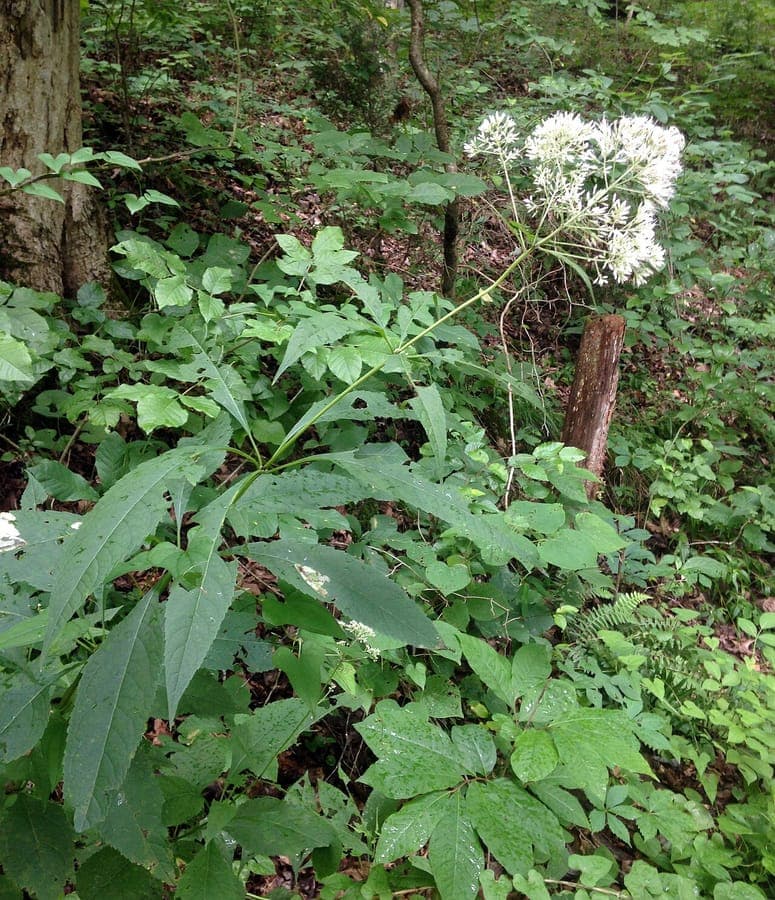
Mason Brock (Masebrock) / Public domain, via Wikimedia Commons
Sweet Joe-Pye weed: complete guide
Eutrochium purpureum
Want to see Sweet Joe-Pye weed: complete guide in your garden?
1 minute, no credit card
Overview
Sweet Joe-Pye weed (Eutrochium purpureum) - long listed under its older name Eupatorium purpureum - is one of the most stately herbaceous perennials native to eastern and central North America. Growing naturally from Ontario southward through the Appalachians and into Florida, this robust plant has found enthusiastic fans in European gardens where it brings late-season colour and ecological richness to borders and wildlife areas. Plants routinely reach 150 to 200 cm in height, sometimes taller in ideal conditions, and carry broad, dome-shaped flower clusters in shades of rose-pink to soft purple from July through September. The species earned its descriptive name from the pleasantly sweet, vanilla-like scent released when the leaves are bruised. On gardenworld.app you can explore garden layouts that feature tall flowering perennials like Joe-Pye weed as structural anchors in naturalistic borders.
Appearance and bloom cycle
The stems of Eutrochium purpureum are one of its most distinctive features: they are green but flushed noticeably purple, especially at the joints, giving the plant ornamental interest even before flowering begins. Leaves are broad-lanceolate, coarsely toothed, and arranged in whorls of three to five around each stem node - a detail that sets this species apart from the spotted Joe-Pye weed (Eutrochium maculatum). Individual leaves can reach 25 to 30 cm in length. The flower clusters are made up of many small tubular florets - no ray petals - grouped into large, flat-topped to gently domed corymbs that can span 30 cm or more. Flowering begins in early July and continues until late September, making this one of the most valuable late-season perennials available. After blooming, the small achenes develop tufted pappus hairs that aid wind dispersal and attract birds such as goldfinches.
Ideal location
Sweet Joe-Pye weed thrives in full sun to partial shade. A position that receives at least four to six hours of direct sunlight per day produces the strongest stems and most abundant flowers. Deep shade causes etiolation and poor flowering. The plant naturally grows along stream banks, at woodland edges, and in moist meadows, so positions near a pond or rain garden replicate its habitat well. Because of its imposing height, Joe-Pye weed works best at the back of wide borders or as a statement plant in a meadow-style planting. Shelter from strong winds helps prevent stem lodging; planting in groups of three or more also provides mutual support. Allow at least 80 cm between plants to accommodate their spread at maturity.
Soil
The ideal soil for Eutrochium purpureum is moist, humus-rich, and slightly acidic to neutral (pH 5.5 to 7.0). Heavy clay soils are acceptable provided drainage is not completely blocked; on pure dry sand, generous additions of compost are essential. Before planting, incorporate two or three buckets of well-rotted compost per planting hole. A permanent mulch of composted bark or wood chip around the base of each plant retains soil moisture and suppresses weeds. On fertile, moist soils the plant grows vigorously and may need no supplementary feeding; on poorer soils, a balanced slow-release fertiliser applied in April gives the season a strong start.
Free design
Want to see Sweet Joe-Pye weed: complete guide in your garden? Make a free design now.
Watering
This is an inherently moisture-loving plant and performs best where the soil stays consistently damp. During the first growing season after planting, water regularly - particularly during dry spells in summer - to help the root system establish. Once well rooted, Eutrochium purpureum tolerates short dry periods far better than young transplants, but prolonged drought restricts growth and flower production noticeably. A rain garden or pond-side location largely removes the need for supplementary watering. In standard garden borders, water when the top 5 cm of soil feels dry to the touch. Avoid waterlogged conditions: the roots tolerate brief wet periods but suffer in permanently stagnant water.
Deadheading and cutting back
Leave the old stems standing through winter - they provide shelter for overwintering insects and catch frost beautifully in winter light. Cut them back to 5 to 10 cm above ground level in late February or early March as new shoots emerge from the base. To produce a more compact plant with stiffer stems that are less likely to flop, apply a Chelsea Chop around the end of May: cut all stems back by half. This delays flowering by two to three weeks but results in shorter, sturdier stems and, in some cases, a more prolific flower display. There is no need to remove spent flower heads in autumn unless self-seeding is a concern, as the seed structures also add winter interest.
Maintenance calendar
January to February: plant is dormant; leave stems standing as insect habitat and for winter structure. Late February to March: as new basal growth appears, cut last year's stems to ground level; divide large clumps if needed. April: top-dress with compost; plan Chelsea Chop for end of May if compact growth is desired. May: apply a balanced fertiliser on poor soils; watch for slug damage on emerging shoots. Late May: Chelsea Chop if chosen. June: rapid stem extension phase; water in dry conditions. July: first flowers open - peak period for bumblebees, butterflies, and other pollinators. August to September: full bloom; stake individual stems if they lean in exposed gardens. October: seed heads develop; leave for birds or cut stems to ground level. November to December: stems remain decorative through frosts.
Winter hardiness
Sweet Joe-Pye weed is fully hardy throughout the British Isles, northern and western continental Europe, and is rated to USDA hardiness zone 4, tolerating temperatures down to approximately -35 degrees Celsius. The plant requires no winter protection in temperate maritime climates. Only in the first winter after planting in very cold, exposed positions might a light mulch of bark or straw over the crown be beneficial. Established clumps need no protection at all.
Companion plants
The soft rose-purple of Joe-Pye weed combines superbly with the golden yellows of Rudbeckia fulgida and Helenium cultivars, creating a warm late-summer palette. Blue-flowered plants like Veronicastrum virginicum, Agastache foeniculum, and Salvia nemorosa provide tonal contrast. Lower-growing companions such as Echinacea purpurea, Geranium sanguineum, and Nepeta racemosa create a graduated foreground. For a full prairie or meadow scheme, tall grasses such as Miscanthus sinensis and Panicum virgatum echo the plant's height and movement. Visit gardenworld.app to generate a complete garden design incorporating these naturalistic combinations.
Closing thoughts
Few herbaceous perennials deliver the combination of scale, late-season colour, and ecological value that sweet Joe-Pye weed offers. It asks for moisture, reasonable sunlight, and space - and in return provides months of floral interest, a feeding station for a remarkable range of insects, and elegant winter structure. Look for young plants at garden centres in spring - it is an increasingly popular choice for wildlife-friendly and naturalistic planting schemes.
Want to see Sweet Joe-Pye weed: complete guide in your garden? Make a free design now.
Upload a photo, pick a style, and get a photorealistic design with plant list in under a minute.
10,000+ gardens designed already
No credit card required


Similar plants
Spotted Joe-Pye weed: complete guide
Eutrochium maculatum
Everything about spotted Joe-Pye weed (Eutrochium maculatum): cultivation, location, soil requirements and care for this majestic moisture-loving perennial.
Subalpine fleabane: complete guide
Erigeron peregrinus
Full guide to growing Erigeron peregrinus: purple blooms, moist soils, ideal site, winter hardiness, and companion plants for this alpine daisy.
Maximilian's sunflower: complete guide
Helianthus maximiliani
Full guide to growing Maximilian's sunflower: site, soil, watering, pruning, and companion planting for this towering late-season prairie perennial.