SAplants / CC BY-SA 4.0, via Wikimedia Commons
Grey-leaved euryops (Euryops pectinatus): complete guide
Euryops pectinatus
Want to see Grey-leaved euryops (Euryops pectinatus): complete guide in your garden?
Full design in HD: €7.99
Look after your Grey-leaved euryops with the GardenWorld app
Identify plants with your camera and get a care calendar with reminders for this plant.


Overview
Euryops pectinatus, known in Britain as grey-leaved euryops and elsewhere as golden daisy bush, is an evergreen shrub from the Western Cape of South Africa. In northern Europe it is grown mainly as a patio and container plant, and it earns its place with two features at once: finely cut, felted silver-grey foliage and a long succession of bright yellow daisies held on slender stems. In the wild it grows on rocky sandstone slopes between the Gifberg and the Cape Peninsula, where winters are mild and wet and summers are dry. That background tells you exactly what it wants in a garden: plenty of sun, free-draining soil and a frost-free spot in winter.
It belongs to the daisy family (Asteraceae), alongside marguerites, sunflowers and pot marigolds. The species name pectinatus means comb-like and refers to the deeply divided leaves, whose narrow lobes really do resemble the teeth of a fine comb.
In a pot, the shrub usually reaches 60 to 100 cm in height and spread. Planted out in a mild coastal garden it can grow to around 1.5 m. Little is recorded about toxicity: it does not appear on the usual lists of plants poisonous to people, dogs or cats, and no serious cases are known. As with any ornamental, it is sensible to stop children and pets from chewing the leaves. The species is not regarded as invasive anywhere in Europe, and in northern gardens it neither survives a normal winter outdoors nor self-seeds.
Appearance and bloom cycle
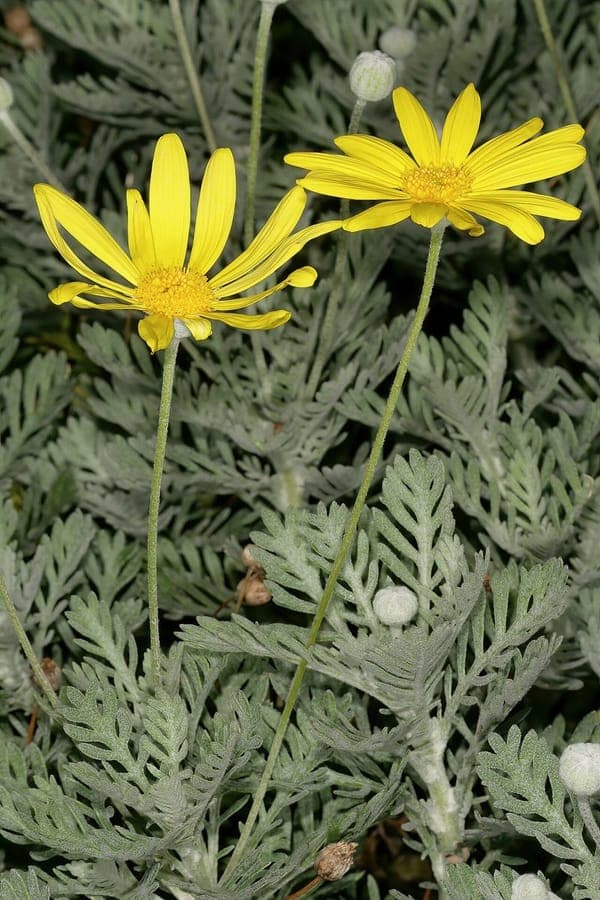
The foliage is the year-round attraction. Each leaf is 4 to 8 cm long and deeply pinnately divided into narrow, slightly rounded lobes. A dense coat of fine white hairs gives the plant its soft, silvery sheen and protects it from strong sun and drying winds in its native habitat.
The flower heads are 4 to 5 cm across, with a ring of bright yellow ray florets around a slightly deeper yellow central disc. Each one sits alone on a long, bare stalk of 10 to 15 cm, so the blooms seem to hover above the foliage.
At home in South Africa the shrub flowers mainly during the cool, damp months. In our climate it behaves as a true repeat bloomer: flowers appear from April or May until well into autumn, with a peak in late spring and early summer and a second flush once September nights cool down. In a bright, cool conservatory it can even produce a few blooms in winter. Bees, bumblebees and hoverflies visit the open flowers readily.
Ideal location
Give Euryops pectinatus the sunniest position you have. A south- or west-facing patio, a bright balcony or a sheltered corner against a warm wall is ideal. At least six hours of direct sun a day keeps the plant compact and the flowers coming. In partial shade it grows lax, leans towards the light and flowers far less.
The shrub copes reasonably well with wind, but the long flower stalks snap easily in a gale, so a spot out of the strongest gusts is best. In a mild coastal area you can also plant it out in a border from May to October, for instance in a gravel garden with other silver-leaved plants, and lift it again before the first frosts.
Soil requirements
Sharp drainage matters more than anything else. In the wild the plant grows in poor, sandy, stony ground and it dislikes wet roots. For containers, use a good multipurpose or loam-based compost and mix in roughly one third grit, coarse sand or pumice. A layer of crocks or gravel at the bottom of the pot helps excess water drain away.
Soil pH is not critical: slightly acidic to neutral suits it well, and a little lime is tolerated. If you plant it in the ground, open up heavy clay with grit, or plant on a slight mound so that rain drains away quickly.
During the growing season, feed every two to three weeks with a liquid fertiliser for flowering plants at half strength. Stop feeding from late August so that the stems can firm up before winter.
Watering
In summer, a container plant needs regular watering. Water thoroughly whenever the top 2 to 3 cm of compost feels dry, and always let the surplus drain away. A saucer of standing water is the quickest route to root rot. On hot days that may mean watering daily; in cool, cloudy spells every few days is enough.
The felted leaves hide drought stress well, so do not wait for the plant to wilt; check the compost with a finger instead. Once established in open ground, Euryops pectinatus is fairly drought tolerant, but in a pot it depends on you.
Over winter, water much less: just enough to stop the root ball drying out completely, roughly once every one or two weeks depending on temperature. Always water the compost rather than the hairy foliage.
Free preview
Want to see Grey-leaved euryops (Euryops pectinatus): complete guide in your garden? Make a free preview of your design.
Pruning
Pruning is not optional with this shrub. Left alone, the stems become long and bare at the base after a few years, with leaves and flowers only at the tips. Remove spent flowers along with their entire stalks; it looks tidier and encourages new buds.
In spring, when you move the plant outdoors in April or May, cut the stems back by about a third, each time just above a pair of leaves. A light trim after the first flush in July keeps the plant compact. Avoid cutting deep into old, leafless wood, as it is slow to resprout.
Cuttings root easily. In summer, take tip cuttings of 8 to 10 cm, strip the lower leaves and insert them in a gritty cutting compost. Under a clear cover they root within a few weeks, giving you a spare plant in case the parent does not make it through winter.
Maintenance calendar
January to March: Keep the plant somewhere cool and bright indoors. Water sparingly and check for aphids and whitefly. Pick off any dead leaves.
April: Put the plant outside on mild days and bring it back in at night while frost threatens. Repot into a slightly larger container if needed and prune.
May and June: After the last frost, usually mid-May, the plant can go out for good. Start feeding and keep the compost lightly moist. The first big flush of flowers begins.
July and August: Water on hot days, deadhead and trim lightly. Take cuttings for next year.
September and October: A second flush of flowers. Stop feeding. Bring the plant indoors before night temperatures drop below 0 °C, usually by mid to late October.
November and December: Overwinter in a bright, frost-free place at 5 to 10 °C. Little water, no feed.
The plant calendar on gardenworld.app shows the jobs due each month for your container plants and the rest of the garden.
Winter hardiness
Euryops pectinatus is only half hardy. The RHS rates it H3, meaning it tolerates at most a brief, light frost of around -3 to -5 °C, and only when the roots are dry. Prolonged frost or cold, wet conditions will kill it. In most of Britain and the Low Countries it therefore needs to come indoors every winter.
The best winter quarters are bright and cool: an unheated greenhouse, a frost-free conservatory, a garage with a window or a cool spare room. Around 5 to 10 °C is ideal. In a warm living room the plant keeps growing, becomes leggy and attracts aphids and whitefly.
Companion plants
Silver foliage and vivid yellow make Euryops pectinatus an easy partner for other sun-loving patio plants. For a classic Mediterranean look, pair it with blue or purple flowers. French lavender (Lavandula stoechas) and African lily (Agapanthus africanus) give a lovely contrast, and an olive tree (Olea europaea) in a large pot sets the southern mood.
To continue the silver theme, combine it with cotton lavender (Santolina chamaecyparissus) or curry plant (Helichrysum italicum). For a cheerful mix, marguerites (Argyranthemum frutescens) in white or pink sit well beside the yellow, as do zonal pelargoniums (Pelargonium zonale) in soft shades. A low ornamental grass such as feathertop (Pennisetum villosum) adds movement to a large planter.
Final thoughts
Euryops pectinatus is a container shrub that gives a great deal for very little effort. It offers silver foliage all year, flowers from spring into autumn and draws in pollinators. Its needs are simple: full sun, gritty compost that never stays wet, a spring prune and a bright, frost-free place for winter.
If you want your patio to feel a little more southern, this South African is a dependable ally. On gardenworld.app you can create a garden design in which pots and borders work together, with plants that share the same light and soil. Set a Euryops pectinatus beside your lavender next spring and enjoy its yellow daisies above the silver foliage all summer long.
Frequently asked questions about Grey-leaved euryops
Is Grey-leaved euryops winter hardy?
Euryops pectinatus is only half hardy. The RHS rates it H3, meaning it tolerates at most a brief, light frost of around -3 to -5 °C, and only when the roots are dry.
When and how do you prune Grey-leaved euryops?
Pruning is not optional with this shrub. Left alone, the stems become long and bare at the base after a few years, with leaves and flowers only at the tips.
How much water does Grey-leaved euryops need?
In summer, a container plant needs regular watering. Water thoroughly whenever the top 2 to 3 cm of compost feels dry, and always let the surplus drain away.
Where does Grey-leaved euryops grow best?
Give Euryops pectinatus the sunniest position you have. A south- or west-facing patio, a bright balcony or a sheltered corner against a warm wall is ideal.
What soil does Grey-leaved euryops need?
Sharp drainage matters more than anything else. In the wild the plant grows in poor, sandy, stony ground and it dislikes wet roots.

See it in your garden
See Grey-leaved euryops in your garden
One photo of your garden and a few questions. You see the result in about a minute.
Try it with a photoIdentify this plant in your own garden. Identify a plant
Similar plants
Topped lavender: complete guide
Lavandula stoechas
Complete care guide for Lavandula stoechas: ideal location, soil, pruning and companion planting. Perfect for sunny, well-drained gardens.
Boston daisy: complete guide
Argyranthemum frutescens
Boston daisy is a prolific Canary Island shrub with vibrant green foliage and abundant flowers from spring through autumn. Ideal for borders, containers, and patio plantings.
Lavender cotton: complete guide
Santolina chamaecyparissus
Lavender cotton (Santolina chamaecyparissus) is a beautiful gray-green shrub from the Asteraceae family. This Mediterranean plant offers fragrance and refined appearance for dry gardens.
