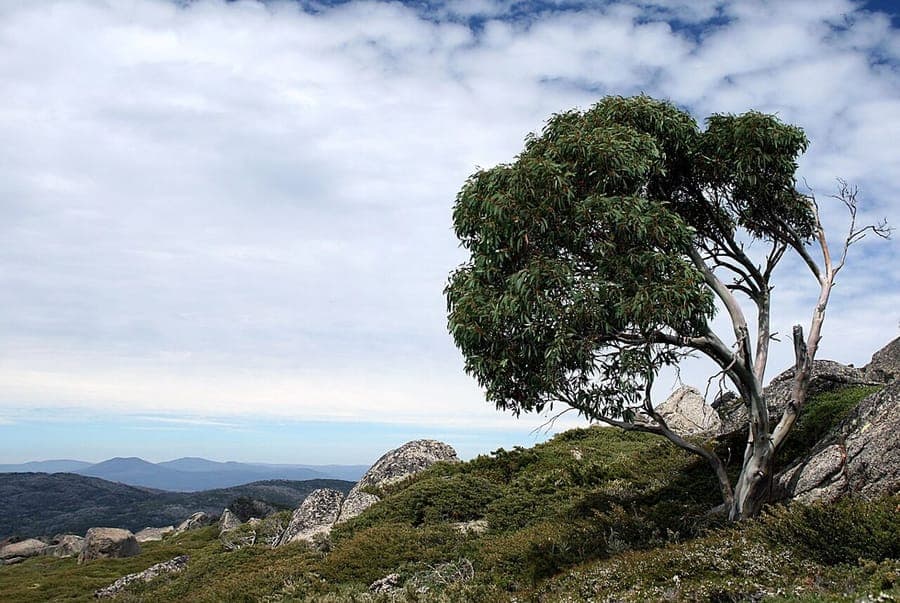
Toby Hudson / CC BY-SA 3.0, via Wikimedia Commons
Snow gum: the hardiest eucalyptus for the garden
Eucalyptus pauciflora
Want to see Snow gum: the hardiest eucalyptus for the garden in your garden?
Full design in HD: €7.99
Look after your Snow gum with the GardenWorld app
Identify plants with your camera and get a care calendar with reminders for this plant.


Overview
The snow gum (Eucalyptus pauciflora) is the eucalyptus best able to cope with cold. It comes from south-eastern Australia, from the Australian Alps in New South Wales and Victoria down to Tasmania. There it grows right up to the treeline, on slopes that lie under snow for months in winter. It belongs to the myrtle family, Myrtaceae.
What makes it so popular is the combination of an evergreen, grey-green crown with a smooth trunk in shades of white, cream and grey. In summer the old bark peels away in strips, revealing tones of green, olive and salmon pink. In gardens the tree usually reaches 6 to 12 m, with an open, irregular crown. It often grows with several stems and develops gnarled, curving branches with age, as you can see in the photo of a tree in its native mountains.
Several subspecies exist. The best known in European nurseries is subsp. niphophila, which comes from the highest slopes. It stays smaller, often 4 to 6 m, and is considered the hardiest form. Subsp. debeuzevillei is also available. If you want to give such a striking tree a position that truly suits your garden, you can have a garden design made on gardenworld.app that takes into account its eventual size, the shade it casts and the planting around it.
Appearance and flowering
Young plants carry broad, oval leaves in a bluish grey. These are soon followed by adult leaves: lance-shaped to sickle-shaped, 6 to 15 cm long, thick and leathery, and a glossy grey-green. Unusually, the veins run almost parallel along the length of the leaf. Crush a leaf and you get the familiar fresh eucalyptus scent. New growth is sometimes flushed with red.
In Europe the tree usually flowers in late spring and summer. The buds sit in clusters of seven or more and open into fluffy pompoms of white stamens. Bees and hoverflies love them. Small, cup-shaped woody seed capsules follow. At its base the tree forms a swollen woody root crown, a lignotuber, from which it can regrow after damage.
The snow gum grows fast: young trees easily put on 50 to 100 cm a year. It sheds some leaves and bark all year round, which you will notice beneath it.
On toxicity: the leaves contain essential oil, including eucalyptol. Do not eat them. Eucalyptus leaves are poisonous to cats, dogs and horses and can cause vomiting, drooling and lethargy. Never use the oil undiluted, and certainly not around pets.
Ideal position
Plant the snow gum in full sun. It copes well with wind and even suits an exposed coastal garden. Do choose a spot with enough room: at least 6 to 8 m from buildings. The roots are vigorous and go looking for water in dry summers.
Avoid frost pockets and full shade. Shelter from the coldest easterly winds is welcome, especially for young trees. Evergreens keep losing water through their leaves in winter, and when the ground is frozen and the wind is bitter, the foliage can dry out.
Soil requirements
This tree is undemanding. It grows on sand, loam and even poor soil, as long as it drains well. Slightly acidic to neutral ground is ideal; on very chalky soil the leaves may turn a little yellow. It dislikes standing water in winter.
There is no need to feed it. Rich soil makes growth too fast and the wood weaker, so the tree becomes less hardy and more likely to blow over.
Planting
Plant a snow gum young. A plant in a 2 to 3 litre pot, no more than 1 m tall, establishes far better than a large specimen. Older container plants often have roots circling the pot, and such a tree remains poorly anchored for life. The best time to plant is April to June, giving the tree a whole summer to root before its first winter.
In the first year, use a short, low stake of about 50 cm so the trunk learns to strengthen itself in the wind. Remove the stake after a year.
Free preview
Want to see Snow gum: the hardiest eucalyptus for the garden in your garden? Make a free preview of your design.
Watering
Keep the soil evenly moist during the first summer, giving 10 to 20 litres a week in dry weather. From the second year the snow gum is quite drought tolerant and, in the ground, seldom needs extra water. Only in a long heatwave will a deep soak help.
In a container, which only makes sense for young plants, the compost dries out quickly. Check every few days in summer.
Pruning
Prune the snow gum as little as possible. Remove dead or crossing branches in April or May, once the risk of hard frost has passed. Never prune in autumn, as the soft new growth that follows will be killed in winter.
If you want to keep the tree small, you can cut it back in April to 30 to 50 cm above ground, a technique known as coppicing. Thanks to the lignotuber it regrows with several stems and the attractive rounded juvenile foliage. This way you can keep it as a shrub of 2 to 4 m.
Care calendar
March: After a hard winter, check which branches have died back, but hold off pruning for now.
April–May: Remove dead wood, or coppice if you want to keep it small. Ideal planting time.
June–August: Flowering and rapid growth. Water young trees in dry spells.
September: No more pruning. Let young shoots harden off.
October–November: Mulch around young trees to protect the roots from frost.
December–February: In the first winter, protect the base of young trees in hard frost and wrap the crown in fleece if needed.
If you would rather not keep track of all this yourself, use the plant calendar on gardenworld.app, which shows month by month what your plants need.
Hardiness
Eucalyptus pauciflora is the hardiest of all eucalyptus species. Exactly how hardy depends on the subspecies and the origin of the seed. Mature trees generally tolerate -15 to -18 °C. Trees of subsp. niphophila from high-altitude sources survive harder frost in the wild, though horticultural sources usually give about -20 °C as the limit in gardens.
Young trees are more vulnerable. Protect them in their first winter with a thick mulch and wrap the crown in fleece when frost below -10 °C is forecast. More damaging than the temperature itself are long spells of frozen ground combined with dry easterly winds. If the tree is killed to the ground, it often regrows from the lignotuber.
Is the snow gum invasive? In Britain and the Low Countries it does not self-seed in a troublesome way, and it is not on any European list of invasive species. In Spain and Portugal some other eucalyptus species do naturalise, and forestry planting of eucalyptus is restricted there.
Companion plants
The snow gum provides a light, silvery backdrop that suits plants with a Mediterranean or New Zealand feel. New Zealand flax (Phormium tenax) and giant feather grass (Stipa gigantea) add bold shapes and movement. Kohuhu (Pittosporum tenuifolium) makes an evergreen screen or hedge nearby.
Lavender and rosemary enjoy the same sunny, well-drained conditions and dryness. Leave a generous circle around the trunk, or stick to low, drought-loving plants, as the ground beneath the tree gets dry in summer.
Final thoughts
The snow gum brings something exceptional to the garden: a white, peeling trunk, an evergreen grey-green crown and fast growth. Plant it young, in full sun and in well-drained soil, and prune only in spring. Then you will have a striking tree that can take a cold winter. Do keep the poisonous leaves in mind if you have pets.
Frequently asked questions about Snow gum
Is Snow gum winter hardy?
Eucalyptus pauciflora is the hardiest of all eucalyptus species. Exactly how hardy depends on the subspecies and the origin of the seed.
When and how do you prune Snow gum?
Prune the snow gum as little as possible. Remove dead or crossing branches in April or May, once the risk of hard frost has passed.
How much water does Snow gum need?
Keep the soil evenly moist during the first summer, giving 10 to 20 litres a week in dry weather. From the second year the snow gum is quite drought tolerant and, in the ground, seldom needs extra water.
What soil does Snow gum need?
This tree is undemanding. It grows on sand, loam and even poor soil, as long as it drains well.

See it in your garden
See Snow gum in your garden
One photo of your garden and a few questions. You see the result in about a minute.
Try it with a photoIdentify this plant in your own garden. Identify a plant
Similar plants
New Zealand flax: complete guide
Phormium tenax
Discover Phormium tenax, the stunning architectural plant from New Zealand. Learn about its dramatic foliage, growing requirements, and design applications.
Stipa gigantea: complete guide
Stipa gigantea
Giant feather-grass is a striking ornamental grass with feathery seed heads and golden shimmer. Learn how to grow this monumental grass successfully in your garden design.
Pittosporum tenuifolium: complete guide to Tawhiwhi
Pittosporum tenuifolium
Tawhiwhi is an elegant New Zealand tree with thin leaves and fine texture. Learn growth, shaping and maintenance requirements.
