
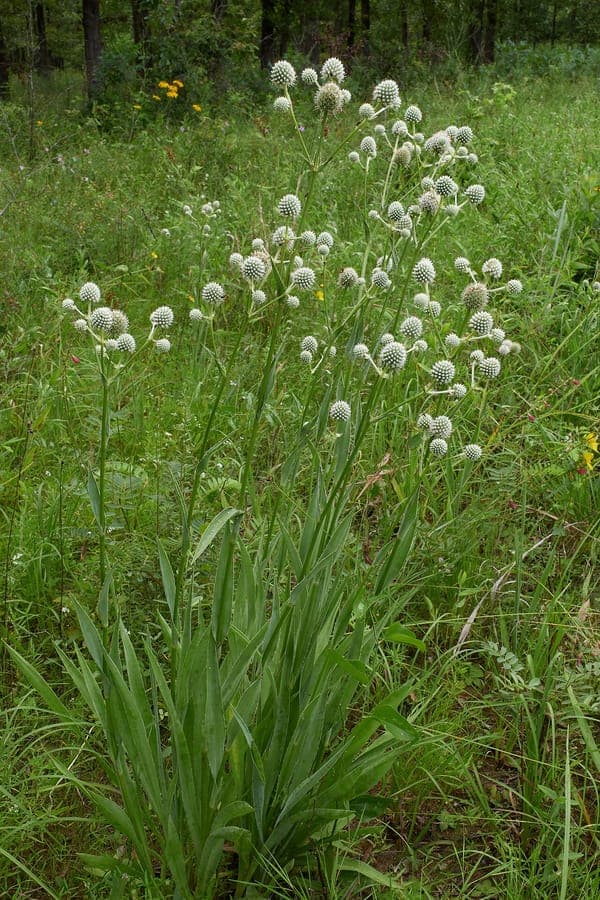
Eric Hunt / CC BY-SA 4.0, via Wikimedia Commons
Rattlesnake master: complete guide
Eryngium yuccifolium
Want to see Rattlesnake master: complete guide in your garden?
1 minute, no credit card
Overview
Eryngium yuccifolium, commonly known as rattlesnake master or button eryngo, is one of the most architecturally striking prairie perennials native to the central and eastern United States. Its natural range extends from Texas and Florida in the south northward through Arkansas, Missouri, Illinois, Indiana, Ohio, and on to Minnesota, Wisconsin, and Nebraska. The species was formally described by the French botanist Andre Michaux in 1803. Its botanical epithet yuccifolium - meaning yucca-leaved - precisely describes the long, linear, slightly blue-green leaves edged with small spines, which bear an uncanny resemblance to those of a yucca or agave. This distinctive foliage, combined with round, creamy white flower heads held on tall, branching stems, has made rattlesnake master a favourite in naturalistic and prairie-style garden design across North America and increasingly across Europe. At gardenworld.app you can explore how this bold native fits into a modern, low-maintenance front garden design.
Appearance and bloom cycle
Rattlesnake master produces a bold basal rosette of long, linear leaves that can reach 60 to 90 cm in length. The foliage is a distinctive blue-grey to blue-green, with small, non-aggressive teeth along the margins. From midsummer, stiff, branching stems rise to 100-150 cm in height, each branch tipped with a rounded, button-like flower head of 1.5 to 3 cm across. The florets are white to creamy white with a very faint blue tinge, surrounded by spiny, grey-green bracts. Flowering runs from June through September, peaking in July and August. The dried flower heads remain on the plant through winter, providing structural interest and seeds for birds. Bees and butterflies visit the blooms prolifically during the long summer flowering period.
Ideal location
As a native of open prairie, rattlesnake master demands full sun. At least six hours of direct sun daily is essential - ideally more. In the garden, an open, south or south-west facing position in a prairie planting, gravel garden, or dry perennial border is perfect. The plant is entirely at home in exposed sites where wind is a factor; in fact, staking is rarely needed thanks to its rigid stems. It does not tolerate prolonged shade: insufficient light results in a lax, poorly flowering plant. Avoid positions beneath overhanging trees or close to shading structures. It looks superb planted in sweeps alongside other prairie species or as a bold architectural specimen rising above lower groundcover plants.
Soil
Rattlesnake master is unfussy about soil quality but insists on good drainage. In the wild it grows in the thin, sandy, well-drained soils of open prairies and glades. In the garden, replicate these conditions by choosing a light, open-textured soil or improving heavier ground with a generous addition of horticultural grit or coarse sand. A pH of 5.5 to 7.5 suits it well. Do not fertilise generously: an overly rich soil produces leafy, lax growth at the expense of the characteristic compact form and flower production. A surface mulch of gravel around the plant base keeps the crown dry and helps replicate the visual quality of a prairie or gravel planting scheme.
Watering
Once established, rattlesnake master is highly drought-tolerant - one of the features that makes it so valuable as a garden plant in climates with warm, dry summers. In the first growing season, water regularly to help the deep, fleshy taproot develop. After establishment, rainfall alone is usually sufficient in most European climates. During extended drought, a single deep watering is more beneficial than frequent shallow applications; deep watering encourages the taproot to reach down into the cooler, moister subsoil. Avoid waterlogging at all costs: standing water, especially in clay soil, is the surest way to lose this plant to root rot. Container specimens need free-draining compost and pots with large drainage holes.
Free design
Want to see Rattlesnake master: complete guide in your garden? Make a free design now.
Pruning
Pruning is minimal. The dried flower heads and stems are highly ornamental through autumn and winter, and provide food and shelter for insects and birds, so it is well worth leaving them in place until early spring. In February or March, cut all old stems back to just above the ground before new growth begins to emerge. Remove any dead or tatty leaves from the basal rosette at the same time. Wear gloves to protect your hands from the leaf margin spines. If you wish to allow self-seeding, leave some flower heads in place until the seeds ripen and disperse; seedlings appear the following spring and can be transplanted when small.
Maintenance calendar
February to March: cut old stems back to the ground, tidy the basal rosette. April: new leaf growth begins; check drainage if the winter was wet. May: rapid growth of the rosette and first flower stems emerging. June: stems rise quickly, first flower buds visible. July to August: peak bloom; maximum pollinator activity. September: flowering winds down; allow stems to stand for autumn and winter interest. October to November: do nothing - let stems and heads stand for wildlife and decoration. December to January: full dormancy. At gardenworld.app, browse complete prairie-garden designs to see how rattlesnake master works in the wider composition.
Winter hardiness
Eryngium yuccifolium is exceptionally winter-hardy. In its natural range it endures the harsh continental winters of the American Midwest, and it is reliably hardy to USDA zone 3, tolerating temperatures below -40 degrees Celsius. In the Netherlands, Belgium, the UK, and most of central Europe (zones 6 to 8), it presents no winter hardiness challenges whatsoever. The only genuine risk is winter wetness combined with heavy, impermeable clay soil: this combination can cause root rot over a prolonged wet winter. Ensure the soil drains freely year-round. Planting slightly raised above the surrounding grade also helps. Pot-grown plants should have unobstructed drainage holes and should be moved to a sheltered but frost-exposed position (not a heated greenhouse) to maintain proper dormancy.
Companion plants
Rattlesnake master thrives in the company of other prairie natives and drought-tolerant perennials. Classic companions in a North American-style prairie include Echinacea purpurea (purple coneflower), Rudbeckia hirta (black-eyed Susan), Asclepias tuberosa (butterfly weed), Baptisia australis (blue wild indigo), and Monarda fistulosa (wild bergamot). Tall native prairie grasses such as Andropogon gerardii (big bluestem) or Sorghastrum nutans (Indian grass) complement the bold foliage of the rattlesnake master beautifully. In a European garden context, compatible drought-tolerant perennials include Salvia nemorosa, Agastache, Penstemon, and Nepeta. Most garden centres stock at least some of these companions. At gardenworld.app you can plan out an entire prairie or gravel garden composition before you commit to planting.
Closing thoughts
Rattlesnake master is a plant with presence. The dramatic yucca-like rosette, the tall architectural flower stems, and the long season of interest from June through winter make it one of the most rewarding prairie perennials available. It demands little in return: full sun, good drainage, and the occasional tidy-up in late winter are all it needs. For gardeners who want a striking, drought-resistant, wildlife-friendly perennial that looks good from midsummer right through the first frosts, Eryngium yuccifolium is a superb and distinctive choice.
Want to see Rattlesnake master: complete guide in your garden? Make a free design now.
Upload a photo, pick a style, and get a photorealistic design with plant list in under a minute.
10,000+ gardens designed already
No credit card required

