
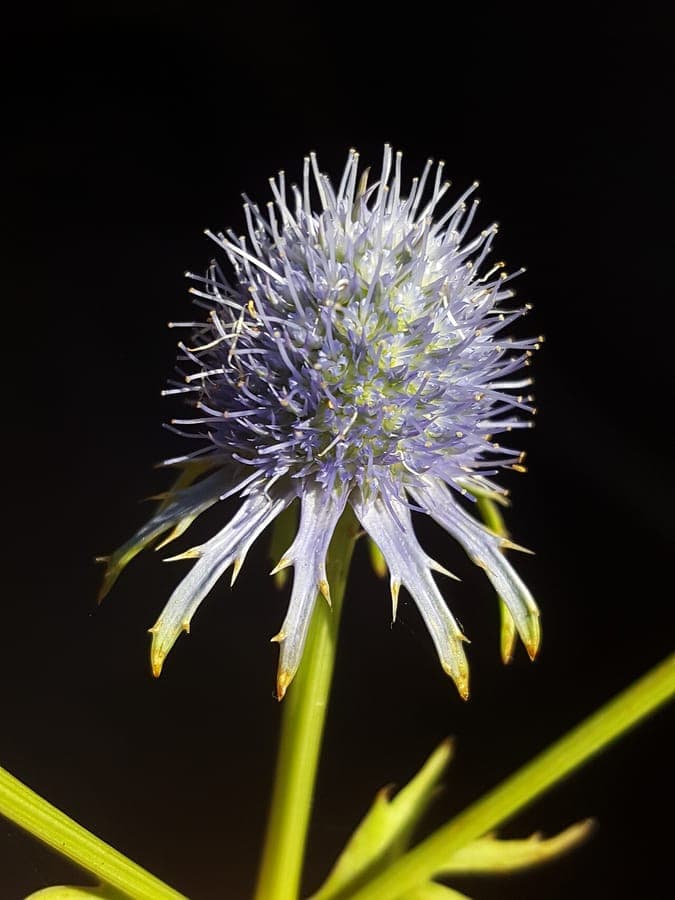
Alex Abair / CC BY 4.0, via Wikimedia Commons
Water eryngo: complete guide
Eryngium aquaticum
Want to see Water eryngo: complete guide in your garden?
1 minute, no credit card
Overview
Eryngium aquaticum, commonly called water eryngo or marsh rattlesnake master, is a striking native perennial belonging to the carrot family (Apiaceae). Unlike most sea hollies, which thrive in dry, sandy or gravelly conditions, this species is a true wetland plant. It is native to the eastern and central United States, ranging from Connecticut and New Jersey south to Florida and Georgia, and west to Minnesota and Mississippi. It was formally described by Carl Linnaeus in 1753 in his Sp. Pl. In its natural habitat it colonises freshwater marshes, wet meadows, stream margins, and low-lying coastal plains. The plant has a long folk history in eastern North America, where it was sometimes called rattlesnake master due to supposed medicinal uses against snakebite - a name it shares with the related but different Eryngium yuccifolium. For gardeners with a wet or boggy corner to fill, water eryngo is a dramatic, wildlife-friendly choice. At gardenworld.app, you can explore garden layouts that incorporate native wetland plants.
Appearance and bloom cycle
Water eryngo is a bold, upright perennial capable of reaching 120 to 150 cm in height under good conditions. The rigid, branching stems terminate in round, thistle-like flower heads measuring roughly 1.5 to 3 cm across. The florets are pale blue to blue-white, backed by prickly, greenish bracts that give the whole plant a distinctive architectural quality. Lower leaves are long, linear to lance-shaped, with spiny margins; stem leaves are smaller and clasping. The main flowering period runs from July through September, peaking in August. Spent flower heads dry elegantly on the stem and make excellent material for dried arrangements. The blooms are highly attractive to bees, bumblebees, and butterflies, making the plant a valuable component of a wildlife garden.
Ideal location
Unlike its close relatives, water eryngo does not want dry ground. In the wild it grows with its roots in persistently moist to wet soil - beside ponds, in bog gardens, along stream banks, and in damp meadows. In the garden, position it at the water's edge, in a rain garden, or in a permanently moist border where other plants struggle with wet feet. Full sun to light partial shade is acceptable; full sun produces the most abundant bloom. Avoid any spot that dries out significantly in summer: water eryngo is far less tolerant of drought than typical sea hollies. It is also well suited to large containers standing in shallow water trays, provided the roots have sufficient volume of moist medium.
Soil
Rich, moist to wet soil suits water eryngo best. A loam or clay-loam, with added organic matter such as garden compost or well-rotted leaf mould, replicates the fertile marsh soils of its native range. A pH of 5.5 to 7.5 is acceptable. Unlike most eryngiums, this species actually benefits from some soil fertility: avoid very impoverished substrates. The key requirement is consistent moisture - the soil should never dry out completely. A thick organic mulch applied over the root zone helps retain moisture in drier spells. In permanently moist locations beside water, no amendment is usually necessary.
Watering
Water eryngo is thirsty by nature and demands consistent moisture throughout the growing season. In the first year after planting, water generously and frequently to help the plant establish a strong root system. On a naturally moist site - beside a pond or in a bog garden - supplemental watering is rarely needed. During dry spells in summer, water deeply and regularly; never let the soil dry out between waterings. In containers, daily checking is advisable in hot weather. Signs of drought stress include drooping stems and leaf edge browning. Unlike most ornamental perennials, this species responds poorly to dry conditions and may fail to return the following year if allowed to dry out severely.
Free design
Want to see Water eryngo: complete guide in your garden? Make a free design now.
Pruning
Pruning is straightforward. Leave the decorative flower heads standing through winter, as they provide structure in the garden and shelter for overwintering insects. If you wish to prevent self-seeding, cut the stems off at the base in October, once the flowers have fully browned. Otherwise, allow the plant to shed its seeds naturally and you may find seedlings emerging nearby the following spring. In early spring, cut all old stems back to ground level to make room for fresh new growth. Always wear gloves when handling water eryngo, as the bracts and leaf margins are prickly.
Maintenance calendar
March: remove winter debris, resume regular watering. April: check that the planting site remains adequately moist; apply a balanced, slow-release fertiliser if soil is lean. May: growth accelerates; maintain consistent moisture. June: stems elongate rapidly, first flower buds visible. July to September: peak bloom; water freely and deadhead if self-seeding is unwanted. October: leave stems standing for winter interest or cut back if tidy appearance preferred. November to February: dormant period; no special action needed on naturally moist sites. At gardenworld.app, discover how to plan a complete bog garden or water-edge planting scheme.
Winter hardiness
Eryngium aquaticum is reliably hardy in USDA zones 5 to 9, withstanding minimum temperatures of around -29 degrees Celsius. Across most of northern and western Europe, including the Netherlands and Belgium, it comes through winter without any difficulty provided the root zone stays moist rather than frozen solid. Unlike drought-tolerant eryngiums, this species is not harmed by winter rain or wet soil. In fact, a dry winter - particularly one with hard frost and no snow cover - poses greater risk than a mild, wet one. A mulch of straw or leaves over the crown offers useful protection in cold continental climates. In pots, move containers to a sheltered position to prevent the root ball from freezing through entirely.
Companion plants
Water eryngo combines naturally with other moisture-loving perennials and bog plants. Ideal companions include Iris pseudacorus (yellow flag iris), Lythrum salicaria (purple loosestrife), Filipendula ulmaria (meadowsweet), Caltha palustris (marsh marigold), and Pontederia cordata (pickerelweed). For a tall, prairie-edge feel, pair it with clump-forming grasses such as Miscanthus sinensis or Calamagrostis acutiflora. Avoid planting beside drought-tolerant species such as lavender, salvia, or Echinacea, which require opposite conditions. Specialist aquatic and marginal plant nurseries, as well as larger garden centres, usually stock a good range of compatible wetland plants. At gardenworld.app you can visualise and plan your water-garden planting before committing to purchases.
Closing thoughts
Water eryngo is a plant that rewards gardeners willing to think beyond the familiar. Its steely blue-white flower heads, bold architectural form, and genuine attraction for pollinators make it a standout choice for any moist or boggy garden situation. It is reliably perennial, long-flowering from July to September, and remarkably low-maintenance once established in a suitable spot. If you have a pond margin, a rain garden, or a low-lying damp corner in your garden, Eryngium aquaticum is well worth seeking out.
Want to see Water eryngo: complete guide in your garden? Make a free design now.
Upload a photo, pick a style, and get a photorealistic design with plant list in under a minute.
10,000+ gardens designed already
No credit card required

