
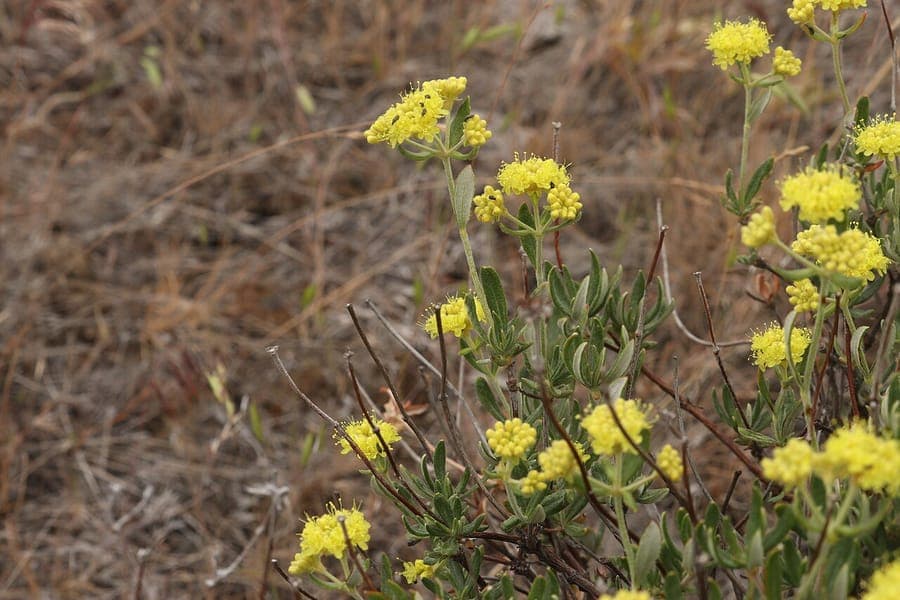
Walter Siegmund (talk) / CC BY-SA 4.0, via Wikimedia Commons
Rock buckwheat: complete guide
Eriogonum sphaerocephalum
Want to see Rock buckwheat: complete guide in your garden?
1 minute, no credit card
Overview
Eriogonum sphaerocephalum, commonly known as rock buckwheat, is a compact subshrub in the family Polygonaceae. The species name sphaerocephalum derives from Greek and means 'round-headed' or 'globe-headed', a direct reference to the characteristic spherical to compact flower heads that distinguish this plant from most other Eriogonum species, which carry flatter, umbel-shaped flower clusters.
Rock buckwheat grows natively across the western United States, particularly in California, Idaho, Nevada, Oregon, and Washington. Across that range it is a characteristic plant of dry cliff faces, stony mountain slopes, limestone ridges, and open rocky terrain at low to middle elevations. The species was formally described by the Scottish botanist David Douglas, who made extensive plant-collecting journeys through western North America in the early nineteenth century.
Eriogonum sphaerocephalum grows as a multi-stemmed subshrub from a shared woody base, typically 15 to 40 cm tall and 30 to 60 cm wide. Growth habit ranges from compact and cushion-like in lower-elevation forms to slightly looser and more sprawling in taller specimens. Discover inspiring garden designs featuring drought-tolerant plants like Eriogonum sphaerocephalum at gardenworld.app - an ideal starting point for planning an attractive, low-water front garden.
In European gardens, rock buckwheat is still relatively uncommon outside specialist collections, though it is gaining ground among enthusiasts of rock gardens and dry borders. Its compact form, striking spherical flower heads, and extreme drought tolerance make it a compelling choice for the thoughtful gardener.
Appearance & bloom cycle
The leaves of Eriogonum sphaerocephalum are oblong-elliptical to spoon-shaped or oval, 1 to 3 cm long and 0.5 to 1.5 cm wide. The upper surface is green to grey-green, while the underside is white-woolly and soft to the touch. This woolly covering is characteristic of the genus and helps the plant retain moisture at high temperatures. The leaves are densely arranged on the stems, giving the plant a dense, cushion-like appearance.
The flowering period runs from May to August, depending on elevation and location. At lower elevations the plant begins flowering in May; at higher elevations and in cooler regions, flowering may not begin until July or August. Flower stems rise 10 to 25 cm above the foliage and carry the characteristic spherical to compact heads of small yellow flowers. Individual florets measure only 2 to 3 mm across but are so tightly packed into the round head that the overall effect is striking and clearly visible from a distance.
The flower colour is bright to soft yellow and contrasts attractively with the grey-green foliage. After flowering, stems dry to brownish, globe-shaped seed heads that remain decorative throughout autumn. They supply seeds for small birds and add interesting texture in the winter garden. The plant is a reliable nectar source for bees, bumblebees, and hoverflies.
Several varieties are recognised: var. sphaerocephalum is the most common standard form; var. halimioides has narrower leaves; var. fasciculifolium has leaves arranged in bundles; var. sublineare has narrowly linear leaves. Gardens most commonly grow the standard form.
Ideal location
Eriogonum sphaerocephalum requires a fully sunny position receiving at least six hours of direct sun daily. It is a characteristic plant of open, exposed cliff faces and stony slopes where the sun shines all day. In partially shaded positions it flowers poorly and becomes more susceptible to fungal problems.
Ideal positions are south-facing or south-west-facing borders, open rock gardens, dry stony slope plantings, gravel beds, and dry paved front gardens. The plant excels in difficult, lean spots: alongside stone walls, on bare rocky terrain, in limestone gardens, and on extensive green roofs.
Eriogonum sphaerocephalum handles high summer temperatures very well. The plant responds positively to the warmth retained by stone walls and rock features, which is an advantage in Dutch and Belgian gardens. Spacing in group plantings: 40 to 55 cm apart. For dense ground coverage in dry zones: four to five plants per square metre.
Avoid wet, dense ground, standing water, and positions in deep shade. In gardens that stay wet for prolonged periods in winter, the plant is not suitable unless drainage is dramatically improved.
Soil requirements
Eriogonum sphaerocephalum has low fertility demands but is strictly dependent on good drainage. Preferred pH ranges from 6.0 to 8.6 - a broad range that reflects how adaptable this plant is. The species tolerates both slightly acid and clearly alkaline soil, making it particularly well suited to limestone rock gardens and gravel gardens.
In freely draining soil - sandy ground, gravel-rich ground, or light loam - the plant grows excellently without amendment. In heavier or less well-draining ground: incorporate 30 to 40 percent coarse grit, perlite, or crushed stone to improve drainage. Add as little compost or organic matter as possible - overly fertile soil promotes lush but weak leafy growth and reduces flowering.
In rock gardens: plant Eriogonum sphaerocephalum in hollows or crevices filled with a mixture of broken stone and coarse sand in a 2:1 ratio. A mulch layer of 4 to 6 cm of coarse grit or broken granite around the plant protects roots, suppresses weeds, and keeps the stem base dry. Avoid organic mulch (bark, leaf compost) placed directly around the stem base.
When planting: dig a planting hole twice as wide as the root ball but only as deep. Plant at exactly the same depth as in the container. Planting too deep increases the risk of crown rot.
Free design
Want to see Rock buckwheat: complete guide in your garden? Make a free design now.
Watering
Eriogonum sphaerocephalum is among the most drought-tolerant subshrubs that can be grown in European gardens. In its native range it grows on parched cliff faces and stony slopes where no rain falls for months in summer. Once well established, the plant requires virtually no supplemental watering in a European climate.
In the first growing season after planting: water once per week in dry, warm conditions to encourage strong root development. Always wait until the top 6 to 10 cm of soil feels completely dry before watering again. Drip irrigation delivering water directly to the roots without wetting the foliage is the best approach. Never water in full midday sun.
From the second season onwards, supplemental watering is normally not needed. Only during extreme dry spells exceeding four weeks without rainfall can a single watering at root level be beneficial. Do not water in autumn or winter under any circumstances. Wet roots during the cold winter period are the most common cause of plant loss in Eriogonum species grown in European gardens.
When in doubt: too little water is safer than too much. The plant signals genuine drought stress through slightly greying foliage. Recovery after drought is rapid.
Pruning
Eriogonum sphaerocephalum requires minimal pruning. Its slow growth rate and compact, multi-stemmed habit mean it rarely needs pruning to maintain its shape. Leave spent dried flower heads in place through autumn and winter - they supply seeds for birds, offer attractive winter structure, and provide some protection for the root crown.
In early spring, once new shoots are visible at the base (typically mid-March to early April), cut back dead stems to approximately 5 to 8 cm above ground level. Always wait until new green growth is visible at the base before cutting. Never cut deeply into the woody basal tissue: Eriogonum sphaerocephalum recovers slowly from hard pruning, similar to other Eriogonum species.
A light tidying cut in April or May - trimming overlapping or protruding shoots - encourages a compact growth form and good flowering. Remove dead or damaged shoots promptly. A light renovation every four to five years is sufficient for a vital, free-flowering plant.
To limit self-seeding: remove seed heads after seeds have dispersed but before full ripening - typically late August to mid-September.
Maintenance calendar
January and February: Full dormancy. No action. Check drainage after prolonged rain.
March: Begin removing dead stems once new shoots appear at the base. Cut back to 5 to 8 cm above ground level. Check the mulch layer.
April: Optional: apply fresh gravel mulch. In dry weather, water weekly to support growth resumption. An optional light application of a potassium-rich fertiliser is beneficial.
May and June: Start of the flowering period. Water once weekly in dry, warm conditions. Weed control in the gravel mulch. The round yellow flower heads appear.
July and August: Peak flowering. The spherical yellow heads are at their most attractive. Minimal watering. Remove only damaged or dead stems.
September: Flowering declines. Leave stems and seed heads for structure and bird food. Stop watering.
October and November: Autumn. No further action. In anticipation of a wet winter, optionally add a thin layer of gravel around the plant base.
December: No further action. Full dormancy.
Winter hardiness
Eriogonum sphaerocephalum is rated hardy to USDA zone 5, corresponding to minimum temperatures of approximately -28 degrees Celsius. This makes it reliably suitable for the majority of gardens in the Netherlands and Belgium, where the coldest nights typically reach -15 to -18 degrees Celsius. In sheltered positions the plant can survive temperatures around -20 degrees Celsius provided drainage is excellent.
As with most Eriogonum species, cold alone is not the main threat: the combination of cold and wet soil is the true danger. In its native range the plant survives harsh mountain winters because the rocky substrate drains almost instantly. That outstanding drainage is the key to winter survival.
Always make drainage the top priority when selecting or preparing the planting site. On light, freely draining soils, virtually no winter protection is needed. On heavier or less well-draining ground: apply a layer of quartz sand or coarse grit around the plant base before winter. Avoid thick organic mulch.
At gardenworld.app you can see how rock buckwheat and other drought-tolerant plants look in a finished, personalised garden design tailored to your specific site and conditions.
Companion plants
Eriogonum sphaerocephalum makes an excellent partner in dry rock gardens, gravel beds, and dry borders. The bright yellow spherical flower heads offer fine colour contrasts with blue, purple, and silver-toned neighbours. At gardenworld.app you can visualise these combinations in a personalised garden layout before committing to planting.
Suitable garden companions:
- Lavandula angustifolia 'Hidcote': Deep blue lavender 30 to 40 cm, blooming simultaneously in June to August and forming a striking colour composition.
- Penstemon caespitosus: Low-growing penstemon 10 to 15 cm with blue to purple tubular flowers, ideal alongside the compact rock buckwheat.
- Artemisia 'Powis Castle': Silver-grey fine-textured sub-shrub 60 to 80 cm as colour contrast and textural accent.
- Sedum spathulifolium 'Cape Blanco': Compact stonecrop 5 to 10 cm with grey-white foliage and yellow flowers - a perfect foreground companion.
- Iberis sempervirens: White candytuft 20 to 25 cm serving as a spring-blooming companion.
- Eriogonum umbellatum: A larger relative with bright yellow umbel-like flower clusters - together in a drought garden they provide mass and textural variety.
- Festuca glauca 'Elijah Blue': Blue-grey ornamental grass 20 to 30 cm as a textural accent at the border front.
Avoid pairing with moisture-loving plants such as Hosta, Astilbe, or wet-loving ground covers. These require a completely different watering regime and are incompatible with the dry site requirements of Eriogonum sphaerocephalum.
Closing
Eriogonum sphaerocephalum is a distinctive, slow-growing subshrub with a character all its own: the globe-shaped yellow flower heads, compact grey-green foliage, and exceptional drought tolerance make it a true asset for dry rock gardens and sunny borders. It demands minimal maintenance and rewards the gardener with years of reliable, colourful flowering.
Whether you are creating a rock garden, planting a dry slope, or establishing a low-maintenance front garden, rock buckwheat deserves a prominent position. Visit gardenworld.app for inspiration and a personalised garden design where drought-tolerant plants like Eriogonum sphaerocephalum set the tone.
Want to see Rock buckwheat: complete guide in your garden? Make a free design now.
Upload a photo, pick a style, and get a photorealistic design with plant list in under a minute.
10,000+ gardens designed already
No credit card required


Similar plants
Sulfur buckwheat: complete guide
Eriogonum umbellatum
Full guide to sulfur buckwheat: siting, soil, watering, pruning and companion planting for this showstopping yellow-flowered perennial from the American West.
Marumleaf buckwheat: complete guide
Eriogonum marifolium
Full guide to Eriogonum marifolium: siting, soil, watering, pruning and companion planting for this yellow-flowered subshrub from the western United States.
Slender buckwheat: complete guide
Eriogonum microthecum
Full guide to Eriogonum microthecum: siting, soil, watering, pruning and companion planting for this drought-tolerant purple-flowered subshrub from western North America.