
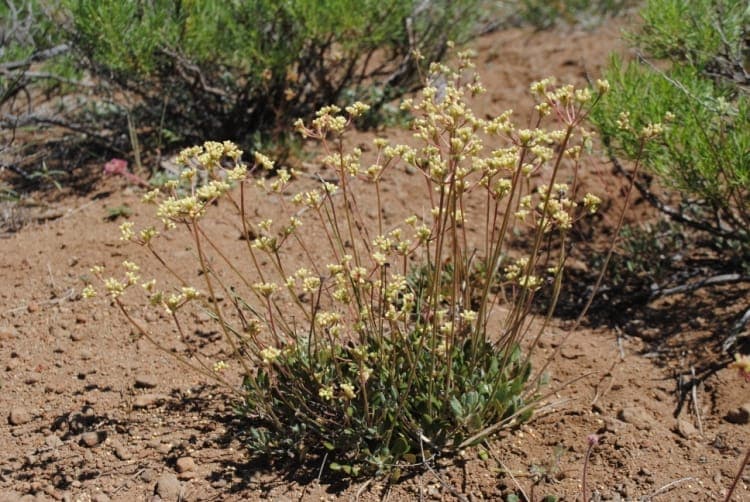
Anthony Baniaga / CC0, via Wikimedia Commons
Marumleaf buckwheat: complete guide
Eriogonum marifolium
Want to see Marumleaf buckwheat: complete guide in your garden?
1 minute, no credit card
Overview
Eriogonum marifolium, commonly known as marum-leaf wild buckwheat or marumleaf buckwheat, is a compact subshrub in the family Polygonaceae. It grows natively across the dry mountain ranges of California, Nevada, Oregon, and Washington. The species name marifolium means 'with leaves resembling Teucrium marum', a small aromatic subshrub from the Mediterranean. That comparison refers to the shape and texture of the narrow, woolly-hairy, faintly aromatic leaves that characterise this plant.
As a member of the genus Eriogonum - North American wild buckwheat - this species shares all the characteristic traits of the group: remarkable drought tolerance, flowering in hot and lean conditions, and high value for pollinators. With more than 250 species, Eriogonum is one of the most species-rich genera in the North American flora. Eriogonum marifolium holds a modest but significant position within that diversity: it is not widely cultivated as a garden plant, but it is an exceptionally well-adapted mountain plant that delivers excellent results in dry gardens, rock features, and low-maintenance plantings.
The yellow flower clusters appear in summer above the compact foliage rosette. For such a small plant, the flowering is generous. Bees, bumblebees, and many other pollinators readily visit the blooms, drawn by abundant nectar production. Explore inspiring garden designs featuring drought-tolerant plants like Eriogonum marifolium at gardenworld.app - an excellent starting point for planning a low-water front garden.
In European gardens, this plant remains relatively little known, but interest is growing among enthusiasts of rock gardens and dry borders. Once established, it demands almost no attention and flowers faithfully year after year.
Appearance & bloom cycle
Eriogonum marifolium is a small to medium-sized subshrub with a characteristic cushion-like or rounded growth habit. Mature plants reach 15 to 35 cm in height and 25 to 50 cm in width. Growth rate is moderate: the plant typically spreads 5 to 8 cm per growing season.
The leaves are narrowly elliptical to oblong-oval, 1 to 3 cm long and 0.5 to 1 cm wide. The upper surface is grey-green and lightly hairy, while the underside is clearly woolly-white and soft to the touch. This woolly covering is typical of the Eriogonum genus and helps the plant retain moisture during periods of high temperature and drought. Leaf colour changes little through the season, though some plants develop red or bronze tones in autumn that extend winter interest.
The flowering period runs from June to August, sometimes extending into September in favourable conditions. Flower stems rise 10 to 20 cm above the foliage and carry small, umbel-like clusters of yellow flowers. Individual florets measure only 2 to 3 mm across but are tightly packed into the flower heads, creating a striking visual effect for such a compact plant. Flower colour ranges from bright yellow to soft ochre, depending on growing conditions and sun exposure.
After flowering, small triangular brown seed capsules form. The plant self-seeds modestly. The dried flower stems remain decorative throughout autumn, providing seeds for small birds and attractive structure in the winter garden.
Ideal location
Eriogonum marifolium thrives only in a fully sunny position receiving at least six hours of direct sun daily. Originating from the hot, dry mountain slopes of the western United States, it truly needs this exposure for strong flowering and healthy growth. In shaded positions, plants quickly become leggy, flower poorly, and become more susceptible to fungal problems.
The best positions are south-facing or south-west-facing borders, open rock gardens, dry slope plantings, and gravel beds. The plant excels in garden spots where few others will grow: dry verges beside paved surfaces, bare rocky areas, extensive green roofs, and gravel paths with ornamental planting.
In urban settings, Eriogonum marifolium proves its worth as heat-resistant planting in enclosed, heat-trapping courtyards and wall bases. Pairing with gravel mulch or lava aggregate as a ground covering enhances its performance. Spacing in group plantings: 35 to 50 cm apart. For dense ground coverage: five to seven plants per square metre.
Avoid positions with standing water, deep shade from trees, or spots where rain pools after storms. The plant has modest requirements, but wet roots combined with cold winters represent its greatest vulnerability.
Soil requirements
Eriogonum marifolium has low fertility demands but drainage is absolutely non-negotiable. The preferred pH range is 6.0 to 7.5. The plant tolerates slightly acid to neutral soils without difficulty. Rich, wet clay soils are its Achilles heel: on such substrates, growth is poor and roots are likely to rot during wet winters.
In freely draining soils such as sandy, chalky, or light loam ground, Eriogonum marifolium grows excellently without any amendment. In less well-draining soil: incorporate 30 to 40 percent coarse grit, perlite, or crushed stone to improve drainage. Limit additions of compost or other organic improvers to a maximum of 10 percent of the planting mix - overly fertile soil promotes lush leafy growth at the expense of flowering.
In rock gardens and stone features: fill the planting pockets with a mixture of crushed stone and coarse sand in a 2:1 ratio. A mulch layer of 4 to 6 cm of broken granite or quartz grit around the plant keeps roots cool, suppresses weeds, and keeps the base dry. Avoid organic mulch placed directly around the stem base.
When planting into a new garden: dig a planting hole twice as wide as the root ball but only as deep. Mix the excavated soil with coarse grit, plant at exactly the same depth as in the container, firm in gently, and water well.
Free design
Want to see Marumleaf buckwheat: complete guide in your garden? Make a free design now.
Watering
Eriogonum marifolium is exceptionally drought-tolerant. Across its native range in the mountain areas of the western United States, it survives in regions receiving 200 to 400 mm of annual rainfall without any supplemental irrigation. It grows on mountain slopes where soil dries out completely to considerable depth for months each summer.
In the first growing season after planting: water once per week in warm, dry conditions to encourage strong root development. Always wait until the top 5 to 8 cm of soil feels completely dry before watering again. Drip irrigation or a watering can delivering water directly to the roots without wetting the foliage gives best results. Never water in full midday sun.
From the second season onwards, supplemental watering under normal rainfall conditions is rarely or never necessary. Only during sustained dry spells exceeding four to five weeks is occasional watering beneficial. Do not water in autumn or winter under any circumstances. Excess moisture in winter is the primary reason Eriogonum species are lost in European gardens.
When in doubt: too little water is safer than too much. The plant gives clear signals when genuinely water-stressed: leaves become slightly greyer or droop lightly. Recovery after a mild dry spell is rapid once water is supplied.
Pruning
Eriogonum marifolium requires minimal pruning. The plant is best left to determine its own shape, with as little intervention as possible. Leave spent flower stems and dried seed capsules standing through autumn and winter - they provide seeds for birds and structure in the winter garden landscape.
In early spring, around mid-March to early April, cut back dead stems and dried flower stalks to approximately 5 cm above ground level. Always wait until new green shoots are visible at the base before cutting. Pruning before new growth appears risks damaging emerging shoots.
Never cut deeply into the woody basal tissue. Eriogonum marifolium recovers slowly from hard pruning. A light tidying cut in April or May - trimming any outward-spreading shoots back to the desired outline - encourages compactness. A gentle renovation every three to four years is sufficient.
To prevent unwanted self-seeding, remove seed heads after the seeds have dispersed but before they are fully ripe - typically late August to mid-September.
Maintenance calendar
January and February: Full dormancy. No action needed. Check drainage after prolonged rain and ensure no water pools around the plant base.
March: Begin removing dead stems and flower stalks once new shoots appear at the base. Cut back to 5 cm above ground level. Check that the mulch layer is still adequate.
April: Optional: add a fresh thin layer of gravel mulch. In dry weather, water weekly to support growth resumption. A light application of a potassium-rich fertiliser is optional.
May and June: Growing season underway. Water once weekly in dry, warm periods. Weed control in the gravel mulch. Watch for the start of flowering.
July and August: Peak flowering season. The yellow flower clusters are at their most striking. Minimal watering. Remove only damaged or dead stems.
September: Flowering winds down. Leave stems and seed heads for wildlife and structure. Stop watering.
October and November: Autumn. No further action. In anticipation of a wet winter, optionally add a thin layer of gravel around the plant base.
December: No action. Full dormancy.
Winter hardiness
Eriogonum marifolium is rated hardy to USDA zone 5, corresponding to minimum temperatures of approximately -28 degrees Celsius. This makes it reliably suitable for the majority of gardens in the Netherlands and Belgium, where the coldest nights typically reach -15 to -18 degrees Celsius. In sheltered positions, the plant can survive temperatures around -20 degrees Celsius provided drainage is excellent.
The greatest threat in European gardens is not cold itself but the combination of cold and wet soil. In its native western mountain habitat, Eriogonum marifolium survives under snow cover that insulates and keeps roots dry. In dry, snowless European winters with simultaneously wet soil, the risk is higher.
Always prioritise drainage above all else when selecting or preparing the planting site. On light, freely draining soils, the plant needs virtually no winter protection. On heavier or less well-draining soils: apply a layer of quartz sand or coarse grit around the plant base before winter. Avoid thick organic mulch (bark, leaf compost) as this retains moisture.
In years with early heavy frost while the plant is still in leaf (October to November), a light protective layer of coarse grit or gravel around the root crown can be applied. Remove this covering once the risk of freeze-thaw cycles has passed, typically in March.
Companion plants
Eriogonum marifolium makes an excellent partner in dry borders, rock gardens, and gravel beds. Its yellow flowers offer beautiful colour contrasts with blue, purple, and silver-toned neighbours. At gardenworld.app you can visualise these combinations in a personalised garden design before you commit to planting.
Suitable garden companions:
- Lavandula angustifolia 'Munstead': Compact lavender 30 to 40 cm with deep blue spikes. Blooms simultaneously in July and August, creating a fine colour composition.
- Penstemon caespitosus: Low-growing penstemon 10 to 15 cm with blue to purple tubular flowers, ideal alongside the compact Eriogonum.
- Artemisia schmidtiana 'Nana': Silver-grey fine-textured cushion 15 to 20 cm as colour contrast and textural accent.
- Sedum album: White-flowered stonecrop 10 to 15 cm, blooming June to July and filling the lower planting zones.
- Iberis sempervirens: White candytuft 20 to 25 cm, blooming May to June and acting as a spring companion.
- Stachys byzantina 'Silver Carpet': Low silver-leaved ground cover 15 to 20 cm that pairs superbly with the grey-green foliage of Eriogonum.
- Eriogonum umbellatum: A larger relative with bright yellow flower clusters - together they create a drought garden full of colour and life.
Avoid pairing with moisture-loving plants such as Hosta, Rodgersia, or damp-loving ground covers. These require a completely different watering regime and are incompatible with the dry site preferences of Eriogonum marifolium.
Closing
Eriogonum marifolium is a small but determined wild buckwheat that has few rivals when it comes to drought tolerance, minimal maintenance, and value for pollinators. Its cheerful yellow flower clusters in summer, compact grey-green foliage, and robust constitution make it an excellent choice for any sunny, dry corner of the garden.
Whether you are creating a rock garden, planting up a gravel bed, or establishing a low-maintenance front garden, Eriogonum marifolium deserves a permanent place in the design. Visit gardenworld.app for inspiration and a personalised garden layout where drought-lovers like this compact wild buckwheat take centre stage.
Want to see Marumleaf buckwheat: complete guide in your garden? Make a free design now.
Upload a photo, pick a style, and get a photorealistic design with plant list in under a minute.
10,000+ gardens designed already
No credit card required


Similar plants
Sulfur buckwheat: complete guide
Eriogonum umbellatum
Full guide to sulfur buckwheat: siting, soil, watering, pruning and companion planting for this showstopping yellow-flowered perennial from the American West.
Rock buckwheat: complete guide
Eriogonum sphaerocephalum
Full guide to Eriogonum sphaerocephalum: siting, soil, watering, pruning and companions for this drought-tolerant yellow-flowered subshrub from the western United States.
Slender buckwheat: complete guide
Eriogonum microthecum
Full guide to Eriogonum microthecum: siting, soil, watering, pruning and companion planting for this drought-tolerant purple-flowered subshrub from western North America.