
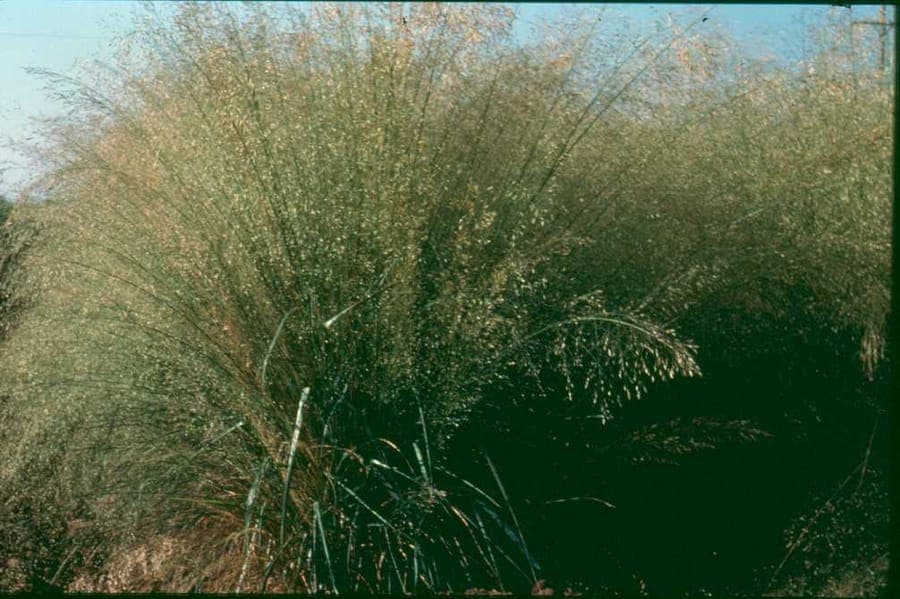
location unknown/photographer unknown/TXPMC / Public domain, via Wikimedia Commons
Sand lovegrass: complete guide
Eragrostis trichodes
Want to see Sand lovegrass: complete guide in your garden?
1 minute, no credit card
Overview
Eragrostis trichodes, commonly called sand lovegrass, is a clump-forming ornamental grass native to the central and eastern United States. Its natural range spans the prairies, savannas, and open woodlands of states including Texas, Kansas, Nebraska, Oklahoma, Missouri, Illinois, Indiana, Wisconsin, and South Dakota - the heartland of North America's tall-grass and mixed-grass prairie biomes. It has since been introduced into parts of Western Europe, including Germany and France, where it has naturalized on calcareous sandy soils.
The species was first described in 1861 by Alph. Wood as Eragrostis trichodes, transferred from Nuttall's original Poa trichodes. The genus Eragrostis (lovegrasses) is enormous, comprising over 350 species distributed across tropical, subtropical, and warm-temperate zones worldwide. Among North American grasses, E. trichodes stands out for its exceptionally fine-textured, hair-like plume branches - the species epithet 'trichodes' means 'hair-like' in Greek - which give the plant an ethereally light, almost misty appearance when backlit by the afternoon sun.
In its native prairie habitats, sand lovegrass occupies disturbed sandy soils, roadsides, and dry open ground, often colonizing areas where other species struggle. It is fast-growing, drought-tolerant, and needs no fertilisation on poor soils. These qualities translate perfectly to garden use: it performs well in low-maintenance prairie-style borders, dry gardens, and modern gravel plantings where its graceful movement is best appreciated.
To see how sand lovegrass fits into a full garden composition, visit gardenworld.app and explore plant combinations for sunny, dry borders.
Appearance & bloom cycle
Sand lovegrass forms tight, upright clumps of narrow, linear leaves 2 to 5 mm wide and 30 to 60 cm long. Leaf colour is fresh mid-green in spring and summer, turning warm gold to reddish-brown in autumn as temperatures drop. The leaf bases often show attractive red or purple pigmentation, especially in hot, dry conditions - a trait that adds interest even before flowering begins.
The overall plant habit is erect and bunching (growth form: Bunch). Mature clumps reach 60 to 90 cm in leaf height, with flowering culms rising to 90 to 120 cm above ground. The panicles, which emerge from July onwards and peak in August and September, are the plant's most distinctive feature. Each panicle is 20 to 40 cm long, composed of thousands of hairlike lateral branches carrying tiny flowers. The overall effect is a diaphanous, shimmering cloud of warm brownish-yellow that moves with every breeze.
Flowers are technically inconspicuous individually - small, yellow-brown - but the massed effect of the enormous panicle is highly ornamental. After flowering, the plumes dry to a buff-tan and hold their structure through winter, providing valuable structural interest and seed for seed-eating birds. In favourable garden conditions, sand lovegrass self-seeds freely, gradually colonising adjacent sandy areas.
Ideal location
Sand lovegrass is a full-sun plant. In its prairie homeland it grows in fully exposed positions with maximum sun exposure - 6 to 8 hours minimum. Partial shade leads to lax, floppy stems and reduced panicle production. In garden use, place it in the hottest, sunniest spot available: south-facing borders backed by reflective walls, dry gravel gardens, or raised beds that warm quickly in spring.
Microclimate matters: sand lovegrass thrives in the kind of warm, dry summer conditions found against south-facing walls, on slopes with good cold-air drainage, or in raised planters on sunny terraces. It performs across USDA zones 5 to 9, making it reliably hardy throughout the UK, Belgium, the Netherlands, and much of France.
Its fine, graceful texture makes it ideal as a see-through backdrop behind more solid perennials, or as a rhythmic repetition plant along path edges.
Soil requirements
This grass is emphatically a lean-soil plant. In nature it thrives on poor, dry sandy soils - hence the common name 'sand lovegrass'. Rich, fertile, moisture-retentive soils cause excessive lush growth, floppy stems, and reduced ornamental value. On heavy clay soil in the garden, incorporate 20 to 30% coarse horticultural sand or perlite into the planting pit to improve drainage.
The pH range is 6.0 to 8.5 - it tolerates mildly acidic to moderately alkaline soils equally well, making it suitable for a wide range of garden situations. On naturally sandy soils, such as coastal gardens or light loam, no soil amendment is needed at all.
Avoid organic mulches such as garden compost or bark chips, which retain moisture and release nutrients that push the grass toward rank, floppy growth. A decorative gravel mulch (20 to 40 mm depth) is far more appropriate - it keeps the crown dry, reflects warmth, and suits the visual language of prairie and gravel planting.
Free design
Want to see Sand lovegrass: complete guide in your garden? Make a free design now.
Watering
Once established (from the second year onwards), sand lovegrass is essentially drought-tolerant and manages on natural rainfall in northern European climates. In the first growing season, water weekly to establish the root system, but thereafter let the plant rely on rainfall. Even in hot, dry summers, fortnightly watering is usually sufficient on sandy soils.
The key concern is avoiding excess moisture, not drought. Waterlogged roots - particularly in winter - cause crown rot and plant death far more reliably than drought. On clay-heavy soils, ensure drainage is excellent before planting. Standing water around the crown after rainfall is a warning sign that the planting position needs to be improved or the plant moved.
No irrigation infrastructure is needed for established plants in average UK, Belgian, or Dutch conditions. In exceptionally hot, dry summers (prolonged dry spells of more than three weeks), a deep watering (15 to 20 mm) once every two weeks will keep plants looking their best.
Pruning
Management is simple: cut the whole clump back hard to 5 to 10 cm above ground level in late February or early March, before new growth emerges. Use sharp shears or a hedge trimmer. This annual cutback removes the winter-dried material and stimulates fresh, vigorous growth.
Do not cut back in autumn - the dried plumes are ornamentally valuable through winter and provide seed for birds. Waiting until late winter is both aesthetically better and horticulturally sounder, as the dry foliage insulates the crown from frost and wet.
If clumps become oversized over several years, lift and divide in early spring. Sand lovegrass divides easily with a sharp spade or fork; the divided sections re-establish quickly when replanted at the same depth. Spacing for new plants: 40 to 60 cm apart, depending on desired effect.
Maintenance calendar
January–February: Leave winter structure in place; enjoy dried plumes in frost and snow; check crown is not sitting in standing water.
March: Cut back to 5 to 10 cm above ground before bud break; divide large clumps if needed; sow seed in trays at 15–20 °C for new plants.
April–May: Rapid new growth; no feeding required; weed around the base of clumps; water young plants once a week.
June: Stems extend; the clump fills out; continue light weeding; remove any self-seedlings from unwanted locations.
July–September: Full ornamental display; plumes emerge and develop; minimal care; enjoy movement in the breeze.
October: Plumes dry to buff-tan; leave in place; stop any watering.
November–December: Full winter structure; valuable for wildlife; no action required.
Winter hardiness
Sand lovegrass is reliably hardy in USDA zones 5 to 9, tolerating temperatures down to approximately -26 °C in the coldest zones. Across the UK, the Netherlands, Belgium, and northern France (zones 7 to 8), it overwinters without any protection on well-drained soils. The main risk is waterlogged soil in winter, which causes crown rot, not cold per se.
On reliably free-draining sandy or gravelly soils, established plants typically live for 5 to 10 years or more. On heavier soils in wetter climates, the lifespan may be shorter and the plant is best treated as a short-lived perennial, replaced from self-sown seedlings. No winter mulching is necessary or desirable - mulching over the crown traps moisture and increases rot risk.
Companion plants
Sand lovegrass pairs beautifully with other drought-tolerant prairie and steppe perennials:
- Echinacea purpurea (coneflower): classic prairie partner sharing the same lean-soil preference; blooms July to September alongside the grass plumes
- Rudbeckia fulgida 'Goldsturm' (black-eyed Susan): warm yellow flowers echo the buff-golden tones of the dried plumes
- Salvia nemorosa 'Caradonna' or 'Mainacht': deep violet spikes contrast beautifully with the airiness of the grass
- Agastache foeniculum (anise hyssop): same sun and drainage requirements, complementary late-summer bloomer
- Verbena bonariensis (tall verbena): weaves among the grass stems, adding transparent purple dots of colour
- Pennisetum alopecuroides 'Hameln' (dwarf fountain grass): similar clumping habit, different plume texture for structural contrast
In the front garden, sand lovegrass works particularly well in combination with flat gravel surfaces, concrete stepping stones, and modern hardwood decking - creating a refined, low-maintenance naturalistic planting.
Conclusion
Sand lovegrass is one of the most elegant and adaptable ornamental grasses for hot, sunny, dry gardens. Its airy, shimmering plumes from midsummer into winter, its negligible maintenance needs, and its tolerance of poor soils make it a standout choice for prairie-style borders, green roofs, and gravel gardens.
Design your own prairie-inspired garden layout and explore plant combinations at gardenworld.app to find the ideal partners for sand lovegrass in your specific space.
Want to see Sand lovegrass: complete guide in your garden? Make a free design now.
Upload a photo, pick a style, and get a photorealistic design with plant list in under a minute.
10,000+ gardens designed already
No credit card required


Similar plants
Sporobolus pungens: complete guide
Sporobolus pungens
Sporobolus pungens is a stoloniferous Mediterranean coastal grass with outstanding salt and drought tolerance, perfect for seaside and dry gardens.
Mediterranean aegilops: complete guide
Aegilops biuncialis
Everything about Aegilops biuncialis, a Mediterranean annual grass with ornamental spikes and outstanding drought tolerance for dry gardens.
Silver bluestem: complete guide
Bothriochloa saccharoides
Full guide to Bothriochloa saccharoides (silver bluestem): site, soil, watering, winter hardiness, pruning, and garden companions.