
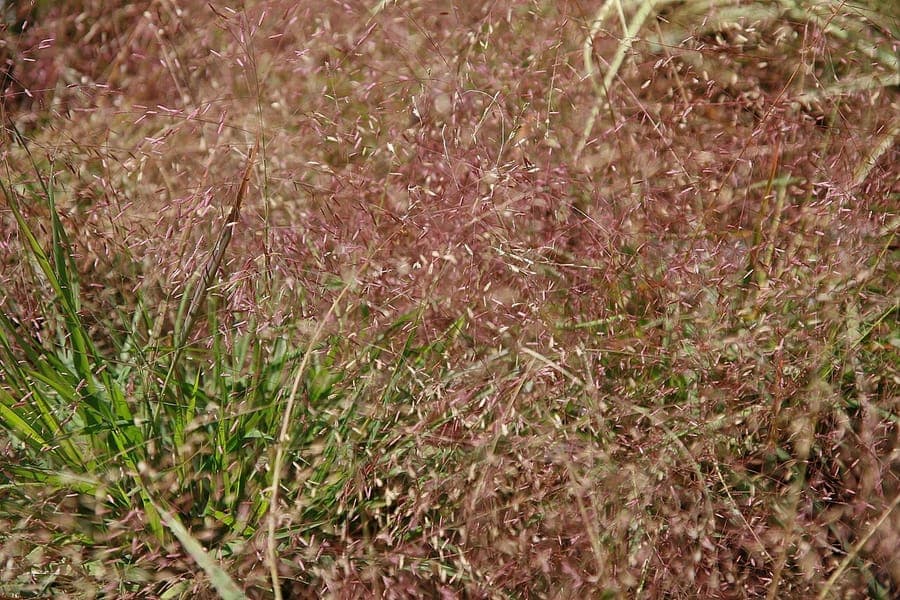
Photo by David J. Stang / CC BY-SA 4.0, via Wikimedia Commons
Purple lovegrass: complete guide
Eragrostis spectabilis
Want to see Purple lovegrass: complete guide in your garden?
1 minute, no credit card
Overview
Eragrostis spectabilis, commonly known as purple lovegrass or petticoat-climber, is a perennial herbaceous plant belonging to the grass family Poaceae. The Latin epithet 'spectabilis' translates literally as 'spectacular' or 'worth seeing' - a name that aptly describes the extraordinary airy purple flower panicles the plant produces in late summer and autumn. The species was formally described in 1840 by Steudel, building on Pursh's earlier 1814 work.
The native range extends from southern Canada through much of the eastern and central United States to northeastern Mexico. The species is native to more than forty American states, from Quebec and Manitoba in the north to Florida, Texas and New Mexico in the south. This extensive range demonstrates the broad adaptability of the plant to widely varying climate conditions.
In its natural environment, Eragrostis spectabilis grows on dry to moderately moist, nutrient-poor soils in open prairie land, along roadsides, in coastal dune valleys and on sandy slopes. As a compact, low-growing ornamental plant it is excellently suited to modern garden styles drawing inspiration from the North American prairie.
On gardenworld.app you can see how ornamental plants like Eragrostis spectabilis are incorporated into naturalistic garden designs that remain attractive through autumn and winter.
The species has a rhizomatous growth habit, meaning it can gradually spread via underground runners. In garden conditions it remains well-behaved and forms compact, billowing clumps.
Appearance and bloom cycle
Eragrostis spectabilis is one of the most spectacular ornamental plants for the autumn border. It forms compact clumps 30 to 60 cm tall and equally wide. Leaves are narrow, linear and green during the growing season, turning russet to orange in autumn for a beautiful seasonal display.
But the real show is the bloom. From August through October, the plant produces lavish, cloud-like purple to reddish-purple panicles rising well above the foliage. The panicles can reach 60 to 90 cm in height, making the plant appear considerably taller in flower than at rest. Individual spikelets are small but numerous, giving the panicle a fine, feather-light quality.
A distinctive feature of Eragrostis spectabilis is that the mature flower stems detach from the plant in autumn and are carried away by the wind like a kind of tumbleweed - hence the alternative common name 'tumblegrass lovegrass'. This contributes to wide seed dispersal.
The bloom has a warm, luminous quality that pairs exceptionally well with other late-season bloomers and with the seed heads of other plants. The purple haze that a flowering plant casts is unique in the palette of autumn-blooming plants.
Ideal location
Eragrostis spectabilis is a plant of open, sunny positions. It requires a minimum of six hours of direct sunlight per day and does best in a fully sunny location. In shade it loses its compact growth form and blooms considerably less.
The plant is closely tied to its natural habitat - open prairies and dry sandy slopes - in terms of soil moisture. It is drought-tolerant and withstands periods without rain better than most garden ornamentals. A position with good drainage is essential; standing water or prolonged wet conditions are its biggest threat.
In the garden it works beautifully in prairie borders, dry borders, sandy areas and on gravelled surfaces, as well as in large pots or containers on the terrace. It combines attractively with Mediterranean plants and other drought-tolerant species.
On a sloping or raised bed, the plant can reach its full potential; drainage is optimal and it can develop into an impressive specimen.
Soil
Soil is a critical factor for Eragrostis spectabilis. The plant grows naturally on lean, free-draining soils - sandy ground, sandy loam or gravelly substrate. It thrives at pH values from 4.0 to 7.5, accepting both mildly acidic and neutral soils.
Rich, heavy clay soils are unsuitable. On fertile ground the plant becomes floppy and lodges easily; bloom is less generous and autumn colour is less intense. If your garden soil is too heavy, improve it with coarse sand and possibly fine gravel to increase permeability.
Avoid adding rich compost or fertiliser. Eragrostis spectabilis is at its best on lean soils, just as in its native prairie environment. Excess nutrients lead to lush but floppy leaf growth and reduced flowering.
Once per year, in early spring, a thin layer of fine sharp sand can be applied around the plant to improve drainage and reduce the risk of frost damage to the roots.
Free design
Want to see Purple lovegrass: complete guide in your garden? Make a free design now.
Watering
Eragrostis spectabilis is exceptionally drought-tolerant once established. After the first season, the plant requires virtually no supplementary watering. In its native habitat - the dry prairies of North America - it survives long periods of drought without difficulty.
In the first year after planting, regular watering is necessary to help the plant establish. Water when the top 5 cm of soil feels dry - typically once a week or once every two weeks in dry periods.
Once the plant is established, rainfall is sufficient in most climates. In extremely dry summers you can water occasionally, but do not overdo it: too much water on a warm, dry site leads to root rot.
The plant is salt-tolerant and handles the desiccating conditions of coastal areas. It is therefore excellent for gardens near the coast or in urban environments where heat and drought occur rapidly.
Pruning
Eragrostis spectabilis needs only a simple annual cutback. The best time is early spring, before new shoots emerge. Cut back the dormant clumps to 5 to 10 cm above ground level.
Leave the plant standing throughout the year, including winter. The dry clumps provide winter structure and are valuable to birds that feed on the seeds. The dead leaf material also protects the root zone during hard frosts.
No pruning is needed during the growing season. Remove any stems broken by strong winds. When flower stems begin to detach from the plant in autumn and blow away, this is a normal biological phenomenon contributing to seed dispersal.
To limit spread, remove the panicles in September before they break off and disperse. The plant self-seeds moderately, so this is rarely a serious issue.
Maintenance calendar
January - February: the plant stands in its dry winter form. Leave the clumps in place for birds and winter structure. No action required.
March - April: cut back dead clumps to 5 to 10 cm above ground. Do not add compost or fertiliser. Check that the plant is well rooted and remove any weeds.
May - June: the plant begins active growth. Minimal water needs; water only during prolonged drought in the first growing year.
July - August: the plant continues growing and prepares for bloom. Still very little maintenance needed. Water during extreme drought for young plants.
September - October: peak bloom period. Purple panicles are in full glory. Enjoy the display. Remove panicles if you want to limit seed dispersal.
November - December: the plant enters dormancy. Dry clumps remain decorative. Visit gardenworld.app for inspiration on autumn and winter borders where purple lovegrass plays a leading role.
Winter hardiness
Eragrostis spectabilis is a robust perennial that tolerates cold winters well. The plant is assigned to USDA hardiness zones 5 to 9, meaning it can survive temperatures down to minus 26 degrees Celsius. In most West European gardens, including those in the Netherlands and Belgium, the plant is fully winter-hardy.
In USDA zone 4 and colder, the plant may struggle with extreme frost. In such areas it is advisable to lightly mulch the clumps in autumn with dry leaves or straw to protect the root system.
The plant owes its hardiness in part to its rhizomatous habit: underground runners act as an energy reserve ensuring regrowth in spring even if the above-ground parts are completely frozen.
In spring the plant regrows quickly as temperatures rise. Young shoots are vulnerable to late frosts, but the roots themselves almost always survive. Wait for final spring cutbacks until the risk of overnight frost has passed.
Companion plants
Eragrostis spectabilis is an ideal candidate for combinations with other late bloomers and prairie-style plants. The purple panicles form a beautiful contrast with the yellow flowers of Rudbeckia (black-eyed susan), the orange tones of Helenium (sneezeweed) and the white plumes of Ageratina (white snakeroot).
In a prairie-style border or naturalistic planting, the plant combines well with Schizachyrium scoparium (little bluestem), Panicum virgatum (switchgrass) and other tall native grasses. For autumn colour contrast, Aster (fall aster), Salvia (sage) and Sedum (stonecrop) make excellent partners.
On gardenworld.app you can find inspiration for autumn borders that use ornamental species like Eragrostis spectabilis as structural elements combined with lower-growing perennials.
For lower colour accents beside the tall panicles of Eragrostis, small drought-tolerant plants such as Dianthus (pinks), Thymus (thyme) and Sedum spectabile work well as foreground companions. Garden centres stock a range of prairie-style plants in spring that pair beautifully with this ornamental.
Closing thoughts
Eragrostis spectabilis is one of the most beautiful and underrated ornamental plants for Dutch and Belgian gardens. With its spectacular purple bloom in autumn, its excellent drought tolerance and its minimal maintenance needs, it is an ideal choice for modern, low-maintenance gardens.
It is excellently suited to prairie borders, dry borders, urban gardens and even large containers on the terrace. As a pioneer on lean soils it asks for little and gives back much in the form of colour, movement and structure.
Looking for a garden that remains attractive through autumn and winter? Then purple lovegrass is your ally. Discover on gardenworld.app how a garden design can be built around season-extending plants like Eragrostis spectabilis.
Want to see Purple lovegrass: complete guide in your garden? Make a free design now.
Upload a photo, pick a style, and get a photorealistic design with plant list in under a minute.
10,000+ gardens designed already
No credit card required


Similar plants
Teal lovegrass: complete guide
Eragrostis hypnoides
Full guide to Eragrostis hypnoides: location, soil, watering, pruning and companion planting for this creeping waterside grass.
African love grass: complete guide
Eragrostis curvula
Everything you need to know about African love grass: growth habits, care, ideal soil, and location. Perfect for drought-tolerant and structural planting.