
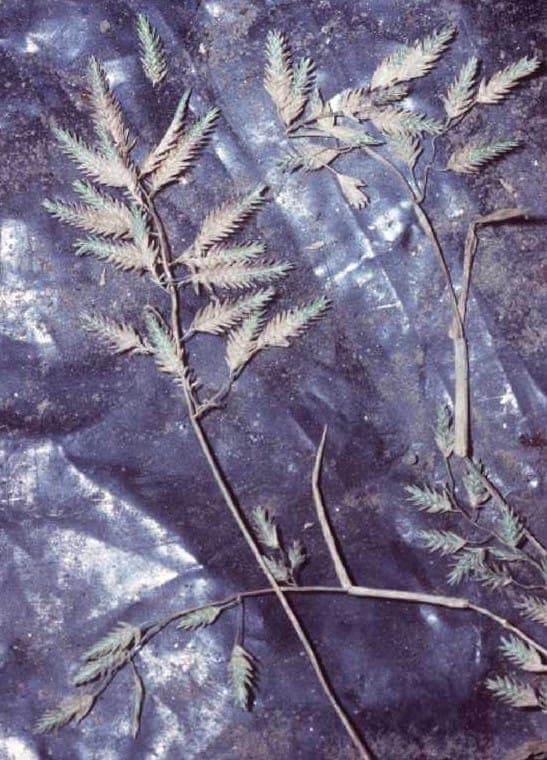
Robert H. Mohlenbrock / Public domain, via Wikimedia Commons
Teal lovegrass: complete guide
Eragrostis hypnoides
Want to see Teal lovegrass: complete guide in your garden?
1 minute, no credit card
Overview
Eragrostis hypnoides, commonly known as teal lovegrass or creeping lovegrass, is an annual to short-lived perennial grass belonging to the large family Poaceae. The botanical epithet 'hypnoides' means moss-like, referring to the low, mat-forming growth habit the plant adopts as it creeps over wet, open banks. The species belongs to the genus Eragrostis, a globally distributed group of over three hundred species.
The native range of Eragrostis hypnoides is exceptionally broad. The species is indigenous to a large portion of North, Central and South America, from southern Canada through the United States and Mexico, the Caribbean, Central America and virtually all of South America. In the United States it has been recorded in dozens of states, from Maine and Vermont in the northeast to Florida, Texas and California. This enormous range demonstrates the remarkable adaptability of the species to diverse climate zones.
Eragrostis hypnoides prefers wet, open, sandy or silty banks of rivers, lakes and drainage channels where water levels fluctuate periodically. It is a pioneer plant that colonises bare, moist ground among the first species after flooding or erosion events. The dense, flowing mats it produces make it valuable for bank stabilisation and for use in naturalistic water gardens.
On gardenworld.app you will find design inspiration featuring ornamental waterside plants like Eragrostis in mood-setting, functional roles alongside ponds and water channels.
The bloom period is long - from early summer through to late autumn - providing extended textural interest even when individual flowers are modest and wind-pollinated.
Appearance and bloom cycle
Eragrostis hypnoides has a creeping to sprawling growth habit that differs markedly from most upright ornamental grasses. The stems lie flat on the ground and root at the nodes, forming extensive dense mats that can cover a wet bank or bare sandy surface. Plant height is only 5 to 25 cm, though horizontal spread can be considerably greater.
The leaves are narrow, linear and fine-textured - typical of the Eragrostis genus. They are green and give the plant a feathery, lightweight appearance. The flower panicles consist of small oval green spikelets arranged in a loosely spreading inflorescence. Flowers are green, inconspicuous, and wind-pollinated.
Blooming begins in early summer, around June or July, and can continue through September or even October in warmer zones. After flowering, seeds ripen and the plant begins to decline. Seed color is yellow, as recorded in botanical literature.
The mat-forming habit gives this plant its distinctive character. Rather than forming rounded clumps as many ornamental grasses do, it produces flat, spreading mats that glide over moist ground. This makes it ideal for waterside plantings but unsuitable for dry borders.
Ideal location
Location is the most decisive factor for Eragrostis hypnoides. In nature the plant is strictly associated with wet, open environments beside water bodies. A position directly beside a pond, stream, ditch or other water feature is therefore the first choice.
The plant thrives in full sun to light shade. Full sun is ideal; in its natural range it grows on open banks without any overhead shade. Light partial shade is tolerated, especially in warmer climates.
More important than light intensity is site moisture. The plant withstands periodic flooding well and can even stand briefly submerged. It is not a true aquatic, however, and prefers the wet bank to permanently submerged conditions.
In garden design the plant can be used as a bank stabiliser alongside ponds, or as ground cover in wet depressions and rain gardens. For artificial settings it is essential to keep the soil consistently moist.
Soil
The soil requirements of Eragrostis hypnoides are notably broad regarding pH: the plant tolerates soils ranging from pH 4.5 to 8.5. This makes it unusually tolerant of both mildly acidic and quite alkaline conditions.
Regarding texture, the plant prefers sandy, silty or clay-rich soils that retain moisture. It grows naturally on muddy banks, sandbanks along rivers and alluvial flats. Nutrient-poor soils present no problem; a too-rich substrate actually favours competition from other, more aggressive plants.
In a garden setting, plant in a mixture of regular garden soil and sand or river clay. Keeping the soil moist is the essential requirement. Compaction is not a problem - the plant survives on compacted banks of high-traffic rivers.
A thick mulch layer is unnecessary and can be counterproductive if it overheats the soil. A thin layer of fine sand over the roots helps retain moisture without overheating.
Free design
Want to see Teal lovegrass: complete guide in your garden? Make a free design now.
Watering
Watering for Eragrostis hypnoides is inseparable from site selection. If the plant is positioned directly beside a water feature or pond, the proximity of water largely manages moisture requirements automatically. Roots seek out groundwater and the plant takes up what it needs.
If the plant is located somewhat away from open water - in a rain garden or wet corner of the garden - supplementary watering is necessary. Water generously and regularly so that the soil remains constantly moist. Never allow the ground to dry out completely, as this quickly leads to wilting and plant death.
During dry spells - particularly in August and September - additional watering is absolutely essential. Ground-level drip irrigation is ideal; overhead sprinkler irrigation that wets the foliage is less ideal, though fungal disease from wet leaves is not a major problem with this species.
On gardenworld.app you can see how irrigation systems can be integrated into a pond-side garden design, keeping maintenance requirements to a minimum.
During winter months, when the plant has died back or is dormant, watering is unnecessary. Simply ensure the soil does not dry out completely before spring regrowth begins.
Pruning
Eragrostis hypnoides is an annual to short-lived plant that primarily self-seeds. Pruning requirements are minimal: remove dead stems and culms at the end of the season or in early winter.
If you want to encourage seed dispersal - usually desirable for bank plants in a naturalistic setting - leave the flower panicles in place until seeds have dispersed. Only then remove the dead culms.
If you wish to limit spread, remove the panicles before they fully ripen. The plant self-seeds readily on wet, bare soil, which is an advantage in the right location but can be unwanted elsewhere.
During the growing season, pruning is rarely needed. Any long, creeping stems that venture beyond the desired planting zone can be trimmed back or removed.
Maintenance calendar
January - February: the plant has died back or is dormant. Allow seeds to distribute naturally for spring germination. No action required.
March - April: new seedlings or regrowth from overwintered plant parts begin to appear. Keep the soil moist. Remove any remaining dead culms from last season if not already done.
May - June: active growth phase. Check regularly that the soil remains sufficiently moist. Transplant young specimens now if establishing new areas.
July - August: bloom period. Maintain constantly moist soil. Additional watering during dry spells is essential.
September - October: seeds ripen and disperse. Decide now whether to encourage or limit self-seeding. Take no action if natural dispersal is desired.
November - December: the plant dies back after the first frosts. Clear culms or leave in place. Visit gardenworld.app for waterside planting inspiration for winter interest.
Winter hardiness
Eragrostis hypnoides is primarily an annual plant that overwinters via seeds in the soil. However, it has been recorded across USDA zones 3 through 10, demonstrating the enormous climatic spread of the species as a whole.
In cold regions the plant survives winter as seed in the soil. Seeds germinate in spring once soil temperature is adequate. In milder climates - USDA zone 7 and warmer - the plant can also survive as a short-lived perennial when conditions are favourable.
In Dutch and Belgian gardens the plant is best treated as an annual. Either plant fresh specimens each year, or allow it to self-seed on wet, bare soil surfaces. Most germination occurs on open soils without a thick mulch layer or competing vegetation.
For added security, seeds can be collected in autumn and stored cool and dry for sowing the following spring.
Companion plants
Eragrostis hypnoides works particularly well alongside other pioneer bank plants sharing the same site requirements. Good companions include Bidens (beggarticks), Polygonum (knotweed) on wet banks, and other Eragrostis species such as Eragrostis spectabilis for a colour accent.
For a more structured bank planting, it combines well with Phragmites australis (common reed) at larger scale, or more intimately with Carex (sedge), Juncus (rush) and Scirpus (bulrush) for a varied wetland margin.
In a garden setting alongside a pond, suitable neighbours include Mentha aquatica (water mint), Lysimachia nummularia (creeping jenny) and Veronica beccabunga (brooklime). All these plants thrive in moist to wet conditions and together form an ecologically valuable community for insects and amphibians.
Avoid drought-tolerant plants as immediate neighbours; the difference in water requirements makes such combinations difficult. Also avoid very aggressive wetland species like Lythrum salicaria (purple loosestrife) at close range on a small scale, as they can easily crowd out the more delicate Eragrostis.
Closing thoughts
Eragrostis hypnoides is a fascinating, versatile waterside plant whose creeping habit gives it a character entirely its own. As a pioneer on wet, bare banks it plays an ecologically valuable role while simultaneously providing fine, airy textural interest in the garden.
It is not the most showy plant in the palette, but that very modesty makes it so valuable in naturalistic water gardens. Related waterside species can sometimes be found at garden centres; for Eragrostis hypnoides itself, specialist botanical nurseries are the best source.
For inspiration on integrating waterside plants like Eragrostis hypnoides into your garden design, gardenworld.app is the ideal starting point for a bespoke design where water, plants and space work in harmony.
Want to see Teal lovegrass: complete guide in your garden? Make a free design now.
Upload a photo, pick a style, and get a photorealistic design with plant list in under a minute.
10,000+ gardens designed already
No credit card required


Similar plants
Purple lovegrass: complete guide
Eragrostis spectabilis
Full guide to Eragrostis spectabilis: location, soil, bloom cycle, pruning and companion plants for this stunning prairie grass.
African love grass: complete guide
Eragrostis curvula
Everything you need to know about African love grass: growth habits, care, ideal soil, and location. Perfect for drought-tolerant and structural planting.