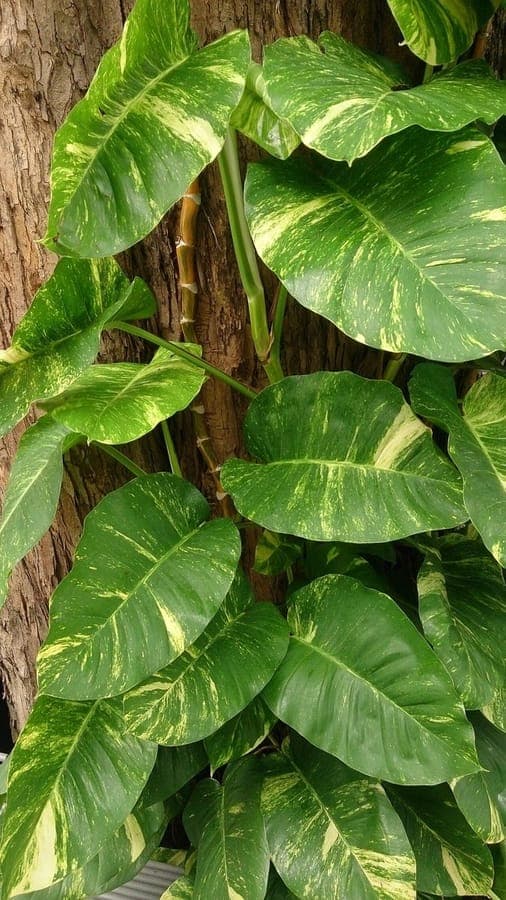
Mokkie / CC BY-SA 3.0, via Wikimedia Commons
Golden pothos (Epipremnum aureum): complete guide
Epipremnum aureum
Want to see Golden pothos (Epipremnum aureum): complete guide in your garden?
Full design in HD: €7.99
Look after your Golden pothos with the GardenWorld app
Identify plants with your camera and get a care calendar with reminders for this plant.


Overview
Golden pothos (Epipremnum aureum) may well be the easiest trailing houseplant there is. It is also widely sold as devil's ivy or simply pothos, and it belongs to the arum family (Araceae). It originally comes from Mo'orea, an island in French Polynesia, but has since naturalised across almost every tropical region. In places such as Sri Lanka, Florida and Hawaii it is regarded as an invasive species that smothers trees. In Europe it poses no such threat outdoors, because it cannot survive a single winter.
Indoors it is a rewarding climber or trailing plant with heart-shaped green leaves marbled in yellow or cream. It grows quickly, forgives the occasional missed watering and copes with less light than most houseplants. That makes it ideal for beginners, offices and student rooms. At gardenworld.app you can have a garden design made, but it pays to think about position and combinations indoors too: a pothos tumbling down from a bookcase changes a room more than you might expect.
Besides the classic green-and-gold form, often sold as 'Golden', there are cultivars such as 'Marble Queen' (lots of white), 'N'Joy' and 'Pearls and Jade' (small white-and-green leaves) and 'Neon' (bright lime-green leaves without markings).
Appearance and growth
Indoors the stems can reach several metres; 2 to 4 metres is nothing unusual. Each node carries a leaf and often a brown aerial root, which the plant uses to cling to tree trunks in the wild. The juvenile leaves are heart-shaped, glossy, 10 to 20 cm long and irregularly streaked or speckled.
What few people realise is that once the plant climbs a tree in the wild, it changes completely. The leaves become much larger, up to half a metre or more, and develop splits and holes rather like a Swiss cheese plant. The photograph above shows just such a climbing plant with large, marbled leaves against a trunk. Indoors you will only reach that adult stage if you let the plant climb a moss pole, and even then usually only in part.
Epipremnum aureum almost never flowers in cultivation. The plant does not produce enough of the growth hormone gibberellin on its own to form flowers, so it is grown entirely for its foliage.
Position in the home
A pothos grows best in a bright spot without fierce midday sun, for example 1 to 2 metres from an east-, west- or south-facing window. It also tolerates partial shade and even a fairly dim corner, but there it grows more slowly, produces smaller leaves with long bare stretches of stem in between, and loses some of its variegation. Variegated cultivars such as 'Marble Queen' clearly need more light than the standard form.
Direct summer sun through glass causes brown, scorched patches. The ideal temperature is 18 to 27 °C. Below 15 °C growth stops, and below 10 °C the leaves suffer damage. Keep the plant out of draughts and away from radiators. Normal household humidity is fine, although it often grows even more lushly in a bathroom with daylight.
You can let it trail from a shelf or hanging basket, train it up a moss pole or guide the stems along small hooks around a wall or window. Turn the pot a quarter turn now and then for even growth: unlike a weeping fig, a pothos does not mind being moved at all.
Compost and repotting
Use an open houseplant compost with extra perlite, or an aroid mix containing bark and coir. The roots need air and must never sit in water, so a pot with drainage holes is essential.
Repot in spring every two years, or when roots start growing out of the bottom of the pot. A pot 2 to 4 cm wider than the previous one is plenty. A pothos is perfectly happy when slightly pot-bound.
Free preview
Want to see Golden pothos (Epipremnum aureum): complete guide in your garden? Make a free preview of your design.
Watering and feeding
Let the top 3 to 5 cm of compost dry out before watering again. In summer that usually means once a week, in winter every two to three weeks. Limp, drooping leaves tell you the plant is thirsty; after a thorough soak they perk up within a few hours. Yellow leaves and blackened stem bases, on the other hand, point to overwatering and root rot.
From April to September feed every three to four weeks with a liquid houseplant fertiliser. Do not feed in winter. Rinsing the leaves now and then, or wiping them with a damp cloth, keeps them glossy and helps you spot spider mite and mealybug early.
Pruning and propagation
Pruning is not essential, but it keeps the plant full. Cut long, bare stems back in spring or summer to just above a node. New shoots will form there, making the plant bushier.
Propagation could hardly be simpler. Take a piece of stem 10 to 15 cm long with at least two nodes and an aerial root. Stand it in a glass of water in a bright spot; within two to three weeks white roots appear. Once they are 3 to 5 cm long, pot the cuttings up, ideally three to five together in one pot for a fuller look. You can also insert cuttings straight into moist compost. Wear gloves when cutting if you have sensitive skin.
Care calendar
January–February: little water, no feeding. Check for spider mite and mealybug.
March–April: repot if needed. Cut back bare stems. Start feeding.
May–June: best time for cuttings. The plant is growing at its fastest.
July–August: water weekly and feed every three to four weeks. Protect from strong midday sun.
September–October: gradually reduce watering. Last feed in early September.
November–December: quiet period. Move the plant a little closer to the window when days are short.
Temperature and overwintering
Epipremnum aureum is a tropical plant and is not hardy anywhere in a north-west European garden. At most it can spend summer on a sheltered, shady patio, and it must come back indoors as soon as nights drop below 15 °C. In winter it simply stays in the living room. A cool rest period is unnecessary; the main thing is to let the compost dry out properly between waterings, because the plant uses very little water in the dark months.
Toxicity to people and pets
All parts of Epipremnum aureum contain needle-shaped crystals of calcium oxalate. Anyone who bites a leaf immediately feels a burning, stinging pain in the mouth and throat. In cats and dogs it causes drooling, pawing at the mouth, vomiting and swelling. The pain stops most animals before they eat much, so serious poisoning is rare. Even so, this plant belongs out of reach of cats, dogs, rabbits, small rodents and young children. A hanging pot high up near the ceiling works well, as long as no stems trail down to play height. If in doubt, call your vet.
You will often read that pothos purifies the air, citing a NASA study from 1989. Those trials took place in small sealed chambers; in an ordinary home the effect of a few plants is negligible. Keep ventilating as usual.
Companion plants
A pothos works well as a green veil above or beside upright plants. It suits a Swiss cheese plant (Monstera deliciosa), which needs similar care, as well as the peace lily (Spathiphyllum wallisii) and the spider plant (Chlorophytum comosum). For a different leaf character, add a Tradescantia zebrina with its purple and silver striped foliage. If you want to explore the genus further, try Epipremnum pinnatum, which develops deeply divided leaves as it matures.
Final thoughts
Epipremnum aureum is the ideal houseplant for anyone who wants quick results without much fuss. A bright spot away from harsh sun, water when the surface is dry and an occasional trim are all it takes. Just hang it out of reach of pets and children.
Want a reminder of when to repot, take cuttings or stop feeding? The plant calendar at gardenworld.app lays it out month by month, for your houseplants and your garden. That way your pothos stays full and glossy year after year.
Frequently asked questions about Golden pothos
When and how do you prune Golden pothos?
Pruning is not essential, but it keeps the plant full. Cut long, bare stems back in spring or summer to just above a node.
How much water does Golden pothos need?
Let the top 3 to 5 cm of compost dry out before watering again. In summer that usually means once a week, in winter every two to three weeks.

See it in your garden
See Golden pothos in your garden
One photo of your garden and a few questions. You see the result in about a minute.
Try it with a photoIdentify this plant in your own garden. Identify a plant
Similar plants
Monstera deliciosa: complete guide
Monstera deliciosa
Discover the fruit-salad plant (Monstera deliciosa) - a popular houseplant with characteristic holes in leaves. Professional care and growing tips for success.
Epipremnum pinnatum: complete guide
Epipremnum pinnatum
Discover Epipremnum pinnatum, the variegated philodendron or tongavine, a stunning tropical climbing plant. Learn care tips, light requirements, watering, and propagation for indoor gardening success.
Peace lily: complete guide
Spathiphyllum wallisii
How to grow a peace lily (Spathiphyllum wallisii): light, watering, repotting, getting it to flower again, and why it is toxic to cats and dogs.
