
Dcoetzee / CC0, via Wikimedia Commons
Longleaf jointfir: complete guide to Ephedra trifurca
Ephedra trifurca
Want to see Longleaf jointfir: complete guide to Ephedra trifurca in your garden?
1 minute, no credit card
Overview
Ephedra trifurca, known variously as longleaf jointfir, longleaf Mormon tea, or longleaf ephedra, is a distinctive desert plant from one of the oldest plant families on Earth. Native to a wide arc of the American Southwest and northern Mexico - from southeastern California through Arizona, New Mexico, and Texas - it is a plant shaped by millions of years of adaptation to arid conditions. The species name trifurca refers to the characteristically three-branched nodes that distinguish it from other Ephedra species, giving it a more open, airy silhouette than relatives like Ephedra nevadensis. For anyone building a drought-tolerant, desert-inspired, or Mediterranean garden, Ephedra trifurca offers year-round structural interest with genuinely minimal maintenance. See how plants like this work in a complete garden scheme at gardenworld.app.
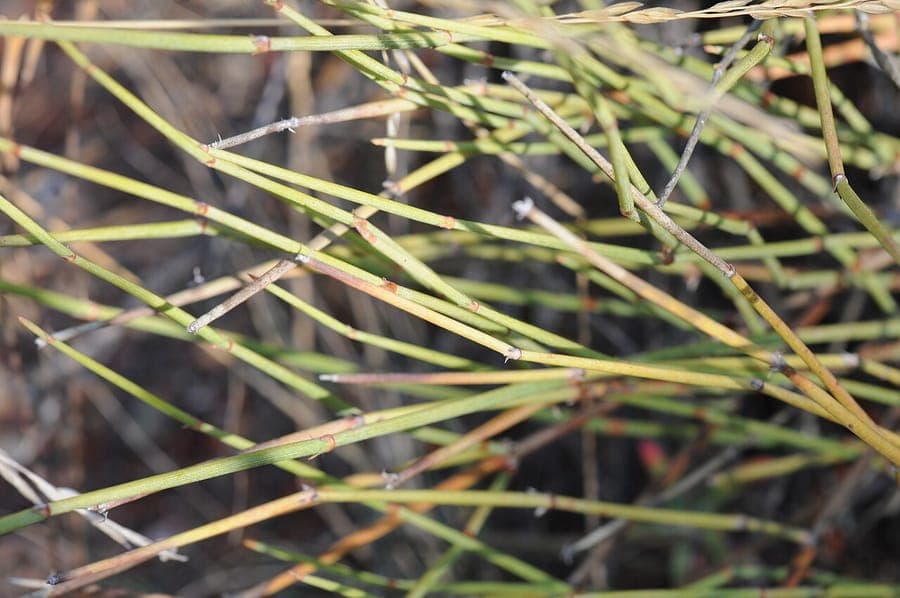
Like all Ephedra species, E. trifurca carries out photosynthesis through its stems rather than conventional leaves. The leaves are reduced to tiny scale-like sheaths at each jointed node - an evolutionary solution to the problem of water loss in an intensely arid environment. The stems are longer and more slender than in many Ephedra species, giving this plant a particularly graceful, almost feathery quality that sets it apart from denser relatives.
Appearance and bloom cycle
Ephedra trifurca forms a broad, multi-stemmed plant typically 60 to 150 cm tall and of similar or greater width. The stems are long and slender, pale yellow-green to mid-green, and branch in groups of three at each node - the feature that gives the plant both its name and its characteristic open structure. This tripartite branching pattern creates a lighter, more fluid silhouette than the denser clumping habit of related species.
Flowering occurs in early spring, generally March to April. The flowers are small and unshowy - pale yellow-green cone-like structures at the stem nodes - but they attract early pollinators including bees. The plant is dioecious: male and female flowers develop on separate individuals. On pollinated female plants, small brownish-red seed cones develop in late spring and provide food for birds and small mammals. For seed production in a garden setting you need at least one male and one female plant in proximity.
Stem colour varies subtly through the year: bright fresh green in spring and early summer, shifting to a more yellow-green in summer heat, and remaining green and intact through winter when most deciduous plants are bare. This persistence of green stems makes Ephedra trifurca a particularly valuable plant for winter structure and year-round garden interest.
Ideal location
Full sun is non-negotiable. In the wild, Ephedra trifurca grows on exposed desert slopes and open flats with no overhead cover at all. In the garden it needs at least six hours of direct sun daily; in less light it grows slowly and loses its characteristic open, wiry form. Best settings include rock gardens and gravel gardens with mineral soil, Mediterranean or desert-themed borders in open, sunny positions, large containers on south-facing terraces, and dry slope plantings as specimens or in groups.
The plant is highly wind-tolerant and resistant to salt-laden coastal air, making it a good candidate for exposed seaside gardens. Once established it is entirely self-sufficient through dry summers when many other plants need frequent watering.
Soil
Excellent drainage is the one absolute requirement. Ephedra trifurca cannot survive in heavy, waterlogged, or persistently moist soils. It is native to alkaline substrates - the pH range cited for this species runs from 7.5 to 9.5, making it one of the most alkaline-tolerant Ephedra species. Sandy or gravelly, low-nutrient soil is ideal. In the garden, work generous quantities of coarse sand and fine gravel into the planting area. For container growing, use a cactus and succulent compost mixed with perlite or pumice for rapid drainage.
Avoid rich, organic soil mixes and fertilisers. Excess nutrients produce soft, fast-growing stems that are more frost-sensitive and lack the attractive lean habit of wild specimens.
Free design
Want to see Longleaf jointfir: complete guide to Ephedra trifurca in your garden? Make a free design now.
Watering
Once established, Ephedra trifurca is among the most drought-tolerant plants you can grow in a temperate garden. In its native Chihuahuan and Sonoran Desert habitat it survives on as little as 200-350 mm of annual rainfall. In a garden context, water every two weeks in spring and early summer in the absence of rain. During midsummer in potential semi-dormancy, water every three weeks or less. In autumn during any secondary growth flush, water every two weeks if dry. In winter, minimal or no supplemental watering is needed if rainfall is adequate.
For container plants, always let the top 3-4 cm of compost dry out completely before watering again. Overwatering is the most common cause of failure with this plant. Browning at the stem bases is the first sign of root rot from excess moisture.
Pruning
Ephedra trifurca requires very little pruning. The best time to intervene is early spring, just before new growth begins. At that point you can remove any completely dead or frost-damaged stems at their base, and shorten stems that have grown beyond the desired size by cutting back to a node - the plant will re-sprout from the cut point.
Light summer trimming can keep wayward stems in check. Avoid heavy pruning in late autumn or winter; fresh cuts in cold weather are vulnerable to fungal infection. Given the naturally open, graceful habit of E. trifurca, significant pruning is rarely necessary more than once per year.
Maintenance calendar
January - February: Little action needed; check container plants for frost damage; water very rarely. March - April: Flowering begins; new stem growth emerges. Light pruning if needed. Resume watering every two weeks. May - June: Full growth; water every two weeks in dry weather. Remove any weak or damaged stems. July - August: Possible semi-dormancy in intense heat; water every three weeks or less. September - October: Possible secondary growth flush with cooler temperatures; increase watering slightly. November - December: Winter rest; minimal watering. Bring container plants indoors if prolonged hard frost is forecast.
Winter hardiness
Ephedra trifurca is cold-hardy to approximately -15 degrees Celsius, placing it in USDA zones 5 to 6. This makes it suitable as a permanent outdoor plant throughout most of northwestern and central Europe, including the UK, the Netherlands, Belgium, Germany, and Austria. In normal winters no protection is required. During prolonged extreme cold with freeze-thaw cycles, a gravel mulch around the root zone provides useful insulation without retaining excess moisture.
Container-grown specimens are slightly less cold-tolerant because the roots are less insulated. In severe winters, move large containers to an unheated but frost-free shed or wrap the pot in insulating material. In warmer parts of Europe - the Iberian Peninsula, southern Italy, the French Riviera - the plant requires no winter care at all and becomes a long-lived garden feature. Visit gardenworld.app for garden design ideas featuring drought-tolerant plants for Mediterranean and dry garden styles.
Companion plants
The open, long-stemmed structure and yellow-green colour of Ephedra trifurca make it a natural companion to other drought-tolerant plants. Excellent combinations include Encelia farinosa (silver foliage and golden flowers provide vivid contrast to the green stems), Ephedra nevadensis as a related species forming an interesting botanical pairing, Salvia greggii in red, pink, or purple to complement the cool green tones, Agave, Yucca, and Nolina as sculptural companions with identical site requirements, Festuca glauca (blue-grey tones deepen the mineral quality of the planting), and low Sedums and Sempervivum as ground-level companions in a rock garden.
Avoid moisture-loving plants or anything that will cast significant shade onto the Ephedra - both shorten its productive life considerably.
Closing
Ephedra trifurca is a plant of genuine distinction: ancient in its lineage, elegant in its long-stemmed, three-branched architecture, and practically indestructible once established in the right conditions. For gardeners seeking a year-round structural plant that demands almost nothing in return, the longleaf jointfir is an outstanding candidate. It rewards good siting with decades of low-maintenance beauty and provides a botanical talking point that few other garden plants can match.
Want to see Longleaf jointfir: complete guide to Ephedra trifurca in your garden? Make a free design now.
Upload a photo, pick a style, and get a photorealistic design with plant list in under a minute.
10,000+ gardens designed already
No credit card required


Similar plants
Brittlebush: complete guide to this silver desert shrub
Encelia farinosa
Full growing guide for Brittlebush (Encelia farinosa): a drought-tolerant desert shrub with silver leaves and golden flowers for sunny gardens.
Nevada jointfir: complete guide to this desert shrub
Ephedra nevadensis
Full growing guide for Ephedra nevadensis (Nevada jointfir / Mormon tea): a hardy, drought-tolerant desert shrub with green jointed stems for dry gardens.