
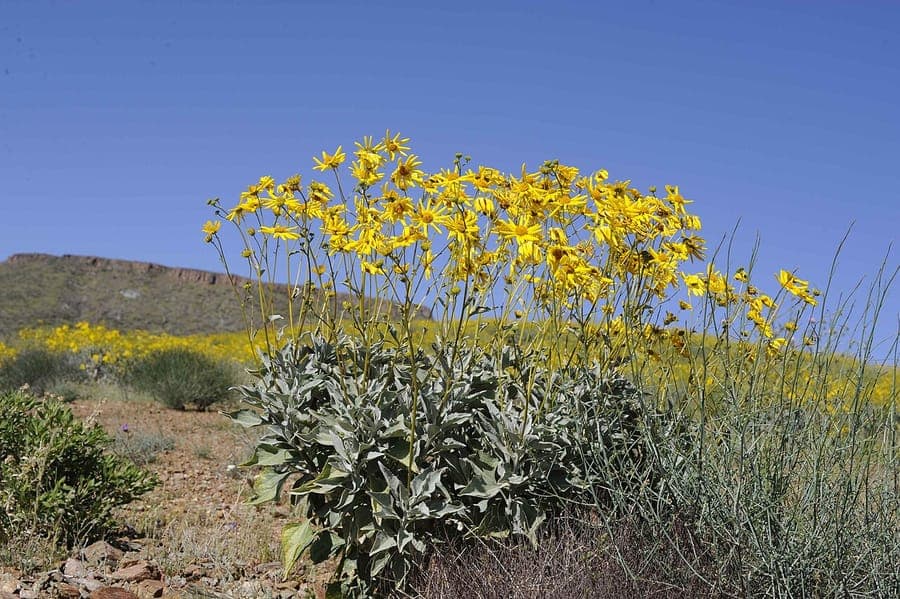
Gentry George, U.S. Fish and Wildlife Service / Public domain, via Wikimedia Commons
Brittlebush: complete guide to this silver desert shrub
Encelia farinosa
Want to see Brittlebush: complete guide to this silver desert shrub in your garden?
1 minute, no credit card
Overview
Brittlebush (Encelia farinosa) is one of the most recognisable plants of the Sonoran and Mojave deserts, native across Arizona, California, Nevada, and northern Mexico. A fast-growing subshrub in the daisy family (Asteraceae), it earned its common name from the dry, brittle stems that snap off easily during drought - a clever evolutionary trick that reduces surface area and slows water loss. Today, Brittlebush is gaining popularity among gardeners across southern Europe and beyond, valued for its striking silver-grey foliage, its exuberant spring flower display, and its near-zero demand for supplemental water once established. Whether you are building a Mediterranean courtyard garden, a gravel border, or a container display for a sunny terrace, Encelia farinosa deserves serious consideration. You can explore how this plant fits different garden styles at gardenworld.app.
Appearance and bloom cycle
Encelia farinosa forms a rounded, multi-branched mound typically 60 to 120 cm tall and equally wide. The most immediately striking feature is the foliage: leaves are covered in a dense mat of fine white hairs (trichomes) that reflect intense sunlight and reduce evaporation, giving the plant its characteristic silver to grey-green appearance. In prolonged dry spells the plant may drop a portion of its leaves to conserve water, re-leafing rapidly once moisture returns.
The flower display, which typically runs from February through May, is spectacular. Slender, upright stems rise 30 to 50 cm above the foliage and carry cheerful, daisy-like blooms with bright golden-yellow ray florets surrounding a darker brownish-yellow disc. During peak bloom the flowers can almost completely obscure the foliage. After flowering, small black seeds develop and are dispersed by wind. In favourable conditions a second, lighter flush of flowers can appear in autumn after summer rains.
Ideal location
Brittlebush needs full sun - at least six hours of direct sunlight per day, and preferably more. In partial shade the plant becomes leggy, loses its dense mounded form, and blooms poorly. Its natural habitat consists of rocky slopes, dry arroyos, and open desert flats - all characterised by excellent drainage, intense reflected heat, and minimal competition from other vegetation.
In a garden context this translates to: a south-facing position, ideally backed by a heat-retaining wall, on a sunny terrace, or in an open rockery. In the UK and northern Europe it is best grown as a container plant that can be brought indoors before hard frost. In USDA zone 9 and warmer - broadly corresponding to southern Spain, Portugal, southern Italy, and coastal areas of France - it can be planted in the ground and left year-round.
Soil
Perfect drainage is non-negotiable. Encelia farinosa will not tolerate waterlogged, heavy clay soils or ground that stays moist for extended periods. In the wild it thrives on poor, often calcareous, sandy or gravelly soils with a pH between 7.0 and 8.5. For containers, a cactus and succulent compost is ideal. In the ground, dig in generous amounts of coarse horticultural sand and fine grit to create a free-draining mix. A base layer of 5 to 10 cm of gravel at the bottom of a container greatly improves drainage.
Avoid rich, fertile soils. Excessive nitrogen produces lush, floppy growth at the expense of flowers, and produces soft tissue that is more vulnerable to frost damage.
Watering
Once established - typically after one growing season - Brittlebush is remarkably drought tolerant and requires very little irrigation. During its active growing and flowering season (February to May) water every ten to fourteen days if there is no significant rainfall. In summer, when the plant may enter a semi-dormant phase, reduce watering to once every two to three weeks or suspend it almost entirely in areas with reliable summer rainfall. Resume more frequent watering in autumn when temperatures cool and growth restarts.
For container-grown plants, always allow the top few centimetres of compost to dry out completely before watering again. Overwatering is by far the most common cause of failure. Good drainage holes are essential. Avoid wetting the foliage in full sun, which can cause scorching.
Free design
Want to see Brittlebush: complete guide to this silver desert shrub in your garden? Make a free design now.
Pruning
Brittlebush requires minimal pruning. Once flowering has finished - usually by late May or early June - remove the spent flower stems at their base to keep the plant tidy and redirect energy into new growth. A moderate trim of the overall plant by one quarter to one third after the main bloom helps maintain a compact, bushy shape and can encourage a secondary flush of growth and occasionally flowers.
Avoid hard pruning in autumn or winter, as this removes protective tissue and increases frost vulnerability. In spring, once the risk of frost has passed, cut away any dead or frost-damaged stems cleanly back to healthy wood. Always use sharp, clean tools to minimise infection risk.
Maintenance calendar
January - February: Monitor overwintering container plants; protect from prolonged frost with horticultural fleece or move indoors. March - April: Flowering begins; increase watering slightly as growth accelerates. Do not prune during bloom. May: Peak bloom. Remove spent flower stems at the end of the month. June - July: Light trim to maintain shape; switch to a reduced summer watering schedule (every two to three weeks). August: The plant may semi-rest in extreme heat; water minimally. September - October: Growth may resume; increase watering slightly. This is a good time to repot container plants if needed. November - December: Bring containers indoors to a bright, frost-free space before temperatures drop below -3 degrees Celsius.
Winter hardiness
Encelia farinosa is rated for USDA zones 9 to 11, tolerating minimum temperatures down to approximately -6.7 degrees Celsius (zone 9). In practice this means it survives brief overnight frost but cannot withstand sustained cold or ground frost. In northern Europe and the UK it must be treated as a tender perennial and overwintered in a cool glasshouse, bright conservatory, or unheated porch at between 5 and 12 degrees Celsius. During winter dormancy, water sparingly - roughly once every three to four weeks.
In warmer European climates (southern Spain, the Algarve, Liguria, Corsica) it can remain outdoors permanently and becomes a reliable, low-maintenance feature of the garden.
Companion plants
The silver and gold palette of Brittlebush combines naturally with other drought-tolerant plants. Excellent companions include Salvia greggii (autumn sage, in purple or red), Agave americana, Yucca filamentosa, Opuntia species, and the blue-grey fescue Festuca glauca. For a complementary colour contrast, pair it with the purple spikes of Lavandula angustifolia - the combination is classic and visually striking. Penstemon species and low-growing Eriogonum also work well in a gravel garden setting.
Avoid moisture-loving neighbours such as Hostas, Astilbes, or Hydrangeas, which require exactly the wet soil conditions that are lethal to Brittlebush. This plant is best grouped with plants sharing the same cultural requirements: full sun, sharp drainage, and minimal water.
Closing
Brittlebush (Encelia farinosa) offers gardeners a plant of genuine distinction: architectural silver foliage throughout the year, a dazzling golden flower display in spring, rapid establishment, and genuinely low maintenance once it is settled. For gardens where water conservation is a priority, or for anyone drawn to the clean lines and warm tones of desert-inspired planting, this is an exceptional choice. Visit gardenworld.app to see how Brittlebush and similar drought-tolerant plants can be woven into a cohesive, beautiful garden design.
Want to see Brittlebush: complete guide to this silver desert shrub in your garden? Make a free design now.
Upload a photo, pick a style, and get a photorealistic design with plant list in under a minute.
10,000+ gardens designed already
No credit card required


Similar plants
Nevada jointfir: complete guide to this desert shrub
Ephedra nevadensis
Full growing guide for Ephedra nevadensis (Nevada jointfir / Mormon tea): a hardy, drought-tolerant desert shrub with green jointed stems for dry gardens.
Longleaf jointfir: complete guide to Ephedra trifurca
Ephedra trifurca
Full growing guide for Ephedra trifurca (longleaf jointfir / longleaf Mormon tea): a resilient desert shrub with long jointed stems for dry, sunny gardens.